Collagen Dosage Calculator
Estimate daily collagen peptides from your goal, body size, joint load, training week, protein intake, serving scoop, timing preference, and vitamin C plan.
◎Presets
Presets load realistic collagen plans and recalculate instantly.
⚙Calculator
Collagen dosage snapshot
Enter your goal and serving details to estimate a daily plan.
▦Fitness Metrics Grid
▣Reference Tables
| Goal | Common daily range | Best timing | Calculator bias |
|---|---|---|---|
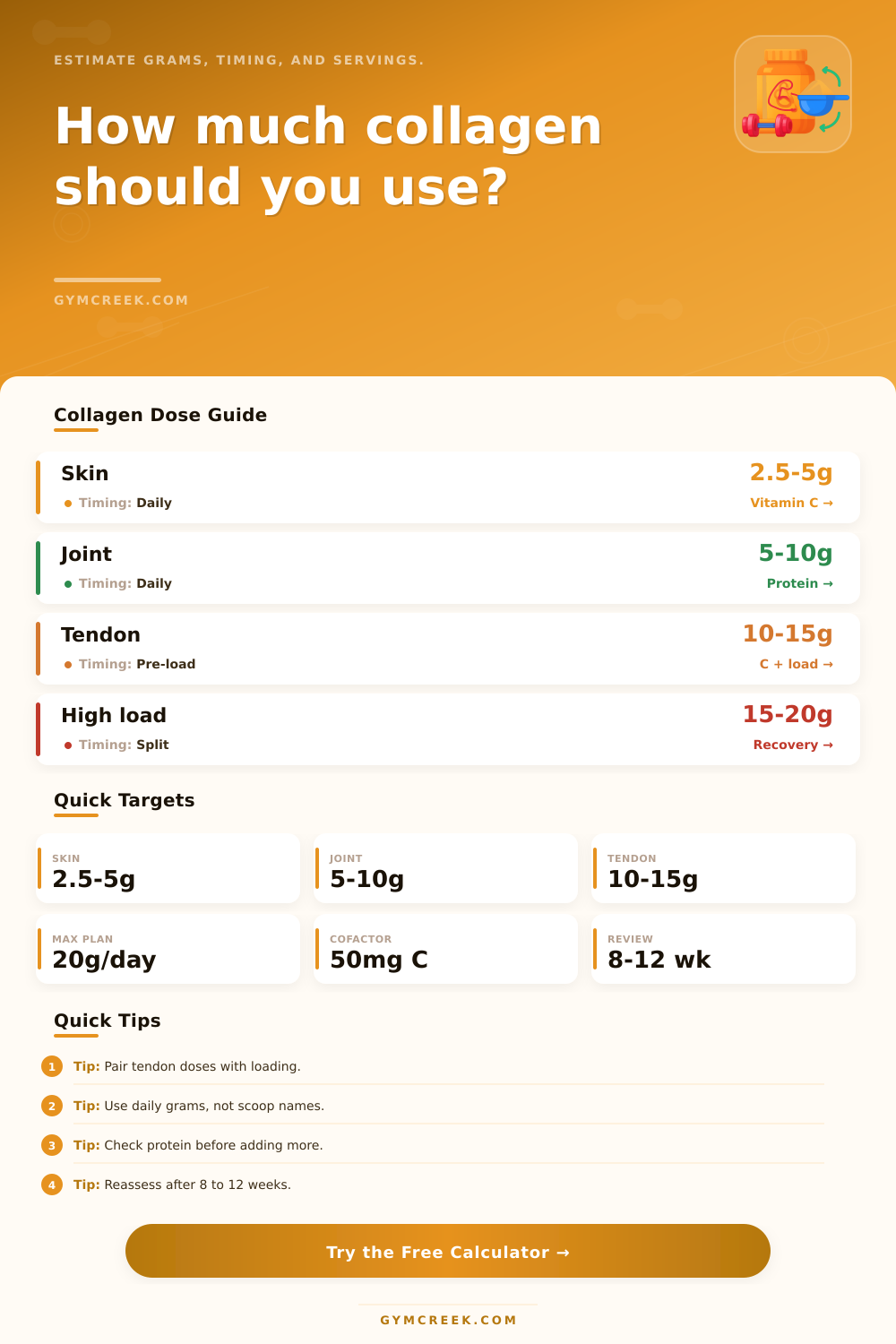
| Skin, hair, nails | 2.5 to 5 g | Any consistent time | Lower band unless body size is high |
| Joint comfort | 5 to 10 g | Daily with routine | Raises with age and impact load |
| Tendon or ligament support | 10 to 15 g | 30 to 60 minutes before loading | Raises when training is frequent |
| High-load sport recovery | 15 to 20 g | Split or pre-load around key sessions | Caps at a practical upper plan |
| Format | Typical label amount | What to enter | Planner note |
|---|---|---|---|
| Powder scoop | 10 to 20 g collagen | Grams per scoop | Most flexible for 10 g or higher plans |
| Liquid shot | 5 to 10 g collagen | Grams per bottle | Often one full serving per day |
| Capsules | 0.04 to 1 g each | Total grams per serving | High-dose plans may need many capsules |
| Undenatured type II | About 40 mg | 0.04 g per serving | Use label directions instead of peptide grams |
| Protocol | Timing | Vitamin C cue | Use when |
|---|---|---|---|
| Daily routine | Same time each day | Normal diet may be enough | Skin or general maintenance goal |
| Pre-load | 30 to 60 min before rehab or lifting | Include at least a small C source | Tendon, ligament, jump, sprint, or heavy session |
| Split dose | Morning and evening | Use food or supplement as needed | Daily dose is 15 g or higher |
| Post-workout | After training routine | Do not skip complete protein | Habit adherence is the main goal |
| Piece | Inputs | What it changes | Why it matters |
|---|---|---|---|
| Goal dose band | Primary goal and collagen type | Base grams per day | Keeps skin, joint, and tendon plans different |
| Body-size adjuster | Weight in kg | Small gram shift | Larger bodies may need the upper part of a band |
| Load adjuster | Training days and joint load | Upper-band pressure | Collagen plans work best with mechanical loading |
| Serving conversion | Grams per serving | Servings per day | Turns daily grams into label-friendly dosing |
◇Tips
What are collagen peptides? People buy it by the tub, assuming they’ll fix their joint (or their skin). They figure one scoop per day is right amount, that’s what’s on the spoon in the container’s lid. The dose is not fixed. It vary based off the intensity of your training volume and the amount of injury or recovery required. Enter your goal into the calculator above, and let it do the math. No need to guess at conversion doses.
First, collagen isn’t an entire amino acid profile like eggs or whey. That’s an important distinction because many people uses collagen as their primary source of muscle building. It can’t be your primary source of protein. Collagen is a structural protein, lacking the essential amino acid tryptophan. Think of collagen as a more targeted scaffold. You’re feeding tendons and ligaments raw materials that they has trouble getting efficienty from the general pool of blood amino acids.
How to Use Collagen Peptides
Choosing a clinical dose band when setting goals in the tool mean that you’re selecting how much of it you want in your system. Two to five grams per day is typicaly all that’s needed for skin maintenance. Joint comfort tend to nudge that number up into 10 gram range. High-impact recovery and tendon pain can easily push that into much higher volumes.
These baselines is adjusted based on your training frequency and body weight. The heavier the athlete, the heavier the load will be. You will also need more material compared to a lighter yogi. More mechanical stress means more micro-tears in connective tissue, which require more material to rebuild.
But there’s also the issue of timing, something most folks don’t pay attention to. You can get away with taking collagen at whatever point during the day you think about it for overall health. In this scenario, consistency beat accuracy. But when you’re aiming for tendon or ligament recovery, things like timing becomes strategic. According to studies, hydrolyzed peptides is absorbed better by the tissue and sent down to the injury site when taken 30-60 minutes prior to mechanically stressing that tissue. That’s why the calculator highlights this nuance. When you choose high load + tendon support, it’ll probably suggest pre-loading over an arbitrary serving in the AM.
And what about vitamin C? Vitamin C helps the process of making collagen, meaning it’s necessary for cross-linking amino acids into stable fibers. If you don’t get enough of this vitamin, all that collagen you ingest goes in one end and out the other, and most of it ends up getting flushed from the body. To make sure the building process begin, pair your dose of collagen with at least 50 milligrams of vitamin C, which the tool questions you about. Take your powder with a handful of strawberries or a glass of orange juice, and the supplement will actualy work.
To make this happen, there are decision points in the UI (reference tables) which give it context. For example, if you choose capsules instead of powder, that means you’ll need dozens of them to hit a therapeutic dose. That’s not a small number! Capsules is nice because they’re one-and-done but it gets expensive realy quick. Powder allows you to scale up easily; it’s also cheaper. That’s all baked into the calculator. It calculates serving sizes based on the grams you want to take per day.
The tissues involved are slow to turn over; that’s why most folks gives up on collagen too early. Two weeks wouldn’t of cut it. That’s one of the reasons that the tool recommend an eight-to-twelve-week trial period. It’s part of the protocol: be patient. Plan, load as directed and let nature take its course.