Coffee Caffeine Calculator
Estimate caffeine in brewed coffee from method, serving size, roast, strength, cups, body weight, and drinking window.
📌Presets
Each preset loads a brewed coffee scenario and recalculates caffeine, body-size dose, daily limit, and bedtime carryover.
⚙Calculator
Coffee caffeine snapshot
Enter your brewed coffee details to estimate caffeine dose and timing.
📊Caffeine Metrics
📑Reference Tables
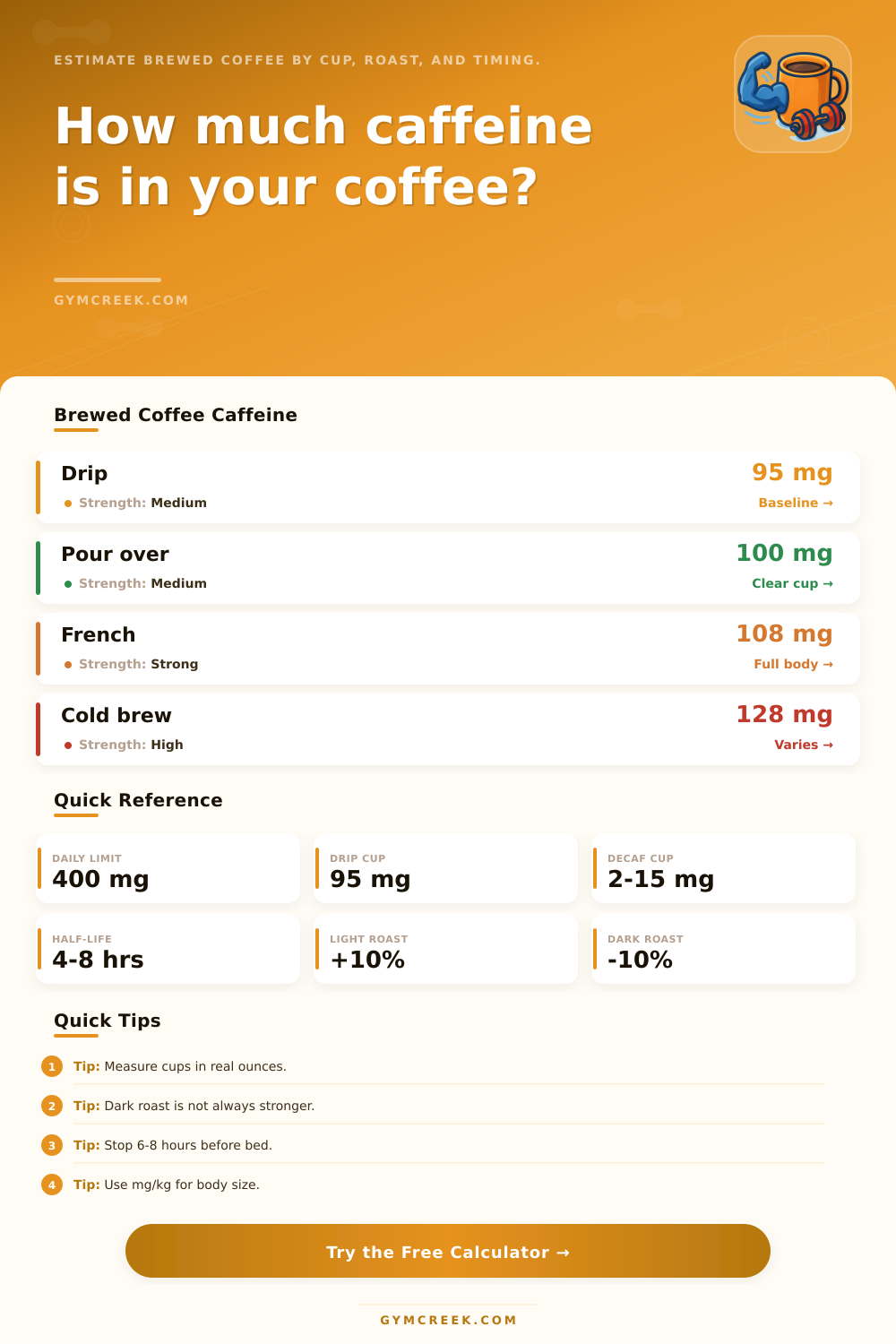
| Brew method | Typical 8 fl oz | Per fl oz | Best use |
|---|---|---|---|
| Drip coffee maker | 80-120 mg | 10-15 mg | Everyday baseline |
| Pour over | 90-130 mg | 11-16 mg | Manual clarity |
| French press | 95-145 mg | 12-18 mg | Longer contact |
| Cold brew | 100-180 mg | 13-23 mg | Varies by dilution |
| Instant coffee | 50-90 mg | 6-11 mg | Lower average |
| Decaf brewed | 2-15 mg | 0.3-2 mg | Not caffeine-free |
| Serving | Volume | Drip estimate | Note |
|---|---|---|---|
| Small cup | 6 fl oz / 177 ml | 71 mg | Classic coffee cup |
| Standard mug | 8 fl oz / 237 ml | 95 mg | Common reference |
| Large mug | 12 fl oz / 355 ml | 143 mg | Home mug size |
| Travel mug | 16 fl oz / 473 ml | 190 mg | Often two cups |
| Large cold cup | 20 fl oz / 591 ml | 238 mg | Dilution matters |
| Body-size dose | Range | Example | Interpretation |
|---|---|---|---|
| Low | Under 1 mg/kg | 70 mg at 70 kg | Light exposure |
| Moderate | 1-3 mg/kg | 70-210 mg at 70 kg | Common coffee range |
| High | 3-5 mg/kg | 210-350 mg at 70 kg | Noticeable dose |
| Very high | Over 5 mg/kg | 350+ mg at 70 kg | Use caution |
| Timing factor | Typical value | Calculator use | Practical meaning |
|---|---|---|---|
| Fast clearance | 4 hour half-life | Lower carryover | Shorter effect window |
| Average clearance | 5.5 hour half-life | Default model | Middle estimate |
| Sensitive | 7.5 hour half-life | Higher carryover | Earlier cutoff helps |
| Conservative | 8 hour half-life | Very cautious | Use lower daily limit |
💡Tips
Is that coffee in your travel mug a mild pick-me-up or a chemical event? It’s both, and it depends more on factors that few consider; not chance. Most people think of coffee as a single thing, something like salt or water; but coffee is realy a complicated solution. Each ingredient tip the scales in that solution.
Knowing how much you’re getting are important because it makes what was once an abstraction into something concrete. It is something you can manage without guesswork. When you choose your serving size and brew method, the calculator above do all the math for you. No need to memorize some obscure rate of extraction.
How to Manage Your Caffeine Intake
A shot of concentrated brew from an AeroPress isn’t the same chemical payload as a diluted glass of cold brew concentrate or a cup of drip coffee brewed on your office pot. Grind size and contact time change density. It is not just the origin of the beans. While grounds are steeping in your French press, they’re sitting with the water for several minutes longer then they would with paper-filtered pour over. That pulls more compounds into the cup. Caffeine is one of those compounds.
If you assume every mug contain ninety-five milligrams regardless of brewing method, your daily total is probably way off. This means you can’t know whether you’re under or over your own personal limit. And there’s yet another wrinkle, which confuses a lot of people: roast level. Because the taste seems more bitter and strong, most people think dark roast contains more caffeine. The truth is, because of how thick it is before being ground, actual coffee bean tends to hold onto a bit more caffeine by volume in light roasts. By weight, the difference isn’t much, but seriously-minded brews work with weights anyway.
So while you don’t have to bust out the scale to grasp the concept, it is worth noting that shade of the bean doesn’t determine how caffeinated the cup will be, as our gut might lead us to believe. It is a little detail, but it makes a difference if you are trying to adjust your drink choices to reduce anxiety or help you get sleepy.
Those milligrams don’t register the same way inside your body depending on your size. One person can take a hundred and be jittery where someone else takes a hundred and hardly feels it. To account for this, tool calculates dose per kilogram. That provides you with a sort of standard metric, something you can compare fairly regardless of how big you are. Same amount of caffeine? Hitting harder on someone who’s smaller.
This brings us back to timing, because time becomes as important as quantity. The half life of caffeine in most people is about five hours. In other words, by 5 p.m., half of whatever you took in at noon remain in your system. And the rest doesn’t simply vanish. It lingers, subtly interrupting deep sleep cycles even though you may feel wide awake when you go to bed.
There’s also an evening decay curve, which no one ever talks about. Except for that table of references on the page, where they lay it all out: Different clearance rates result in different bedtime carryover. Pregnant? Sensitive metabolism? Then that half-life extends further. More active stimulant remaining in your blood long after your last sip. You knock back your coffee at two p.m. Feel great at six. And you still can’t get deep sleep at midnight. That’s what most people miss until they’re suffering from chronic sleep deprivation.
Knowing these biological facts allows you to adjust your cutoff time so that you can enjoy the ritual, without paying for it with exhaustion afterwords. Caffeine doesn’t have a one-size-fits-all solution. Biology is crazy. Some people do great on lots, while some can’t handle more than one cup. Precision control isn’t about kicking coffee out of your life. It’s about having energy without the jitters and feeling rested without feeling stuffed up.
Knowing how much goes into your mug and how it impacts your system takes the guesswork away. This puts the power back in your hands. Understanding puts an end to mindless drinking, you begin to make choices that match your lifestyle. You get to enjoy the perks without paying the price. That awareness transforms something as mundane as waking up into something meaningful; a conscious act of self-love. It’s the reason why the warm cup in your hand becomes fuel for the rest of your day instead of a hindrance.