CO2 Tolerance Test Calculator
Estimate your exhale-hold tolerance, recovery load, breathing-rate context, and repeat-test readiness from one controlled breathing test.
📌Presets
Presets load realistic test contexts and calculate automatically. For your own test, breathe normally first, exhale normally, then time the first definite urge to breathe.
⚙Calculator
CO2 tolerance snapshot
Enter your hold, recovery, and resting breathing context to calculate.
📊Fitness Metrics Comparison
📑Reference Tables
| Adjusted Hold | Training Band | Common Meaning | Retest Focus |
|---|---|---|---|
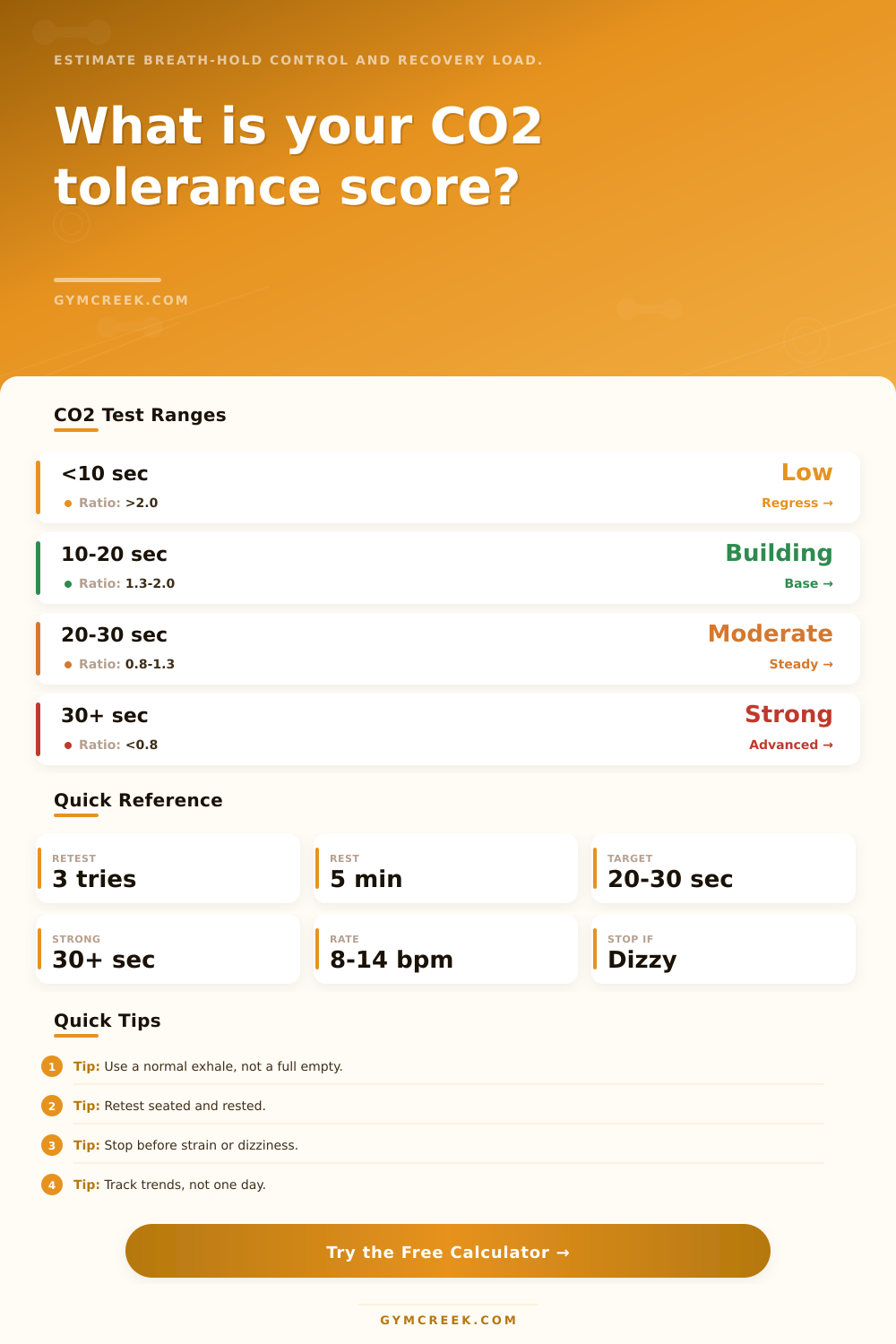
| Under 10 sec | Low tolerance | High air hunger appears quickly | Short, gentle nasal drills |
| 10 to 20 sec | Building | Early control is developing | Relaxed baseline practice |
| 20 to 30 sec | Moderate | Useful recreational baseline | Consistent seated retests |
| 30 to 40 sec | Strong | Good breath-hold comfort | Longer rest between repeats |
| 40 sec or more | Advanced | High tolerance for CO2 rise | Avoid forcing longer holds |
| Recovery Ratio | Read | What It Suggests | Action |
|---|---|---|---|
| 0.60 or less | Calm | Breathing settles quickly | Retest normally |
| 0.61 to 1.00 | Controlled | Recovery is proportionate | Keep protocol steady |
| 1.01 to 1.50 | Loaded | Post-hold breathing takes time | Reduce intensity |
| 1.51 to 2.00 | High load | Air hunger may be too strong | Use shorter holds |
| Over 2.00 | Very high | Test may have been overdone | Stop and retest rested |
| Resting Breaths/Min | Fitness Context | Calculator Penalty | Note |
|---|---|---|---|
| 6 to 8 | Very low | None | Check that breathing is natural |
| 8 to 14 | Common athletic range | None | Good baseline context |
| 14 to 18 | Elevated | Small | Warm up with quiet breathing |
| 18 to 22 | High | Moderate | Retest after rest |
| Over 22 | Very high | Large | Skip hard breath holds today |
| Formula Piece | Calculation | Why It Matters | Limit |
|---|---|---|---|
| Protocol factor | Hold x posture | Normalizes test setup | Trend estimate only |
| Altitude factor | +4% per 1000 m | Offsets reduced oxygen pressure | Capped at 16% |
| Recovery ratio | Recovery / hold | Shows air-hunger load | Lower is calmer |
| Rate penalty | Over 14 bpm | Flags pre-test ventilation | Caps score impact |
| Readiness flag | HR plus training | Helps avoid noisy retests | Not medical advice |
💡Test Tips
Start by exhaling. Not forcing anything, just a normal exhale. And then… Waiting. That pause is when the magic take place. Long before you even think about a marathon swim or deep dive, there is that pause after simple exhale where real work happens.
What many people believe is a test of lung capacity are instead a measure of tolerance to rising CO2 levels. When your chest tell you it is time to breathe, that is not a sign of depleted oxygen stores. Instead, it’s a chemical alarm clock telling you your CO2 level are too high. You’ve got lots of air left in lungs, but your nervous system is saying enough is enough.
The Magic Pause in Breathing
Knowing this will change what you do with training and how you read your own body. All you have to do is enter in your recovery info and your hold time (the calculator above will do all the math for you). No more wondering if a 20 second hold is acceptable/bad/okay/whatever. Hold time absolutely depends based off context. Standing upright after a high interval workout at an altitude of 5,000ft is very different then sitting relaxed at sea level with your legs crossed for ten seconds. The tool takes those factor into consideration.
It is adjusted for recent training load and elevation. This ensures that you’re not competing against some other guy’s baseline reading from this morning. It also consider your resting breath rate. So if you’re out of breath when you start the test, then your score reflect that anxiety. That’s not a bug. That’s a feature.
You can’t train on top of anxiety. Elevated rates will skew results towards faux air hunger, so the system flag them. That being said, if you’re feeling anxious, don’t do it.
The most neglected number among all these metrics is maybe recovery load. That’s how quickly your body recovers its breathing when you release your breath after holding it. A long recovery with a short hold indicate that you’ve pushed too hard into the panic zone, or that your body isn’t good at clearing out the builded up CO2. On the page I have some reference tables that categorize your recovery as loaded, controlled, or calm. Ratios above two is probably overdoing it. You’ve forced yourself beyond comfort and into strain.
This will not serve you well in the long run. It’ll teach your mind to fear the feeling instead of embrace it. To be truly tolerant means to sit comfortabley in the uncomfortable and not react to it. You’re looking to push your window of comfort outward, not test the limits of what you can survive.
Another common error is to try to empty your lungs before beginning the timer. This establishes an artificial baseline. Worse still, it will increase how quickly your blood oxygen level fall. Just let yourself breathe normally. That’s enough. It establishes a consistent starting point for how much air is left and focuses the test on whether your body are sensitive to rising CO2 vs. How well your lungs are moving air mechanically.
Finally, choose one method and use it consistently. Your muscles and posture change how hard you work to breathe based off whether you’re lying down, sitting up, or standing, so that affects the result. If you switch methods every time, you’ll end up chasing a personal best instead of seeing any trend over weeks or months. On top of that, if you’re a little more stressed, tired, or maybe even a bit dehydrated that day, that reduces your tolerance. By taking the long view of what goes into the calculator, it averages out those daily fluctuations and lets you see the overall picture.
Safety is our absolute minimum standard. No, don’t drive around testing this out. And no, don’t try it in the water. Don’t test your limits by ignoring tingles or dizziness. Those aren’t challenges. They’re warnings. If you feel panic rising, breathe. Giving up is a success. You knew your limit and listened to it.
As your body’s tolerance increases over time, your limit will move back. The need to breathe won’t be an emergency siren anymore; it’ll become something you can live with, something in the background. You’ll learn to watch the feeling, let it be there and not act on it, just wait for it to fade away.
That, dear friend, is what winning looks like. It is not about holding your breath longer, but rather being able to sit comfortabley while your body screams at you to stop. You begin by simply taking a breath out, but end up learning to trust yourself in the silence in-between breaths.