Cluster Set Calculator
Build a cluster training plan from load, reps, mini-clusters, rest timing, velocity loss, and reps in reserve.
📌Cluster Presets
Each preset loads a real cluster setup with a named lift, load method, cluster shape, rest target, velocity cap, and RIR guardrail.
⚙Calculator
Cluster set snapshot
Enter load, cluster shape, rest, velocity loss, and RIR to plan the session.
📊Cluster Metrics Grid
📑Reference Tables
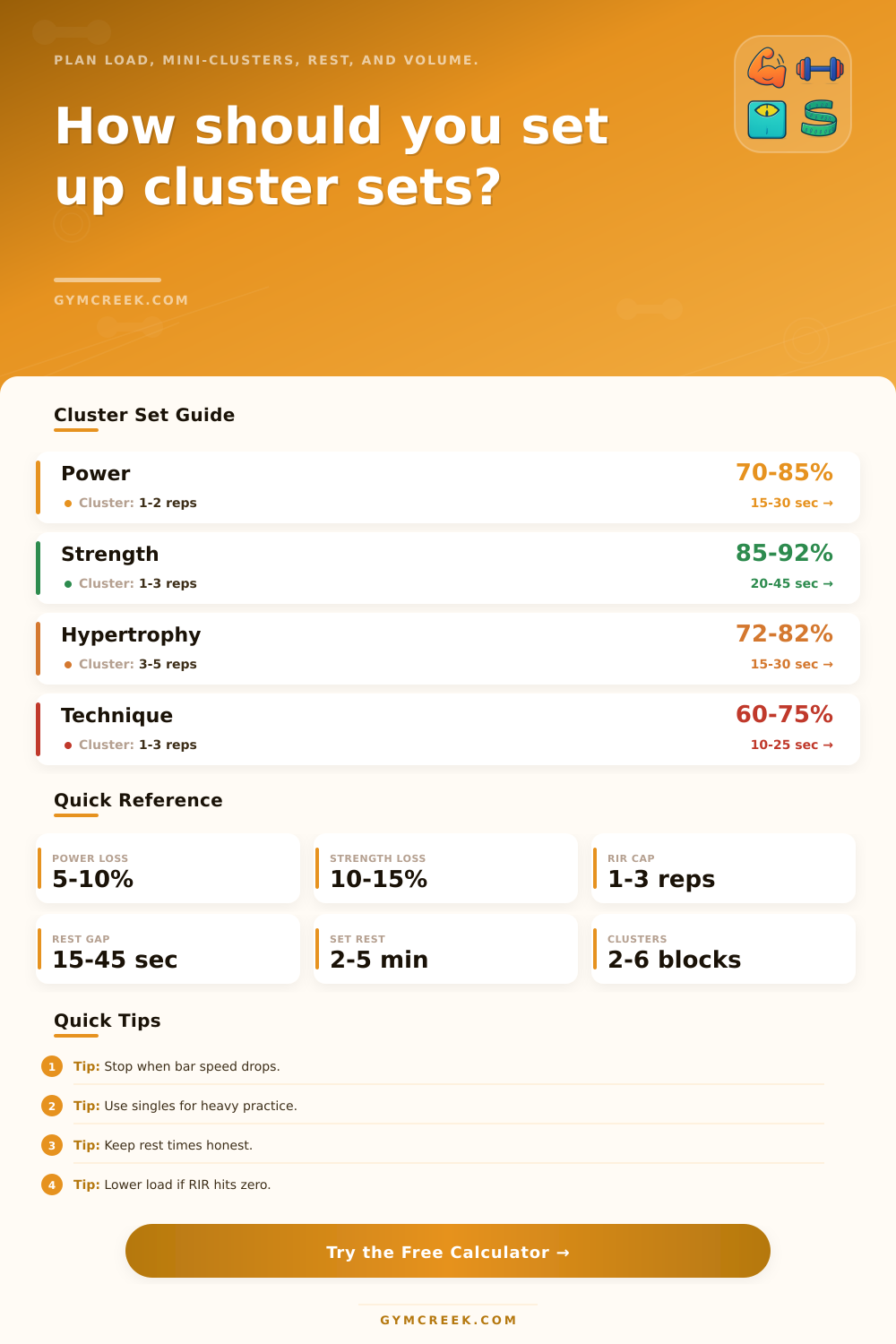
| Goal | Typical Load | Cluster Shape | Intra Rest |
|---|---|---|---|
| Max strength practice | 85-92% 1RM | 1-2 reps x 3-5 | 20-45 sec |
| Power output | 65-82% 1RM | 1-3 reps x 3-6 | 15-35 sec |
| Hypertrophy density | 70-82% 1RM | 3-5 reps x 2-4 | 15-30 sec |
| Technique reinforcement | 55-75% 1RM | 1-3 reps x 3-5 | 10-25 sec |
| Lift Type | Best Cluster Use | Velocity Loss | RIR Guardrail |
|---|---|---|---|
| Back squat | Heavy singles or doubles | 8-15% | 1-3 RIR |
| Bench press | Triples, speed, or volume | 10-20% | 1-3 RIR |
| Deadlift | Low-rep neural practice | 5-12% | 2-4 RIR |
| Olympic pull | Explosive repeat quality | 5-10% | 2-4 RIR |
| Velocity Loss | Training Signal | Fatigue Cost | Adjustment |
|---|---|---|---|
| 0-7% | Power emphasis | Low | Add load only if crisp |
| 8-15% | Strength quality | Moderate | Good default cap |
| 16-25% | Volume emphasis | High | Use lighter loads |
| Over 25% | Grinding risk | Very high | Stop or reduce load |
| Cluster Pattern | Total Reps | Common Load | Best Fit |
|---|---|---|---|
| 1 x 4 | 4 reps | 88-94% 1RM | Heavy singles |
| 2 x 3 | 6 reps | 82-88% 1RM | Strength doubles |
| 3 x 3 | 9 reps | 75-84% 1RM | Dense strength |
| 4 x 3 | 12 reps | 68-78% 1RM | Hypertrophy load |
💡Tips
Cluster set exist because straight sets has a physical limit to how much volume they can take, and because cluster sets allow an individual to overcomes the fatigue that develops during straight set sessions. During straight set sessions, the fatigue that develops in the muscles and the nervous system lead to fatigue in bar speed and technique, causing the nervous system to no longer recieve the expected signal from the muscles. Cluster sets work to overcome this issue of fatigue by breaking one heavy set into smaller sets with short period of rest in between the sets.
These short periods of rest allow an individual to maintain the quality of their lift, as well as to accumulate the volume require of that type of training. Because cluster sets allow for the maintenance of high quality lift, powerlifters often use cluster sets in powerlifting cycle, Olympic lifting warm-up, and hypertrophy blocks. The number of repetition that are performed within each mini-cluster within cluster sets is another of the main variable to consider for those who incorporate this type of training into their program.
How Cluster Sets Work
For example, performing only one repetition at 90% of one’s one repetition maximum (ORCM) will allow for the lift to be crisp and powerfully, but performing three or four repetition at a lighter load will allow the trainee to develop local muscular endurance in that particular muscle group. The calculator that is provided to trainees will help individual to perform the calculations necessary to determine the number of repetitions that should be performed within each cluster set. The two most important variable for this calculation are the quality of each repetition within each cluster set, and the amount of rest that is taken between each repetition.
Another variable for those cluster set session is the length of rest that is provided between each cluster. Twenty seconds of rest between each cluster may not sit well with an individual performing the sets, but twenty seconds of rest is often enough to restore 80 to 90 percent of the phosphocreatine store in the body that are necessary for performing one heavy repetition. Forty-five seconds of rest, however, will shift the focus of that cluster set from power to strength.
The nervous system adapt to the stimuli that is provided to it; therefore, if an individual attempts to provide it with one stimulus but provides a different stimulus, the nervous system will not adapt to the intended stimulus. The other two variables that should be considered within cluster set sessions are the loss of velocity of the bar during those sets, as well as the number of repetition that are left in the tank for each set. If the velocity of the bar slows down more frequent than the target that is set for that particular exercise, the body knows that the purpose of that set has been fulfilled, and that additional repetition will only add to the fatigue that the body experiences.
Conversely, if one or two repetition is left in the tank, high quality repetitions can be ensured throughout each set of cluster sets. The third main variable to consider within cluster set sessions is the load that is considered for each cluster set. For loads that are heavy, fewer repetition will be performed within each cluster set, as well as longer period of rest between each cluster.
For loads that are lighter, more repetition or clusters can be performed; however, only if the loss of velocity for each repetition remain within the target velocity for that particular exercise. The load calculations that are performed with the load calculator will help an individual to determine if the session is dense enough for the adaptation that is desire of that muscle group. One of the most common mistake with cluster sets is in the use of rest period.
If an individual rushes rest periods or makes them too long, based off how an individual feels at the time, the calculations for number of repetition will no longer accurately represent the number of repetitions that will actualy be performed during training. Another of the common mistake with cluster sets is the performance of too many cluster at high levels of intensity. The body can only maintain high quality repetitions for a limited amount of time; after that time, compensation pattern will begin to develop within the body.
Therefore, it is important to end cluster set sessions when the quality of the barbells repetition begins to fade. Technique-based exercises, such as front squat at 70% can be broken into doubles or triples, with a brief pause between each repetition. These brief pauses will allow for the body to reset to its starting position, and will prevent fatigue during that session.
The same principle can be applied to Olympic pulls to ensure that crispness in the performance of a triple extension. Beyond the benefits for each individual session, there are additional benefit to the use of cluster set within the entire training cycle for each individual. By using cluster sets, an individual can accumulate more repetition at loads that would typically result in a drop-off in performance.
Additionally, the body can recover between training sessions due to the fact that training creates fatigue that is more localized to each training session, as well as because the nervous system does not fatigue from performing these sets at high rate.