Close Grip Bench Calculator
Estimate your close grip bench 1RM, training max, grip fit, and weekly pressing volume from a real working set.
📌Presets
Each preset loads a realistic close-grip bench scenario and recalculates strength, training load, and grip-width feedback.
⚙Calculator
Close grip bench snapshot
Enter a working set to estimate max strength, load targets, grip fit, and weekly volume.
📊Fitness Metrics Comparison
📑Reference Tables
| Grip index | Grip style | Likely emphasis | Check |
|---|---|---|---|
| Under 0.80x shoulder | Very narrow | High wrist demand | Use caution |
| 0.80-0.95x shoulder | Narrow close grip | More triceps | Keep elbows controlled |
| 0.95-1.15x shoulder | Balanced close grip | Triceps and press strength | Often best fit |
| Over 1.15x shoulder | Wide for close grip | More chest involvement | May be standard bench |
| Goal | Load zone | Rep target | Weekly sets |
|---|---|---|---|
| Peaking strength | 85-95% 1RM | 1-4 reps | 3-6 hard sets |
| Strength focus | 75-85% 1RM | 4-6 reps | 5-10 hard sets |
| Triceps accessory | 65-80% 1RM | 6-10 reps | 6-12 hard sets |
| Hypertrophy focus | 60-75% 1RM | 8-12 reps | 8-16 hard sets |
| Technique practice | 50-65% 1RM | 8-15 reps | 4-8 crisp sets |
| Formula | Calculation | Best rep range | Use here |
|---|---|---|---|
| Epley | Load x (1 + reps/30) | 1-10 reps | Main 1RM estimate |
| Brzycki | Load x 36 / (37 - reps) | 1-10 reps | Cross-check estimate |
| RPE reserve | Reps + reps in reserve | 6-10 RPE | Max adjustment |
| Strength ratio | 1RM / body weight | Any valid set | Benchmark category |
| Ratio group | Male benchmark | Female benchmark | Reading |
|---|---|---|---|
| Beginner | Under 0.75x BW | Under 0.40x BW | Build base control |
| Novice | 0.75-1.00x BW | 0.40-0.60x BW | Solid early strength |
| Intermediate | 1.00-1.35x BW | 0.60-0.85x BW | Strong gym standard |
| Advanced | 1.35-1.65x BW | 0.85-1.10x BW | High pressing strength |
| Elite | Over 1.65x BW | Over 1.10x BW | Exceptional strength |
💡Tips
With the close grip bench press, it’s usually because of the geometry of your body. You want to get in there for the triceps, so you narrow your hand position to avoid placing as much stress on your shoulders. However, without as much advantage, weight feels heavier. That nice load becomes a grind as the bar starts to tilt forward and put more strain on your wrists in angled position.
Big arms aren’t everything. This is about determining the exact width you need to get the most mechanical advantage while targeting the correct muscle. Most guys either guess at their width or copy another lifter with a different bone structure, so they stall out much earlier then they should.
How to Find Your Perfect Grip Width
Plugging in a real working set, the calculator will run the math for you. And it’s not just estimating your one rep max based on old formulas. It puts you into a strength curve based on your body weight. It compares your shoulder measurements to your grip width to determine whether you’re really training close grip or simply narrow regular bench.
Why does this matter? A true close grip alters joint angles a lot. Too wide and you’re merely performing a standard bench with a little more elbow flare. Too narrow and you may not be activating your triceps much while risking wrist pain. The tool helps you find the sweet spot where stress is both safe and appropriate.
None of this is possible without starting with honest data. So enter a set in which you really struggled, yet managed to finish well. While an easy set of six might be different than a grinding six done near failure, RPE allows you to adjust the estimate accordingly. Because the system use how hard you felt you worked to adjust its estimated max, it paints a more true picture than just using raw weight.
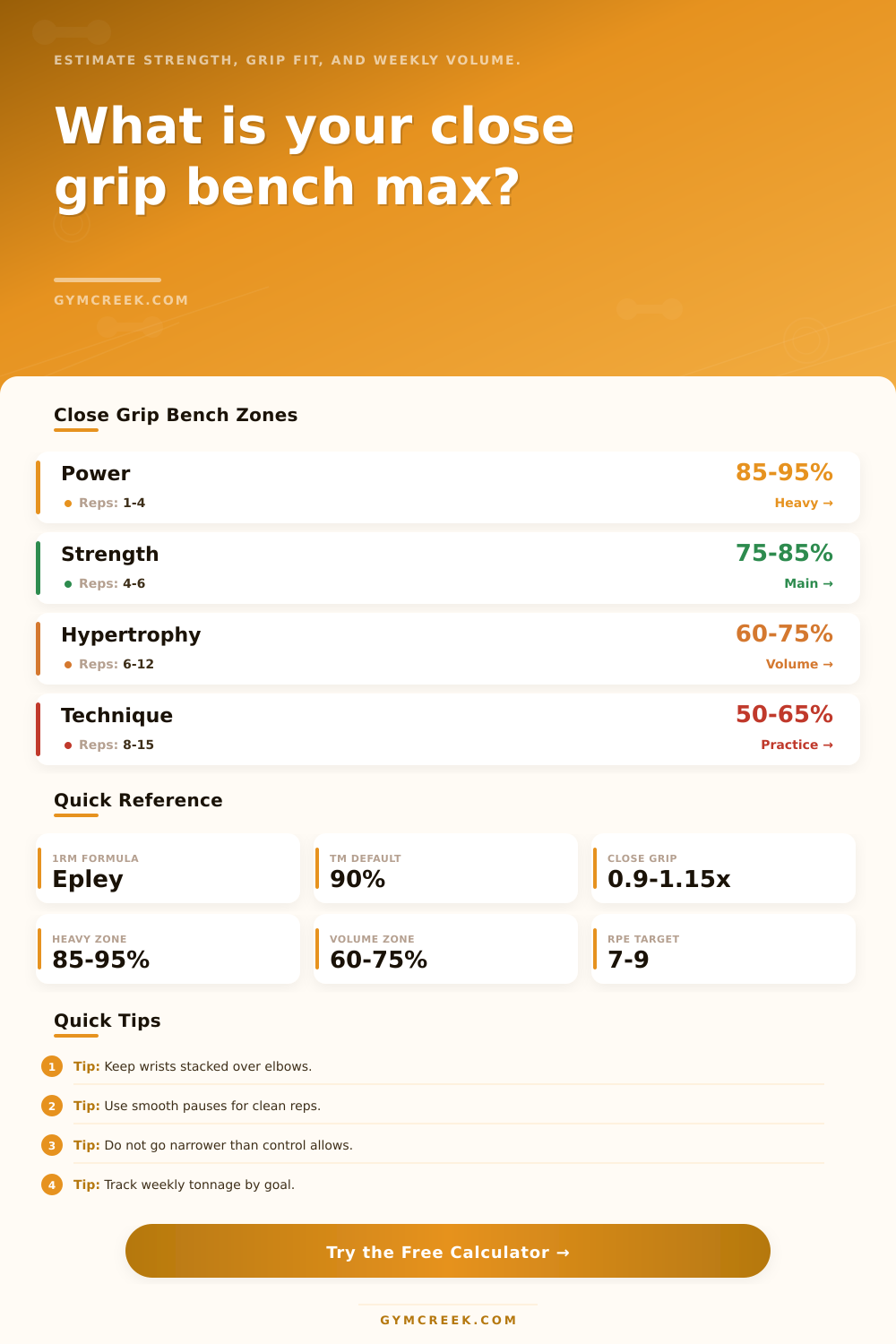
Then it spits out a training max and weekly volume targets. This guides the periodization. Are you building base endurance and need to back off? Or are you heading into strength peaks and time to ramp up? The reference table on the page matches intensity zones to rep ranges and goals. It lays everything out so you can simplify your decisions and no longer guess if eight sets of six will work for muscle growth or hurt recovery.
Most folks struggle with grip width. You want a close grip that is roughly at shoulder width or just inside. That way, your forearms can remains vertical beneath the bar during the bottom of the rep. When forearms remain vertical, it means the weight isn’t ripping at the wrist joint, it’s transferring cleanly into the triceps and elbows. Your hands are too narrow if your wrists is hurting and bending painfully backward. Slide ’em out until they feel naturaly.
The calculator will also give you feedback on the fit since it matches your hand placement to shoulder width. It flags you when you’re starting to drift into styles that favor the chest over the triceps or vice versa. This biomechanical check tends to be far more useful than strength estimate.
From here it’s natural to move into volume management. People underestimate how long triceps take to recover, particularly if they’re taking a pounding from overhead pressing too. Based off their goal, the tool suggests how many intense sets you can do per week. Size-chasers should of do more volume in the moderate load zone. Pure strength-chasers should lower total number of sets and go super heavy for reps. Stepping outside those bounds results in elbow tendonitis, the silent killer of bench press progress.
Usually when you have pain at the joint, it’s because you’re overtrained or using too much weight for your leverage. Backing off on the volume and adjusting width often cure the problem faster than switching exercises altogether.
All this adds up to one thing: the close grip bench is ultimately about how stable your body is. Do you want to feel your arms burning or do you want your elbows to hurt? Trial and error will get you to that sweet spot, but having some sort of framework helps it hurt a little less. Take what the tool tells you to be your baseline, then learn to trust your body for when something isn’t quite right with your grip or the load is too heavy. Let the sensations in your muscle guide you on whether or not you’re driving in the right direction. Keep that wrist stack, keep that bar path vertical and watch your strength develop from there.