Climbing Wall Angle Calculator
Estimate wall angle from height and setback, compare it with a target angle, size panel runs, check board footprint, estimate grade shift, and plan hold setting density.
📌Wall Presets
Presets load real planning patterns for home walls, kids panels, basement boards, spray walls, training boards, and gym-style overhangs.
⚙Calculator Inputs
Climbing wall angle result
Enter wall dimensions to estimate the angle, footprint, panels, and setting density.
📊Wall Metrics Grid
📑Reference Tables
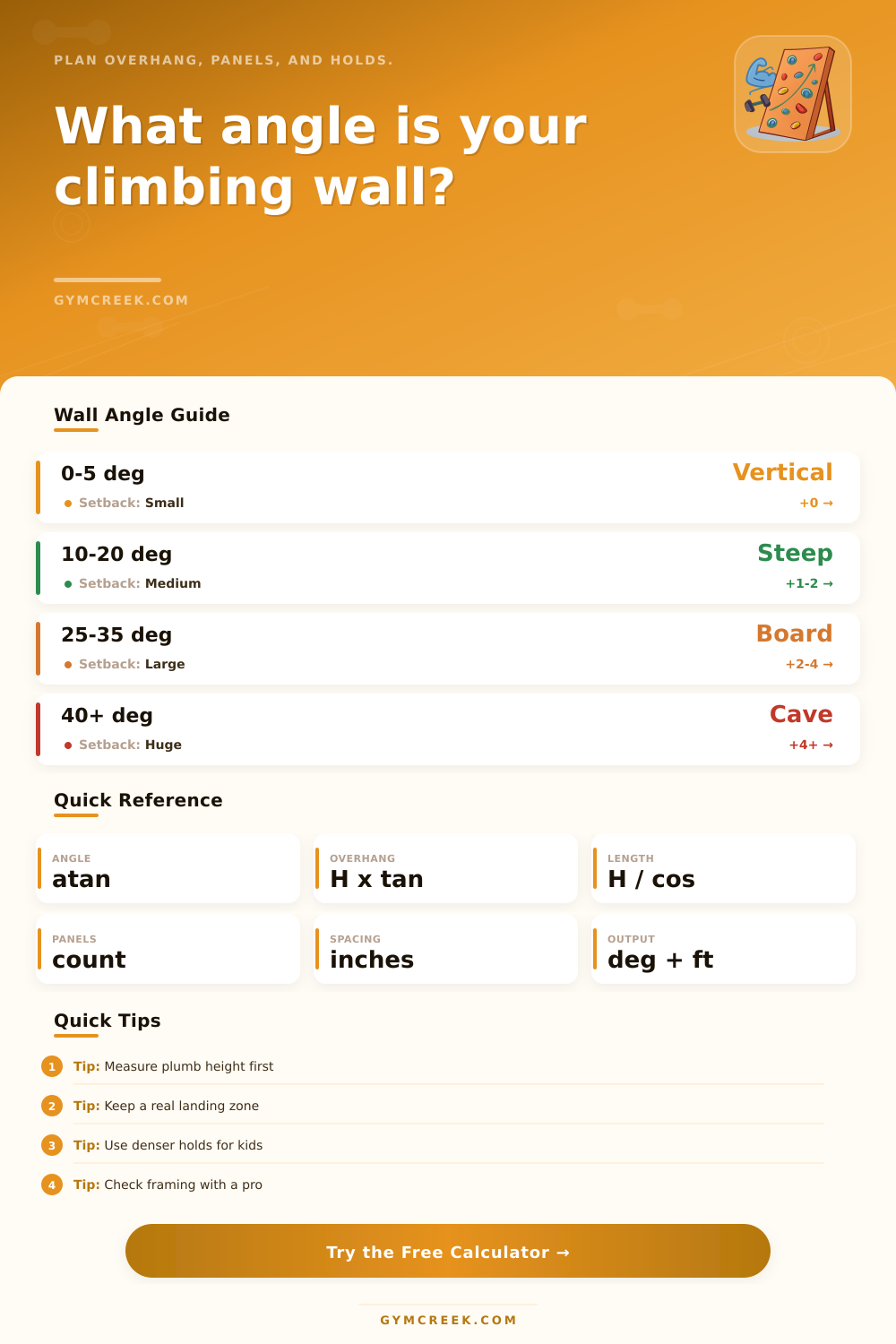
| Angle | Wall Feel | Common Use | Setting Note |
|---|---|---|---|
| -5 to 5 deg | Slab to vertical | Technique, classes, warm-ups | Footwork matters more than power |
| 10 to 20 deg | Mild overhang | Home bouldering and routes | Good all-around training angle |
| 25 to 35 deg | Steep board | Power, tension, spray walls | Requires more core and pulling strength |
| 40 to 50 deg | Cave or board | Hard bouldering, system work | Large feet or dense footholds help |
| Formula | Calculation | Output | Use |
|---|---|---|---|
| Angle degrees | atan(setback / height) | degrees | Measured wall angle past vertical |
| Overhang | height x tan(angle) | distance | Needed base setback for a target angle |
| Wall length | height / cos(angle) | surface length | Panel run along the climbing face |
| Panel length | wall length / panel count | per panel | Modular panel sizing |
| Footprint | width x (setback + landing) | floor area | Space needed on the floor |
| Spacing | Approx Density | Best Fit | Tradeoff |
|---|---|---|---|
| 6 in | 4.0 per sq ft | Youth, classes, spray walls | Many options, more T-nuts |
| 8 in | 2.25 per sq ft | General home walls | Balanced cost and variety |
| 10 in | 1.44 per sq ft | Training boards | Cleaner sets, fewer options |
| 12 in | 1.0 per sq ft | Systems or sparse routes | Needs careful hold selection |
| Setting Context | Density Cue | Grade Cue | Planning Note |
|---|---|---|---|
| Beginner or youth | More holds | Lower shift | Add comfortable footholds and downclimb options |
| Bouldering problems | Medium | Steeper shift | Angle changes difficulty quickly |
| Spray wall circuits | High | Variable | Dense grids keep circuits fresh |
| System board training | Structured | Consistent | Symmetry matters more than route density |
| Lead or top-rope | Lower | Smoother | Longer routes need rest positions |
💡Tips
A climbing wall angle is the mathematical measurement of the climbing wall that determine how the climbing wall will feel to the climber and how much floor space it will take up. The angle of the climbing wall will determine how much strength the person must use when climbing and how much floor space the climbing wall take up. Understanding the climbing wall angle is essential because it dictates the difficulty of the climbs on the wall.
To calculate the climbing wall angle, you must measure the height of the climbing wall and the setback of the climbing wall. The height of the climbing wall is the distance from the floor to the top anchor line of the climbing wall. That measurement isnt the same as the length of the plywood sheet that will make up the climbing wall.
How a climbing wall angle changes how hard it is and how much space it needs
The setback is the distance between the base of the climbing wall and the vertical plumb line. By measuring these two variables, you can determine the angle of the climbing wall. Once you have determined the climbing wall angle, you can calculate the depth that the climbing wall will take up in the room.
The angle of the climbing wall will change the difficulty of the climbs on the wall. A vertical climbing wall will have a zero degree overhang, and these types of climbing walls is often the easiest for the individuals to climb. Increasing the angle of the climbing wall to fifteen degrees will cause the person to use more strength in there shoulders and there core muscles.
Increasing the climbing wall’s angle to thirty degrees will make the climbing holds on the wall feel more difficult because the climber will have to use more tension in their body to remain on the climbing holds. The difficulty level changes due to the position of the climbers center of mass moving further away from the climbing wall. The climbing wall angle will dictate the length of the panels and the distance between the holds on the climbing wall.
The length of the panels is the size of the plywood sheets that will make up the climbing wall. The length of the panels must be long enough to account for the climbing wall’s angle. Another variable to consider is the distance between the holds.
The angle of the climbing wall and the distance between the holds will dictate the difficulty of the climbs. The closer the holds are together, the more options the climber will have for where to place there feet. However, there will be more T-nuts that the builder will have to drill into the climbing wall.
The farther the holds are from one another, the few options that the climber will have for where to place their feet on the climbing wall. The climbing wall angle will also dictate the total footprint that the climbing wall will take up in the room. The footprint will include the overhang of the climbing wall, the size of the landing mat for the climber, and the amount of walking room that will be needed around the climbing wall.
A climbing wall with a steep angle will take up more room in the same footprint as a climbing wall with a shallow angle. If you dont plan for the total footprint that the climbing wall will take up, the landing mats for the climber may not fit into the room that is planned for the climbing wall. You will have to ensure that the landing zone for the climber is large enough and that there is enough walking room around the landing mats for the climber.
The climbing wall angle will also affect the grade shift of the climbing holds. The grade shift is the difference in the difficulty of the same climbing hold on vertical climbing wall compared to a steep climbing wall. If you move the same climbing hold from a vertical climbing wall to a climbing wall with a thirty-degree climbing wall angle, that climbing hold will feel more difficultly.
For these types of steep climbing walls, the designer may have to add more large footholds for the climber to better accommodate for the grade shift of the holds. The grade shift will make all climbing sessions on these types of climbing walls more difficult. Finally, another consideration for the angle of the climbing wall is whether or not you want your climbing wall to have a steep angle or a gentle angle.
Climbing walls with steep angles are beneficial for those who would like to train their specific strength. However, steep climbing walls may limit the number of individuals who can use the climbing wall. Therefore, many climbing wall builders will incorporate at least one panel with a gentle angle to the climbing wall.
This angle will allow the climber to perform their warm-ups prior to ascending the rest of the climbing wall that features a steep angle. The gentle angle of the climbing wall allows for easier climbing, while the steep angle of the climbing wall makes for more difficult climbs. According to these considerations, you can decide which angle to choose for your climbing wall to match the type of climbing that you would like to perform at your home.