Climbing Strength Calculator
Estimate max hang percent of body weight, finger strength index, pull strength score, grade readiness, and imbalance flags from hangs, edge size, pull-ups, lockoff time, grip style, and goal grade.
📌Climbing Presets
Presets are descriptive training profiles, not standards. Replace them with a current, well-rested max hang and a controlled pull-up test.
⚙Calculator Inputs
Climbing strength snapshot
Enter your test numbers to estimate finger strength, pulling strength, grade readiness, and imbalance flags.
📊Metrics Grid
📑Reference Tables
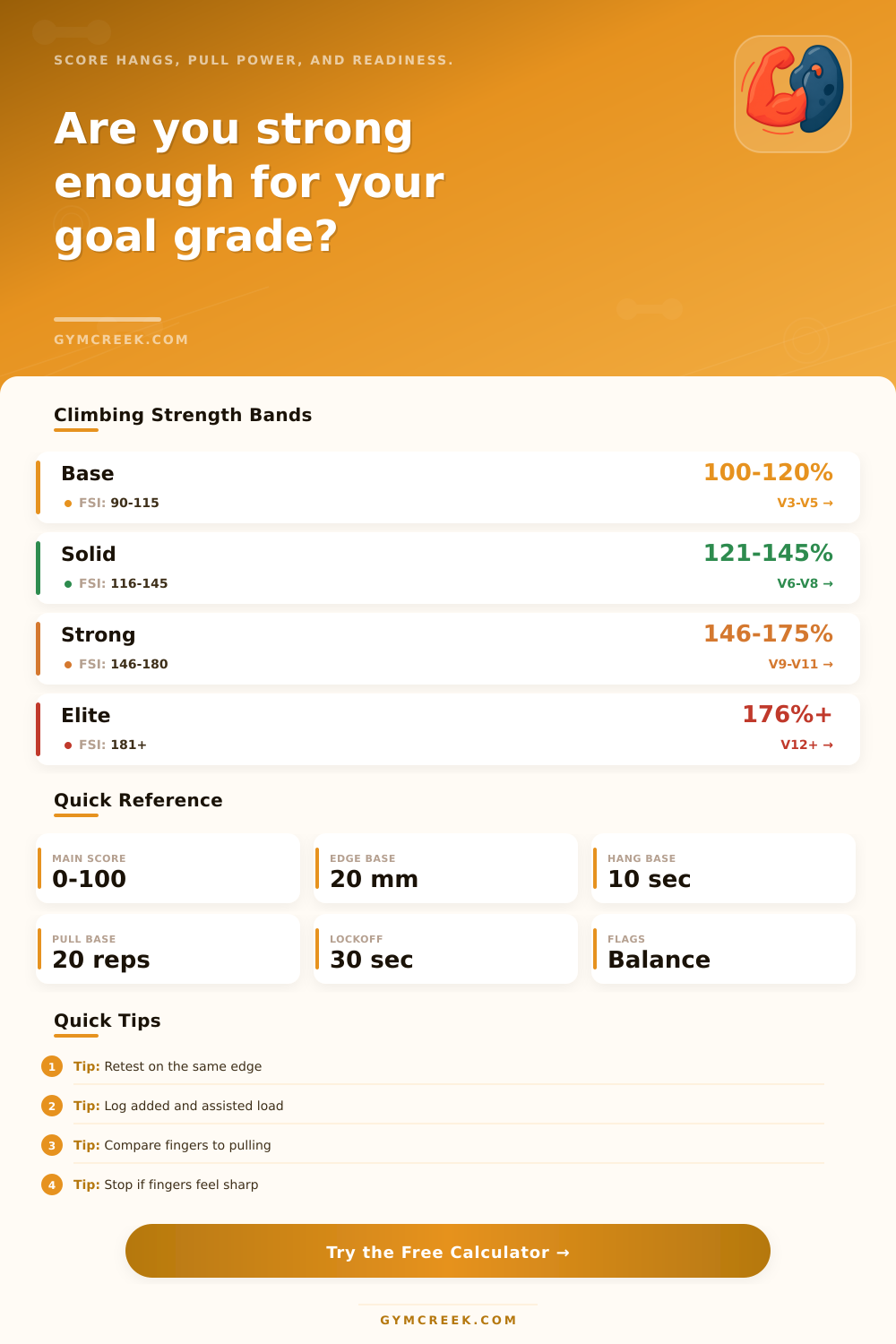
| Band | Max hang percent | Finger index | Common fit |
|---|---|---|---|
| Base | 100-120% BW | 90-115 | New to V4, technique still dominant |
| Solid | 121-145% BW | 116-145 | V5 to V7 or 5.11 to 5.12 |
| Strong | 146-175% BW | 146-180 | V8 to V11 or 5.13 range |
| Elite | 176%+ BW | 181+ | V12+ or high 5.14 potential |
| Goal | Finger target | Pull target | Notes |
|---|---|---|---|
| V3 / 5.10 | 100 | 35 | Movement skill can outweigh strength |
| V5 / 5.11 | 122 | 45 | Basic finger reserve helps consistency |
| V7 / 5.12a | 145 | 56 | Small edges and body tension matter |
| V9 / 5.13a | 168 | 66 | Finger strength usually becomes limiting |
| V11 / 5.13d | 190 | 74 | Power and precision both need margin |
| V13 / 5.14b | 214 | 82 | Elite strength plus refined tactics |
| V15 / 5.15a | 240 | 90 | World-class strength context |
| Input | Adjustment | Why | Use carefully |
|---|---|---|---|
| 20 mm edge | 1.00x base | Common hangboard benchmark | Retest on same edge |
| Smaller edge | Higher factor | More difficult per unit load | Skin and joint stress rise |
| Open hand | 0.94x | Less crimp leverage | Often safer for volume |
| Half crimp | 1.00x | Balanced benchmark grip | Keep wrist consistent |
| Full crimp | 1.05x | Higher mechanical advantage | Use sparingly in testing |
| Formula | Variables | Output | Interpretation |
|---|---|---|---|
| Max hang percent | (BW + load) / BW x 100 | %BW | Raw total load relative to body weight |
| Finger index | %BW x edge x time x grip | Index | Normalizes the hang to a 20 mm, 10 sec test |
| Pull score | Pull-ups + lockoff + reserve | 0-100 | Blends repeat pulling and lockoff strength |
| Readiness | Finger fit + pull fit + style fit | 0-100 | Compares test profile to selected goal grade |
| Imbalance flags | Finger score vs pull score | Text flag | Highlights likely training bottlenecks |
💡Training Tips
Strength testing involve measuring a climber’s physical capacity. Strength testing can happen both by accident and intention. For instance, after performing a climbing session, an individual may ride a hangboard to work out there strength.
Furthermore, that individual can add additional weight to the hangboard to determine how much weight an individual can hold. This measurement will show an individual why a certain climbing grade may be more difficult than other. Yet, the information collected from a single hang on a hangboard provide very little information for climbers about their physical strength.
How to Test Your Climbing Strength
The inclusion of the strength calculator allow for an individual to measure their strength in a variety of ways. The strength calculator intend to use measurable variables to calculate the strength of an individual climber. For instance, the strength calculator consider an individual’s body weight, the amount of additional load that they can hold during a max hang, the depth of the climbing edge that they utilize, and for how many seconds they held on to that edge.
Furthermore, the finger strength index that the calculator calculates account for the depth of the edge, as the finger strength index accounts for the fact that a 15 mm edge is harder to climb than a 25 mm edge. Another value of the calculator is the measurement of pull strength. Yet, the strength calculator does not intend to measure an individual’s pulling strength by the number of pull-ups that they can perform.
Instead, the calculator intends to blend the number of strict pull-ups with the number of lockoff holds that an individual can hold. For instance, an individual may perform twenty strict pull-ups but have difficulty with performing lockoffs on a steep area. Thus, the score accounts for this difference but does not ask individuals to take a variety of tests to determine there strength.
The value of the climbing strength calculator is additionally seen through the comparison of the finger strength score to the pull strength score. A gap between these two scores indicate where an individual should focus their training. For instance, if an individual finds that their finger strength score is high yet their pull strength score is low, performing more hangboard may not provide benefit to the individual.
Alternatively, if an individual has high pull strength but a low finger strength score, small climbing crimps will be difficult for that individual to perform well. The score indicates these difference so that an individual dont have to rely on their feelings about their strength to determine these factor. Another aspect of the climbing strength calculator is the grade readiness metric.
Yet, the grade readiness calculator do not indicate whether an individual will be able to complete a specific climbing grade. However, the calculator will determine if the individual’s strength is within the parameters required for that specific climbing grade. A low readiness score for a climbing grade does not indicate that an individual cannot reach that grade, but it does provide information that their strength test indicate that they may struggle with the specific climbing movement required to reach that grade.
The reference tables provided on the calculator provide individual climbers with information regarding their strength relative to other strength benchmarks. These reference tables allow individual climbers to determine whether they should continue to use the same test to measure their strength or to adjust the focus of their training to specific aspect of their climbing movement. The limitation of the climbing strength calculator include the fact that the numbers cannot indicate if an individual’s tests for strength are performed under the same condition.
For example, an individual’s edge measurement, warm-up routine, strength of their shoulders relative to the climbing position, and the time of day that they perform their tests can all impact their score. Thus, in order to provide the best measurement of strength, an individual must ensure that these variable is held constant during each test of strength using the calculator. Another limitation to the climbing strength calculator is the fact that the calculator is based off climbing style.
For instance, an individual that specializes in trad climbing may have similar score to an individual that competes in bouldering competition. Yet, there may be difference in the strength requirement for these two form of climbing. Thus, the style selector included in the calculator can provide adjustment to the scores of each strength variable, but the calculator does not account for variable like crack strength.
Finally, the purpose of the climbing strength calculator is to provide an individual with a means of checking their strength. Yet, the climbing strength calculator does not provide a final verdict on an individual’s climbing strength. An individual may use the calculator to test their strength, determine where their relative strength and weakness are, adjust their training to account for their weakness, and then test their strength again.
Thus, while the individual may not rely on the specific score that the calculator provides, they may use the score as an indication of whether their training is having the desired effect. Over time, this process could of determine a specific training plan for climbers to follow to increase their strength.