Climbing Shoe Size Calculator
Estimate climbing shoe size from foot length, foot width, street shoe size, brand fit tendency, closure type, discipline, aggressiveness, comfort tolerance, and break-in behavior.
📌Fit Presets
Presets load realistic climber profiles and calculate immediately. Use them to compare comfort-first, balanced, and performance-oriented fit choices.
⚙Calculator
Recommended climbing shoe fit
Calculate to see EU size, US equivalent, downsizing, width fit, break-in, and risk flags.
📊Fit Metrics
📋Reference Tables
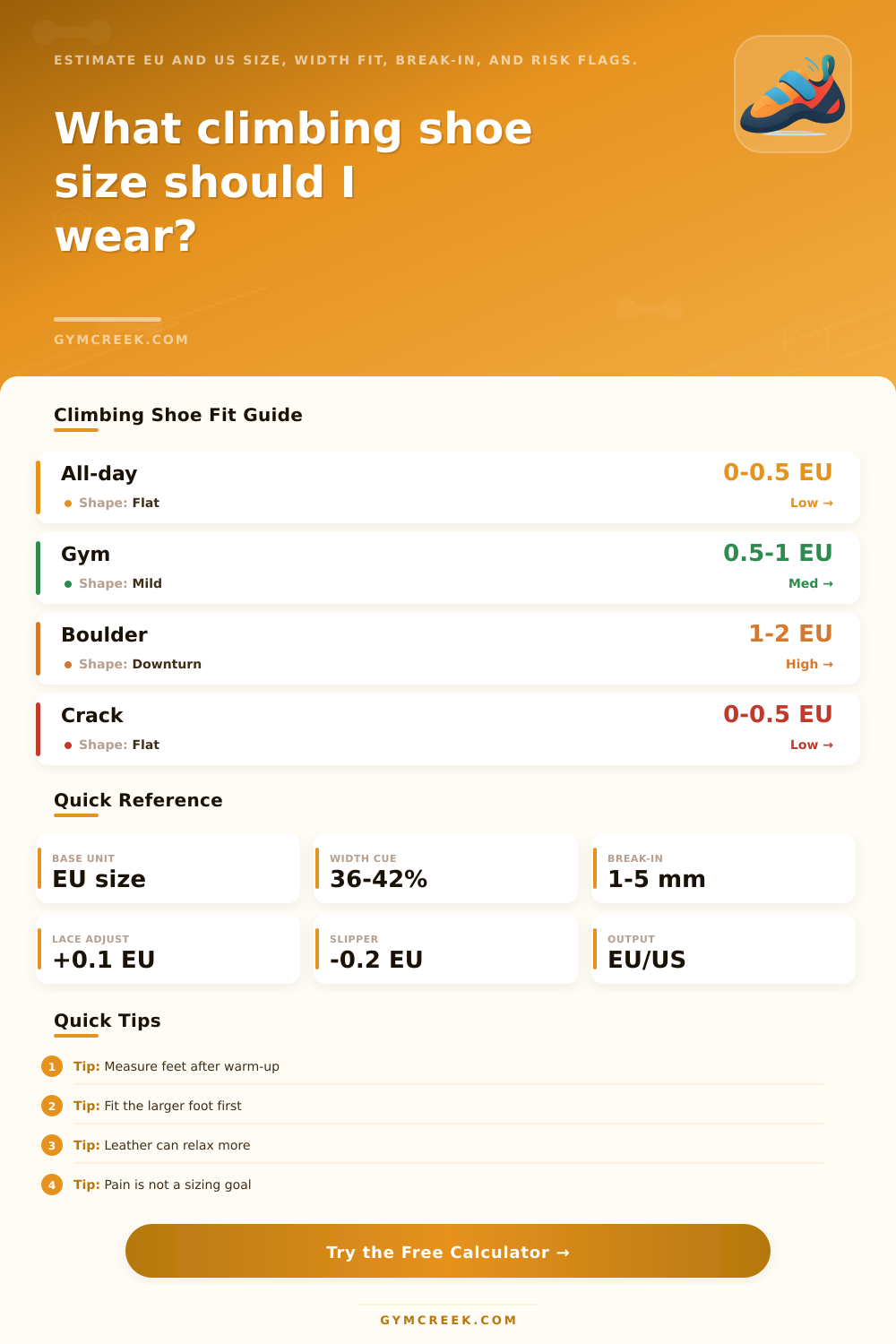
| Discipline | Base downsize | Fit aim | Watch point |
|---|---|---|---|
| Multipitch or trad | 0.0-0.4 EU | All-day comfort | Swelling and descents |
| Gym routes | 0.4-0.8 EU | Snug learning fit | Avoid curled pain |
| Sport climbing | 0.7-1.2 EU | Precise edging | Toe pressure |
| Bouldering or board | 1.0-1.8 EU | Power and hooks | Short-session fit |
| Width index | Profile | Last cue | Fit risk |
|---|---|---|---|
| Under 36.5% | Narrow | Low volume | Heel bagging |
| 36.5-38.5% | Slim | Lower volume | Strap gap |
| 38.5-40.5% | Average | Standard last | Low |
| 40.5-42.5% | Wide | Wider forefoot | Knuckle pressure |
| Over 42.5% | Very wide | High volume | Numbness risk |
| Closure | Adjustment | Break-in cue | Best use |
|---|---|---|---|
| Lace-up | +0.10 EU | Fine volume control | Trad, cracks, varied feet |
| Velcro | 0.00 EU | Moderate adjustment | Gym and sport climbing |
| Slipper | -0.20 EU | Elastic loosens fastest | Bouldering and board |
| Hybrid | +0.05 EU | Good heel control | Performance comfort blend |
| Step | Formula | Output | Purpose |
|---|---|---|---|
| Foot EU | length mm / 6.667 + 2 | EU size | Paris-point estimate |
| Baseline | 65% street + 35% foot | EU size | Balances measured and known fit |
| Downsize | discipline + shoe + comfort | EU sizes | Sets climbing tightness |
| Width index | width / length x 100 | percent | Flags forefoot volume match |
| Break-in | upper + closure + fit stress | mm | Estimates post-use relaxation |
💡Fit Tips
Finding an correct climbing shoe size is a different process from finding the correct size for your street shoes due to the different purposes for which climbing shoes and street shoes is made. A person cant use their street shoe size to calculate their climbing shoe size due to the need for climbing shoes to both transmit power to the rock and to smear against the rock faces. Furthermore, a person must understand the relationship between there foot and climbing shoes to ensure that their climbing shoes fits correctly to there feet.
For example, the shoe should be tight enough to ensure that their toe remain engaged with the climbing shoe but not so tight as to reduce the circulation of blood to their foot while wearing the shoes. One of the factor that must be considered when determining the size of climbing shoes that will best fit a person’s foot is the shape of their foot. For instance, two feet of the same length may require different size of climbing shoes due to the shape of the foot.
How to Find the Right Climbing Shoe Size
Many people have wide feet in comparison to the rest of their foot, or may have a narrow heel. The climbing shoe calculator that use an individual’s measurements to determine the size of climbing shoes that will best fit their foot account for these issue. Additionally, another factor in the calculation of the correct size is the type of climbing that an individual perform as an aggressive climbing shoe has a different fit to a shoe that is used for bouldering activities.
The material from which the climbing shoes are made will also affect how the shoes fits the individual’s feet over time. For instance, climbing shoes whose uppers is made of leather will gradually loosen and stretch as the individual puts weight on those shoes. However, shoes whose uppers are made of synthetic materials will not relax in the same way.
Thus, an individual can use the climbing shoe calculator to estimate how much the material will stretch so that they can decide if they prefer their shoes to be tight with their feet now or to allow for more room in the climbing shoes later. The shape of the climbing shoe will also affect the size that the climber should order. For instance, if the shoe feature a flat last, the shoe will be able to better tolerate downsizing of the shoe as compared to a downturned last that will create more compression against the foot.
Thus, downsizing a downturned last shoe will create more pressure against the feet than downsizing a shoe that features a flat last. The climbing shoe calculator account for these different features in the shoes as it does not treat all climbing shoes the same. The calculator also accounts for the comfort that the individual can tolerate in their shoes as an individual that is training for short effort will have different comfort needs than an individual that is to climb eight pitches of rock.
Another factor of importance in the determination of shoe size is the width and volume of the climbing shoes. An individual that has a wide foot will not comfortabley wear a low-volume climbing shoe. Likewise, an individual that has a narrow foot may experience discomfort in high-volume climbing shoes due to the dead space within the shoe.
The climbing shoe calculator help ensure that these mismatches do not occur based off the use of a width index to calculate the size of climbing shoes that will best accommodate the feet of the wearer. It is also important to consider the differences between the size of the left and right foot of an individual. Most individuals have one foot that is longer than the other foot.
Thus, an individual should use the length of their larger foot when determining the size of their climbing shoes. Furthermore, the climbing shoe calculator allow for the asymmetry between the two feet to be accounted for. Thus, the individual should not average the length of their feet as this could lead to ordering shoes that dont fit either their left or right foot.
Common mistake when purchasing climbing shoes include purchasing shoes of the same size as the runners shoes that the individual owns as the climbing shoes will feel larger once the last and downsizing of the shoes are considered. Additionally, another common mistake is to purchase shoes with more downsizing than other climbers of similar strength. Downsizing of shoes to such an extent can reduce the circulation of blood to the feet and cause an individual to fatigue more quickly during their climbs.
Thus, an individual should of used the calculator to determine the size of climbing shoes that will best fit their feet but should also try on the shoes to ensure that they feel correct for their individual feet.