Climbing Power Calculator
Estimate average watts, watts per kilogram, work per rep, anaerobic power score, and session power load from climbing movement details.
📌Climbing Presets
Each preset loads a realistic climbing power profile using body mass, carried load, vertical rise, rep time, reps, wall angle, grade pressure, and rest density.
⚙Calculator
Climbing power snapshot
Enter movement details to estimate climbing power and session load.
📊Metrics Grid
📑Reference Tables
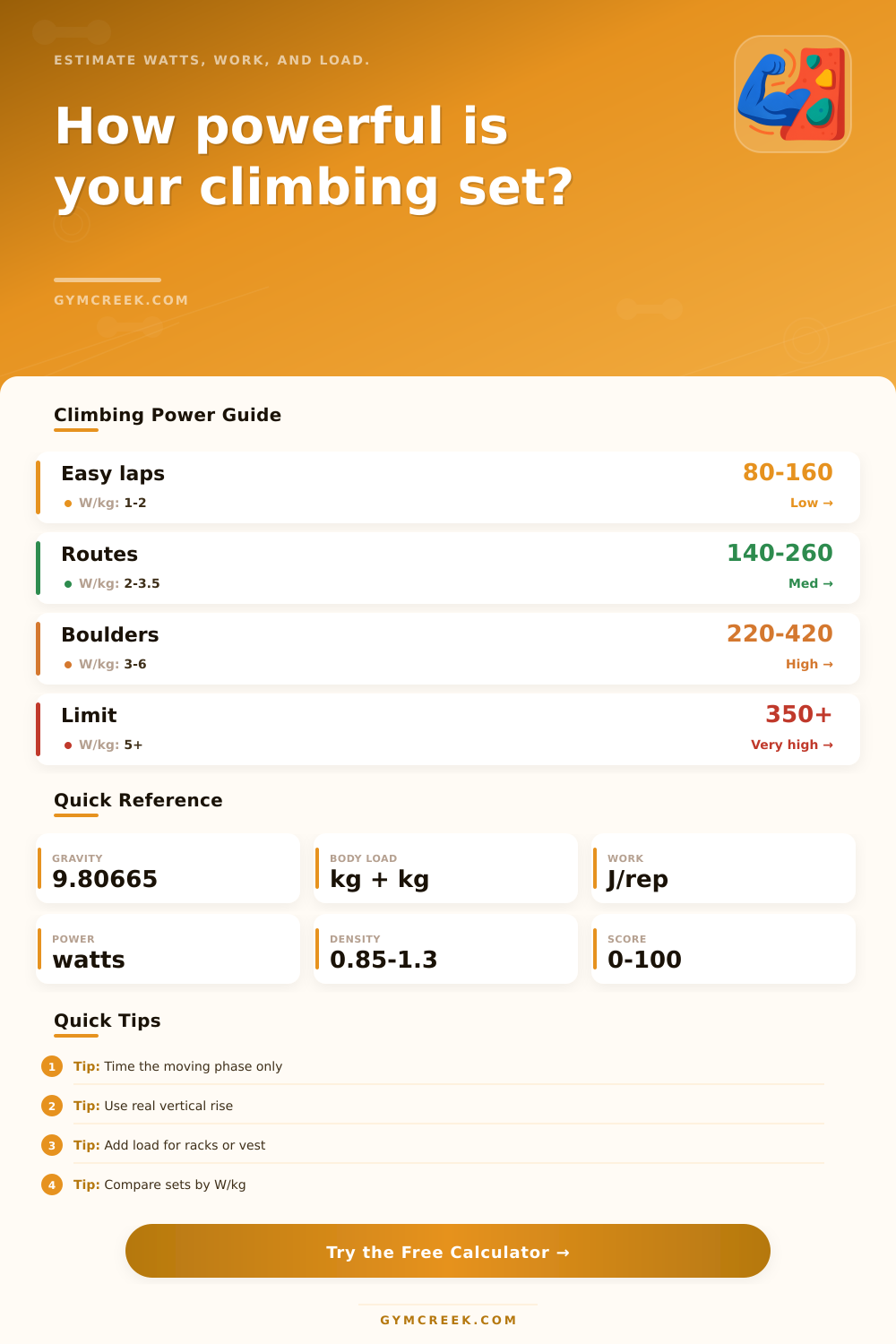
| Power band | Watts/kg | Typical set | Training cue |
|---|---|---|---|
| Low | <2.0 | Easy movement | Technique or recovery |
| Moderate | 2.0-3.5 | Route intervals | Repeatable power |
| High | 3.5-5.5 | Hard boulders | Longer rests help |
| Very high | 5.5+ | Limit or speed | Quality drops fast |
| Angle | Power factor | Demand | Use when |
|---|---|---|---|
| Slab | 0.90 | Feet and balance | Less pulling load |
| Vertical | 1.00 | Baseline climbing | Most wall movement |
| Mild overhang | 1.08 | Core and pulling | Sustained sport |
| Steep overhang | 1.18 | High tension | Board climbing |
| Roof | 1.30 | Very high tension | Caves and links |
| Formula | Calculation | Output | Purpose |
|---|---|---|---|
| Work per rep | mass x gravity x rise | joules | Vertical mechanical work |
| Watts | work / seconds | W | Average movement power |
| Watts/kg | watts / body kg | W/kg | Body-size comparison |
| Anaerobic score | W/kg, grade, density | 0-100 | Hard-power stress |
| Session load | kJ x intensity x density | points | Total set demand |
| Rest density | Multiplier | Pattern | Watch item |
|---|---|---|---|
| Long rests | 0.85 | Project style | Peak quality |
| Balanced | 1.00 | Normal session | Repeatability |
| Dense | 1.16 | Circuits | Pump and fade |
| Competition | 1.30 | Timed attempts | Fast recovery |
💡Tips
Climbing power refer to the amount of work that a climber is able to produce during a climbing session. The power that a climber produce during a session can be calculated using differents data about that climbing session. Many climbers notice that some individuals feel more fatigue than others after performing the same type of climbing session.
This difference in fatigue after the same type of climbing session is often due to the fact that those individuals produce different amount of climbing power. By using a climbing power calculator, an individual can measure the amount of climbing power that they have produced during their climbing session. This climbing power calculator use several data inputs to calculate the amount of power that the climber produced during that session.
How the Climbing Power Calculator Works
The climbing power calculator require the climber to input data regarding their body weight, the load that they added to their climbing session (such as a loaded harness), the vertical rise that they performed per move within the climbing session, and the amount of time that they spent climbing during that session. The calculator also has field for the angle of the wall that they climbed, the intensity of the climbing grade, the density of the rest periods during the climbing session, and the drift in fatigue during the session. The angle of the wall allow for calculations to take into account that steeper walls will produce more tension in the body than flatter walls.
The intensity of the climbing grade allow for observations of whether the individual was climbing close to their limit or performing climbing volume. The density of rest periods and fatigue drift allow the load score to be adjusted to reflect how the session felt to the individual. A climbing power calculator can allow individuals to easily compare the power of different climbing style.
For instance, the climbing power calculator can help to determine how the load that is added to the body when performing trad climbing will affect the total load score of an individual for that session, or how short rest between climbing attempts will affect the load that an individual produces during that session. Because power and fatigue are separate variables of climbing, it is possible for two individuals to exhibit the same amount of power on the same climbing problem, yet one individual will fatigue more then the other. By including factors like movement efficiency and grip factor in the power calculation, the power calculator can produce estimates of the metabolic work that an individual performed during their climbing session.
The climbing power calculator can help to provide insight to individuals about the reasons that they may have faded during their climbing session. In addition to calculating the power of an individual’s climbing session, the calculator also includes reference table that display the typical bands of power within different types of climbing sessions. For instance, three watt per kilogram is the power output that can be sustained for multiple climbing laps, while five watt per kilogram is the output that indicates high-quality climbing, though it requires longer periods of recovery between climbing efforts.
While these values are not rules for climbing performance, they do provide a way of removing guesswork from determining the performance of an individual’s climbing effort. After using a climbing power calculator regularly, individuals will begin to think of their climbing efforts in terms of work density. Work density is a calculation of the metabolic effort that is expended during each minute of climbing and resting.
Sessions that involve long period of rest will have lower load scores than sessions that involve high frequency of short rests to recover from climbing efforts. Thus, work density can allow individuals to more easy structure their climbing sessions for the outcome that they desire. While a climbing power calculator can take various factor into consideration, there are still variables regarding climbing that the calculator cannot measure.
Factors like skin condition, the temperature of the climbing area, the familiarity with the climbing problem, and the psychological pressure regarding climbing all have the potential to impact the power that an individual can generate during a session. However, the climbing power calculator does provide a consistent baseline of effort calculations for individuals. Thus, if an individual’s calculated power declines while other factors remain the same, they can be certain that some outside factor is impacting their climbing performance.
By using the climbing power calculator regularly, individuals can develop a better sense of the effort that they are expending during climbing efforts. This sense of effort will help to inform individuals of whether they should continue to climb or not for the day.