Climbing Grade Conversion Calculator
Convert route, boulder, trad, Ewbank, UIAA, French, YDS, and aid grades while adjusting for angle, style, length, and ascent expectations.
📌Presets
Presets load realistic grade systems and route factors, then recalculate the conversion and readiness estimates automatically.
⚙Calculator
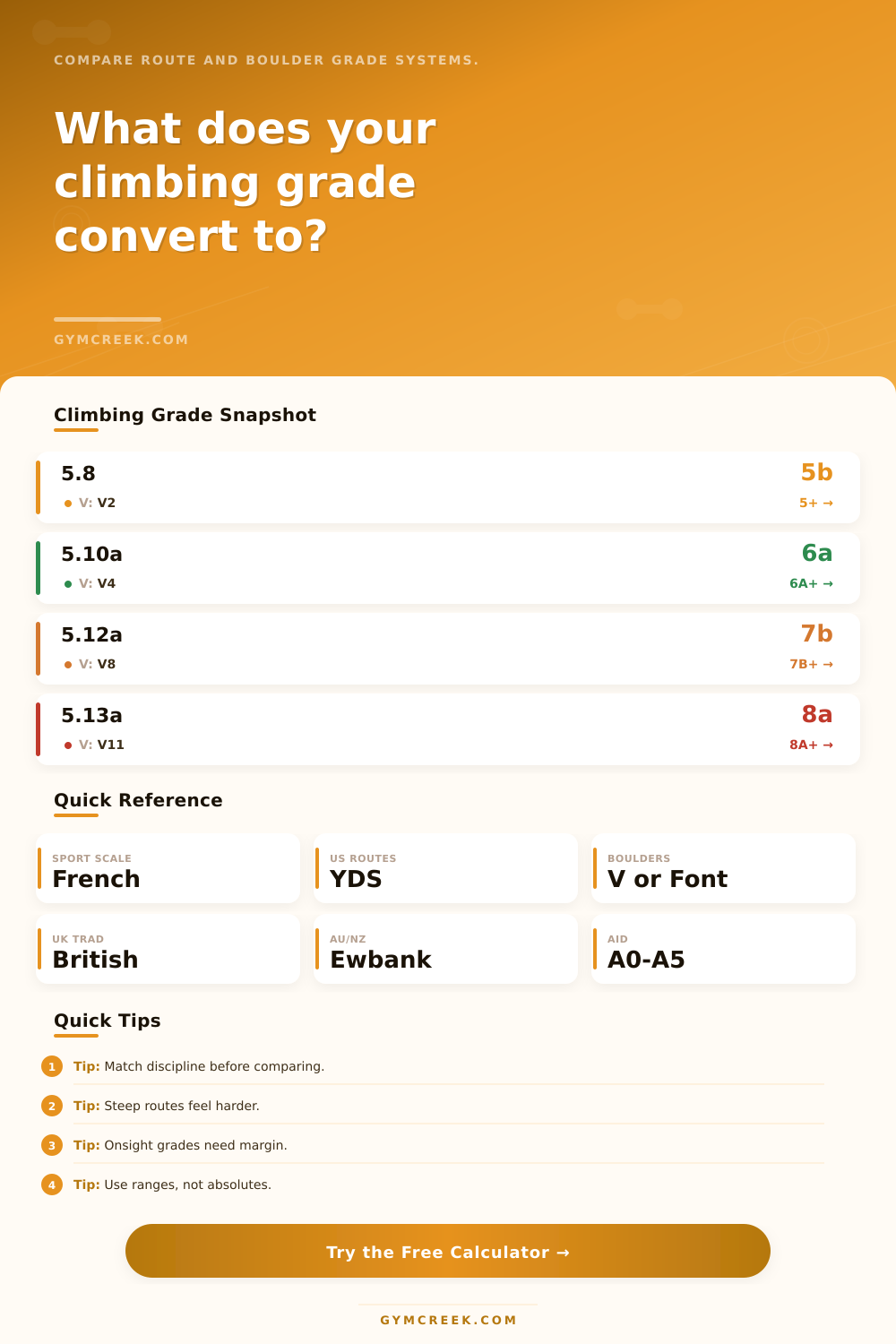
Grade conversion snapshot
Choose a grade and route profile to compare systems.
📊Climbing Metrics Comparison
📑Reference Tables
| YDS | French | UIAA | Ewbank |
|---|---|---|---|
| 5.7-5.8 | 5a-5b | V to V+ | 13-14 |
| 5.10a-5.10d | 6a-6b+ | VI to VII | 16-19 |
| 5.11a-5.11d | 6c-7a+ | VII+ to VIII+ | 20-23 |
| 5.12a-5.12d | 7b-7c+ | IX- to X- | 24-27 |
| 5.13a-5.13d | 8a-8b+ | X to XI | 28-31 |
| V-Scale | Font | Route Feel | Common Use |
|---|---|---|---|
| VB-V1 | 3-5 | Intro movement | Warmups |
| V2-V4 | 5+-6B | Intermediate | Gym circuits |
| V5-V7 | 6C-7A+ | Advanced | Power work |
| V8-V10 | 7B-7C+ | Hard project | Limit boulder |
| V11+ | 8A+ | Elite | Peak attempts |
| Factor | Low Load | Higher Load | Why It Matters |
|---|---|---|---|
| Angle | Slab | Roof | Power and core demand |
| Hold style | Jugs | Pockets | Finger stress changes |
| Length | Short boulder | Long pitch | Endurance rises |
| Protection | Top rope | Trad or alpine | Decision margin grows |
| Formula | Variables | Output | Use |
|---|---|---|---|
| Grade index | Scale + grade | Base level | Conversion |
| Adjusted score | Index + factors | 0-100 score | Session load |
| Readiness | Level gap + rest | Percent | Attempt planning |
| Endurance | Length + pitches | Load rating | Fatigue check |
💡Tips
At your home gym, you climb a solid route, feel strong on that same sequence, and then you visit a new gym or crag abroad, and grades seems different. Climbing isn’t a standardized sport with universal rules. Each area have created its own system of describing difficulty based off history and local rock quality. This leads to confusion as you try to translate these systems in your head. With the calculator, it can bridge that gap and convert from YDS, French, UIAA, V-scale, Font, British, Ewbank, and aid with an adjustment for style factors.
One of the key differences to understand is between bouldering and route climbing. Bouldering is all about raw power and short burst technical problem solving. Route climbing measure your endurance, technique, and overall strength across a longer sequence. Just because you can do V4 boulders doesn’t mean you’ll be able to handle 5.10a routes. Managing a route mean more than just being able to make an explosive move. It’s about having the ability to manage that energy over time. This is why we see those direct conversions are difficult in the reference table, although it do help show the equivalent for both forms. However, you will notice that you can’t take one grade from other and automatically assume it equates directly into the same experience.
How to Use the Climbing Grade Calculator
When using the tool, you need to select which type of discipline you want to use. This way it adjusts your final difficulty score based on how it understands the data. There are many variables beyond the starting grade. What’s the wall angle? Is it a vertical slab with big jugs or a steep overhang with tiny crimps? What is the dominant hold style? How they feel? The angle greatly impact the amount of power demanded as well as center of gravity. More tension in the core, more finger strength, and staying connected to the rock are all necessary when climbing steeper pitches. Users can enters the type of dominant hold and wall angle into the calculator, which adjusts final grade up or down based on how much the body has to do. This way, the number isn’t just a grade anymore, it’s a blend of those factors that reflect actual demands on the body. It gives us a clearer image of what the body needs to provide during that particular ascent.
The physical component of climbing… Specifically endurance, is huge on longer single pitch climbs and multipitches. Twenty minutes at 5.12 with no rest is much different than a handful of moves (five) at the same grade. Your arms burn and fatigue set in rapidly, making easier move feel difficult. The tool has a field for how many pitches the route takes and its total length to account for this endurance burden. The need for extra planning time due to exposure and gear placement on more adventurous climbs, such as alpine routes, also increases the effective grade. All these environmental factor contribute to mental and physical strain that a straight-up grade index doesn’t consider. Adding those makes the prediction closer to reality: Are you going to make it? Or will you hang at your belay rack?
Many climbers fail to consider another key factor: rest. Attempting a route fresh after two days of rest yields different results than trying it during your fourth session of the day. Your focus diminishes and glycogen stores empty out. To account for this, the calculator includes a question regarding rest status which adjust the readiness estimate. It tells you whether you should go for an onsight/flash attempt, or take some more time to rest up. Since you don’t remember the sequence or any advice from others who’ve done it before, you should of allow more buffer for onsights. This allows you to keep each session productive without burning out.
That understanding alters your perspective about learning new routes: rather than focusing so much on beating a specific number, you focus on the route itself, its style, and context. Rather than thinking about grades as rules, you begin to recognize them as guidelines. You work to match your conditioning with the appropriate challenge; either linking up a bunch of moderate pitches or grinding away at some hard boulder problems. And when you do that, your days outside are more successful. The rock will always speak the last word, but the tools help show the way.