Climbing Finger Strength Calculator
Estimate max hang strength, bodyweight percentage, per-finger load, edge-adjusted score, and training targets from added weight, assistance, grip type, edge size, and hang duration.
📌Finger Strength Presets
Presets load realistic hangboard tests with edge size, grip type, added or assisted load, hold time, and training purpose, then calculate immediately.
⚙Strength Test Inputs
Finger strength snapshot
Enter your edge, hang time, body weight, and load details to estimate climbing finger strength.
📊Finger Metrics Grid
📑Reference Tables
| Edge Size | Adjustment | Typical Use | Testing Note |
|---|---|---|---|
| 25 to 30 mm | 0.86x | Intro testing | Lower skin demand |
| 20 mm | 1.00x | Standard max hang | Good comparison edge |
| 15 to 18 mm | 1.12x | Advanced testing | More fingertip demand |
| 10 to 14 mm | 1.28x | Limit edge strength | Use short tests |
| Under 10 mm | 1.42x | Specialized testing | High tissue stress |
| Strength Tier | Edge Score | Bodyweight Load | Common Context |
|---|---|---|---|
| Foundation | Under 95 | Under 100% | Assisted hangs |
| Developing | 95 to 115 | 100 to 115% | Beginner strength |
| Solid | 115 to 140 | 115 to 135% | V3 to V5 range |
| Strong | 140 to 170 | 135 to 160% | V6 to V8 range |
| Elite | 170 plus | 160% plus | High-level climber |
| Training Goal | Target Intensity | Hang Pattern | Rest Style |
|---|---|---|---|
| Return to loading | 45 to 60% | Easy 10 sec holds | Short-moderate |
| Repeaters | 65 to 80% | 6 reps per set | Brief intra-set |
| Density hangs | 70 to 82% | 20 to 30 sec holds | Moderate |
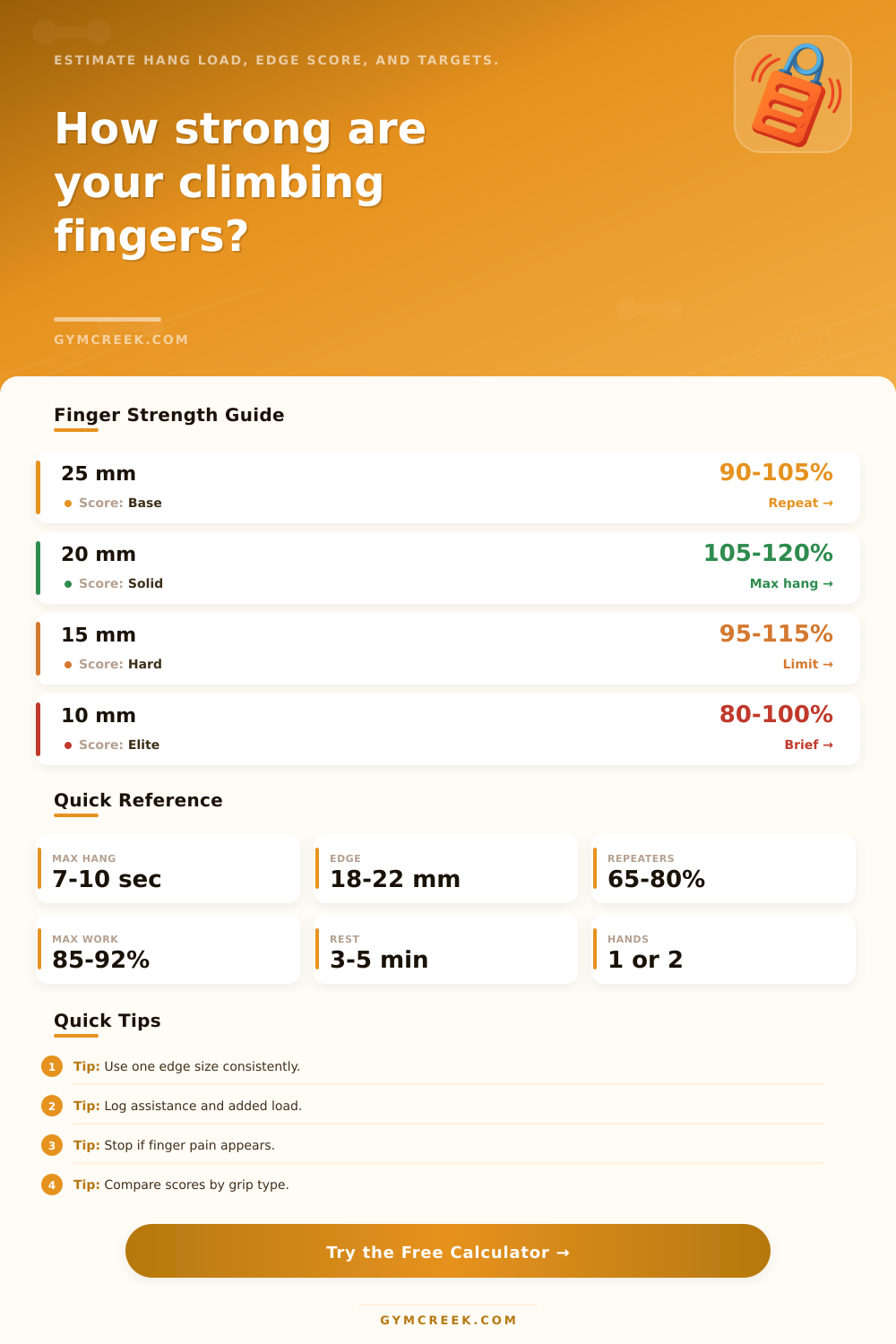
| Max strength | 85 to 92% | 7 to 10 sec holds | 3 to 5 min |
| Maintenance | 75 to 85% | Low volume | Full recovery |
| Formula | Variables | Use | Output |
|---|---|---|---|
| System load | BW + added - assist | Max hang load | Total force |
| BW ratio | System / BW | Bodyweight comparison | Percent |
| Finger load | Hand load / fingers | Digit stress | Load each |
| Edge score | Ratio x edge x time | Normalize tests | Points |
| Load volume | Load x sec x reps | Session stress | Load-sec |
💡Tips
If you struggle on an otherwise easy move and your sending a project, it all boils down to fingers. No matter how strong your forearms are, if you lack the ability to hold onto a tiny little piece with your pulley systems, you’ll stay grounded below the V2 crag no matter how many pull-ups you perform weekly.
But what’s the issue? How do you measure finger strength exactley? It’s hard to tell without some sort of standardization, which is where hangboarding standardizes your test results so that you’re able to see improvement over time. After plugging in your body weight, added load, and edge size, the calculator does the math for you.
How to Measure Your Finger Strength
It eliminates need to convert pounds into kilograms or compare a fifteen millimeter hold to a twenty millimeter hold. After all the raw variables is entered in, it spits out an edge-adjusted score and a bodyweight ratio. The bodyweight ratio is important because it helps you compare your performances with different grip types and edges. If you hang on a big slab hold easly, that’s cool, but doesn’t tell you anything about your limit strength on steep terrain. Normalizing allows you to compare performance without worrying about variable of holds.
The math in it works by understanding the input, not the output. That’s why we start with your current bodyweight as a base. Then you add in assistance or remove it if you are taking weight off your system, it makes a massive difference to the calculation. I see so many climbers make the mistake of thinking they’re stronger then they are. They assume that all that matters is how much weight they have on their system. In fact, they haven’t accounted for how much help they have! That’s why the calculator includes this question about amount of help you’ve taken off. Without this, you might be comparing yourself to someone who has help while you don’t (apples and oranges!).
Remember: you can use the calculator multiple times to work out how your strength compares across different edges and grips. The other important variable that tends to be ignored is edge size. Most testing protocols take twenty millimeters as their default starting point, which provides enough edge for good skin health while still providing adequate demand on the flexor digitorum profundus. Larger edges decreases the mechanical disadvantage of your fingertips; smaller ones increase it. You have the option to set the edge size that best fits your situation and the system will multiply it accordingly.
For example if you test on a ten millimeter edge, it knows this is more mechanically difficult than a twenty millimeter edge so it will reflect this in your score. So when you try a new hold with a smaller edge you won’t get discouraged and think your relative strength has regressed even though it’s really improved.
Intensity means focusing on goals instead of ego. The calculator can also help identify whether you’re suited for max strength work or repeater hangs based on your load. Are you closer to 100% of body weight on your max hang? You might be better off sticking to repeater protocols and going easy enough that you don’t push yourself to failure on every single set.
Training too hard too frequently causes pulley inflammation, something that takes months to recover from fully. Slow and steady wins the race. Patience pays off far more then aggressively loading up. Hangs also require something essential: rest in between. Long rest between short hangs = peak strength; short rests = endurance building. By considering your planned rest/reps/sets, the tool can give meaning to those variables.
For example, if you’re planning to do some density hangs with little or no rest, the tool alerts you that despite moderate felt effort, this could lead to a large volume of load over the week. You should of avoid overtraining before you even get on the wall. Yes, please. Pain is not a good thing. Finger pain is no badge of honor; it’s an indicator that you’ve gone beyond the breaking points of your finger connective tissue. While the reference tables provided with the tool shows what’s within safe range for each strength tier, there is no way to factor your individual injury history into those numbers.
Consider them guidance, not commandments. If your fingers hurt or are sore at the end of a training session, reduce the load or extend the rest period. Long-term consistency trumps short-term intensity. It’s all about pushing limits while minimizing risk. And knowing your numbers allows you to do that without guesswork.
Tracking your bodyweight ratios and edge scores over time gives you an idea of actual progression instead of hoping you’re feeling stronger. Take a base-line test, make detailed notes on the conditions, and then do it again once you’ve had plenty of recovery time. Even though your fingers might ache through the hang session, they’ll thank you for the precision.