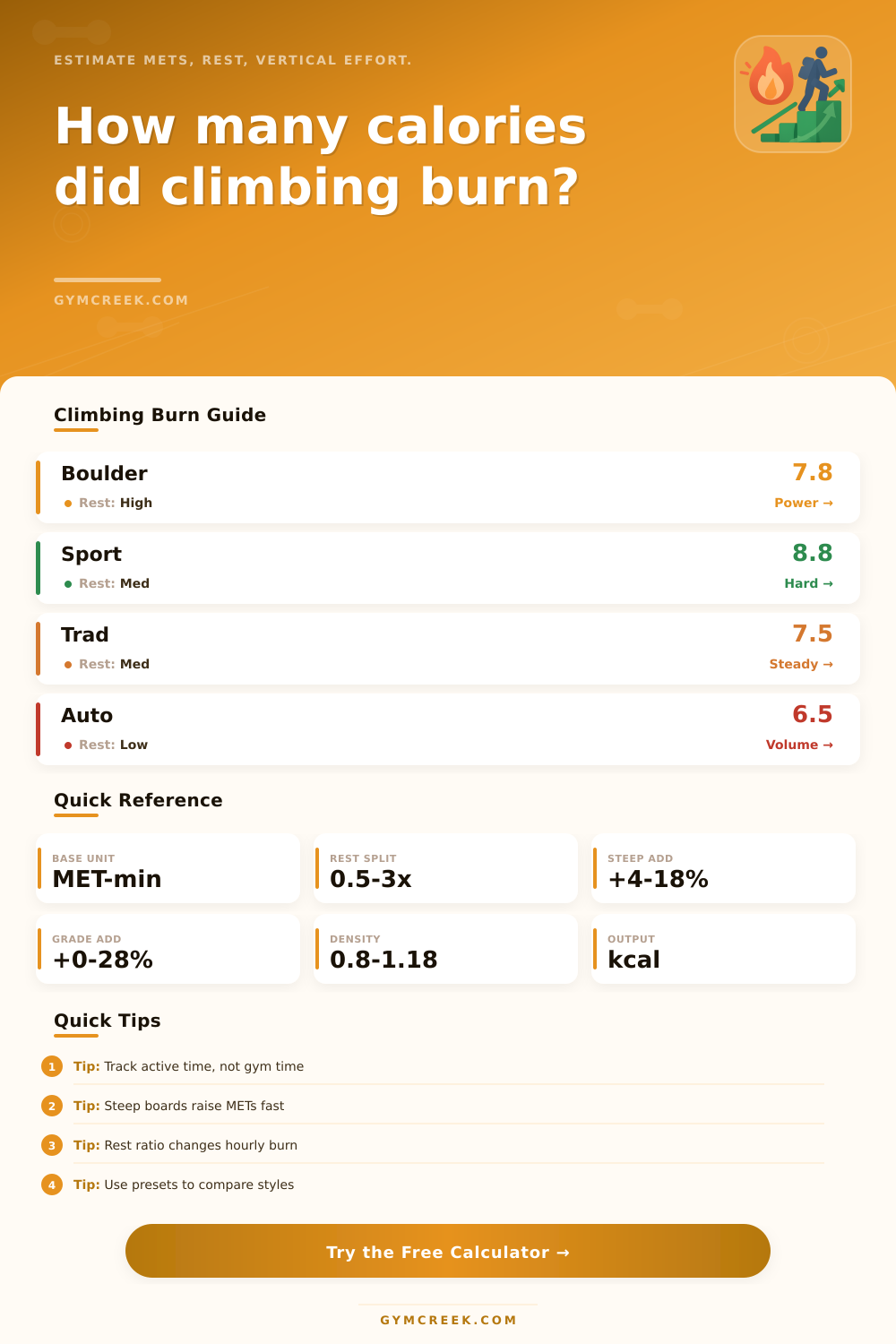
Climbing Calories Burned Calculator
Estimate climbing calories from body weight, discipline, wall angle, grade intensity, active minutes, rest ratio, belay or approach time, and session density.
📌Climbing Presets
Each preset loads a real climbing session pattern with style, angle, grade pressure, density, active climbing, resting, and non-climbing time.
⚙Calculator
Climbing calorie snapshot
Enter the session details to estimate total calories, hourly burn, and training load.
📊Metrics Grid
📑Reference Tables
| Discipline | Base MET | Best fit | Model note |
|---|---|---|---|
| Bouldering | 7.8 | Problems and attempts | Powerful, stop-start work |
| Training board | 8.6 | Spray wall or board | High tension per minute |
| Sport climbing | 8.8 | Lead or hard routes | Longer active burns |
| Trad climbing | 7.5 | Gear routes | Steady plus transitions |
| Top-rope | 6.8 | Gym routes | Moderate route effort |
| Auto-belay | 6.5 | Repeating laps | Volume with short rests |
| Speed climbing | 10.2 | Timed laps | Very dense short work |
| Alpine climbing | 7.2 | Multipitch days | Mixed climbing and movement |
| Wall angle | Multiplier | Typical demand | Use when |
|---|---|---|---|
| Slab | 0.90 | Footwork and balance | Less pulling per minute |
| Vertical | 1.00 | Baseline route climbing | Most gym walls |
| Mild overhang | 1.06 | More core and pulling | Steeper sport routes |
| Steep overhang | 1.14 | High forearm load | Board or cave sections |
| Roof | 1.20 | Very high tension | Horizontal movement |
| Grade intensity | Multiplier | Session cue | Fatigue signal |
|---|---|---|---|
| Warm-up | 0.88 | Easy mileage | Breathing controlled |
| Moderate | 1.00 | Onsight level | Steady pump |
| Hard | 1.12 | Redpoint work | Repeated failure risk |
| Limit | 1.24 | Max boulders | Long rests needed |
| Competition | 1.30 | High pressure burns | Dense hard attempts |
| Formula | Calculation | Output | Why it matters |
|---|---|---|---|
| MET calories | MET x 3.5 x kg / 200 x min | kcal | Standard exercise estimate |
| Rest split | Active min x rest ratio | minutes | Separates work from waiting |
| Vertical work | kg x 9.80665 x meters / efficiency | kcal | Checks upward movement cost |
| Hourly burn | Total kcal / session hours | kcal/h | Compares different sessions |
| Training load | MET-min weighted by phase | points | Tracks session stress |
| Session type | Rest ratio | Density | Expected pattern |
|---|---|---|---|
| Volume laps | 0.5-1.2 | High | Lower peaks, high hourly burn |
| Route climbing | 1.2-2.5 | Balanced | Moderate burn and load |
| Projecting | 2.5-5.0 | Low | High active MET, lower hourly burn |
| Limit boulders | 3.0-6.0 | Low | Power stress with long rests |
💡Tips
Climbing typically burns energies in irregular patterns and does not include any continuous level of effort. Climbing can include periods of high intensity require to perform climbs on overhang section of rock walls, but also includes periods of low intensity when standing on the mat at the gym or waiting for another individual to climb the wall. Because climbing does not include continuous levels of effort, it isnt possible to apply a general multiplier to the caloric expenditure that can be calculated for climbing.
Many individuals measure the length of their climbing session in the total length of time that they spent at the gym or at the crag. The total length of time at the gym, however, also includes periods when they are not climbing, such as when they are chatting with others at the gym, tying they shoes, or walking from one climbing problem to the next. While these periods also require the expenditure of energy, the body burn less energy during these periods than while it is actively climbing.
How to Calculate Calories Burned While Rock Climbing
Therefore, it is necessary to separate the length of time that an individual spent actively climbing from the total length of time that they spent at the gym. Body weight will impact the amount of energies that an individual burns while rock climbing. An individual that weighs more than another individual will burn more energy during the same type of climbing move as the individual that weighs less.
Additionally, an individual may rest for longer periods between climbing attempts. The online calculator will handle the math for you if you enter your weight and other details about your climbing session. Although height and age are not directly related to the calories that are burned rock climbing, they are included in the form to calculate an individual’s basic metabolic rate.
Calculating an individual’s basic metabolic rate allow for the determination of what portion of the individual’s daily energy expenditure is associated with their climbing session. The type of rock climbing that is performed can impact the base intensity of the climbing session. For instance, bouldering session typically include periods of high intensity without climbing rests, but also long periods of rest.
Sport climbing sessions may include continuous periods of climbing over longer periods of time. Auto-belay climbing sessions may include high volumes of climbing session with shorter periods of rest between climbing attempts. These factor will impact the intensity of the session and are accounted for in the tool.
Additionally, the angle and grade of the climbing session will also impact the intensity of the session. Steeper climbing walls and more intense climbs will require more energy from the climber’s forearms than easier, gentle walls. The rest ratio that is entered into the calculator is another factor that many individuals are unaware of.
A rest ratio of 1.8 indicates that the climber will rest for nearly two minute for every one minute that they spend climbing. The ratio will impact the number of calories that the climber burns during the session. For instance, a session with a ratio of 1.8 will have a different rate of calories that are burned per hour than a session with little rest between climbing attempts.
The amount of time that an individual rests while rock climbing still burns some of the bodys energy; whether climbing or resting in position after completing a climbing attempt. However, the online climbing calorie calculator will separate climbing from resting periods so that the energy burned during each period is accounted for in the total estimate of the energy that are burned during the session. An additional factor that may impact the energy that an individual burns while rock climbing is the amount of vertical effort that is required of that individual.
The amount of energy that is burned while climbing up the wall is different from the amount of energy that is burned while performing standing positions on the rock wall. The online calculator will estimate the amount of energy that is burned through the climb by taking into account the height of each climb and the rate at which an individual can perform those climbs. Such an estimate will be included in the tool’s training load number.
The training load number is especially useful for determining the amount of energy that is burned by comparing climbing sessions of vary intensity. An individual’s conditioning may impact the amount of energy that is burned while rock climbing. An individual that is well adapted to rock climbing will require less energy to perform the same moves as an individual with low levels of conditioning.
An individual who may feel “pumped” after performing a challenging route for a novice climber may only require moderate effort from an individual who climb regularly. Common mistakes when estimating the energy expended during rock climbing is to treat the total length of time that an individual spent at the gym as the length of time during which they burned energy. Treating total gym time as work time will result in both overestimations of the energy burned during sessions with long periods of rest between climbing attempts, as well as underestimations of the energy burned during high volume, auto-belay climbing sessions.
Additionally, another common mistake is to ignore the energy that must be expended for the individual to move their body while rock climbing, such as the energy required to move a body of 150 lbs. In a pack that weighs 30 lbs. During a hike.
The reference tables that are included on the page indicate the MET values for different types of rock climbing disciplines. These tables also include factors that account for the angle and intensity of the climbs, as well as the rest patterns that are common during volume climbing days or projecting climbing days. By using the online tool regularly, an individual may begin to notice patterns within their climbing session.
For instance, limit bouldering days may burn a large amount of energy, but the total calories may be moderate. Volume days may exhibit the opposite pattern. Recognizing these differences in energy expenditure can aid in the management of the climber’s physical recovery after climbing sessions, or even in achieving a certain goal in rock climbing.
Additionally, these number will become more useful for individual climbers when the numbers can be associated with the sensation of each climbing session and the goal that is to be accomplish during that session. The overall value of this tool can be realized by comparing the calories that are burned during two different climbing sessions. Although two climbing sessions may appear to be similar according to the calculations that are performed with the online tool, the sensation of those sessions may be different.
Therefore, paying attention to the specifics of each climbing session will allow climbers of all levels to use the tool’s estimated calorie burn values to obtain information that can be used during those climbs.