Circuit Training Time Calculator
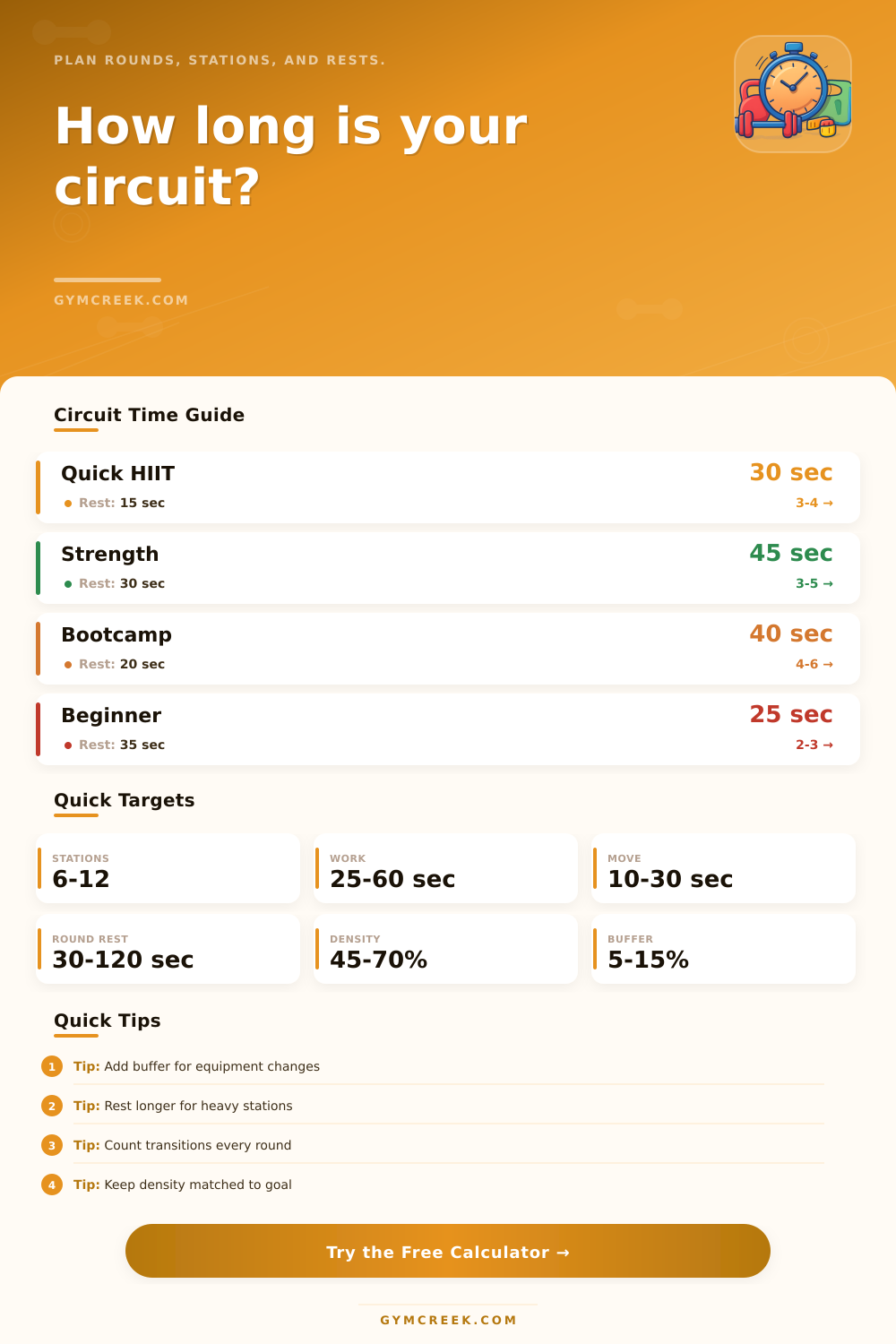
Plan the full clock for a circuit session by combining stations, work intervals, transitions, round rests, warm-up, cooldown, group size, and scheduling buffer.
◎Presets
Presets load realistic circuit formats, demographics, class sizes, and buffer choices so you can compare a short workout, group class, or performance block quickly.
⚙Calculator
Circuit time snapshot
Enter stations, intervals, rounds, and rests to calculate total session time.
▦Fitness Metrics Grid
▣Reference Tables
| Format | Work interval | Transition | Best use |
|---|---|---|---|
| Beginner circuit | 20 to 35 seconds | 25 to 45 seconds | Technique practice, low pressure, and learning stations |
| General fitness | 35 to 50 seconds | 15 to 30 seconds | Balanced class planning and mixed strength-cardio work |
| Strength density | 45 to 90 seconds | 20 to 45 seconds | Heavier stations where setup and bracing matter |
| Conditioning HIIT | 20 to 45 seconds | 10 to 20 seconds | Higher heart-rate blocks with simpler movements |
| Team training | 30 to 60 seconds | 20 to 40 seconds | Larger groups, partner flow, and equipment rotation |
| Work density | How it feels | Round rest cue | Programming note |
|---|---|---|---|
| Under 40% | Technique or recovery focused | Longer rests are expected | Useful for beginners or skill practice |
| 40% to 55% | Moderate and sustainable | 30 to 90 seconds | Works well for mixed circuits |
| 55% to 70% | Challenging conditioning | 45 to 120 seconds | Keep exercises simple and safe under fatigue |
| 70% plus | Very dense and demanding | Short rests or low transitions | Best for short blocks, not every session |
| Scenario | Likely time driver | What to adjust | Planning cue |
|---|---|---|---|
| Small group personal training | Coaching explanations | Add setup minutes | Keep buffer at 8% to 12% |
| Large bootcamp | Station traffic | Increase transition time | Demo stations before the clock starts |
| Heavy strength circuit | Equipment changes | Raise transition and round rest | Density can stay lower and still be productive |
| Lunch express class | Warm-up and cooldown limits | Reduce stations or rounds | Protect at least a short cooldown |
| Team conditioning | Group rotation logistics | Use more buffer | Keep stations easy to identify |
| Output | Formula | Inputs used | Purpose |
|---|---|---|---|
| Round time | Stations x (work + transition) | Stations, work seconds, transition seconds | Shows one pass through the circuit |
| Work time | Stations x work x rounds | Stations, work seconds, rounds | Measures the active training portion |
| Total time | Warm-up + setup + rounds + rests + buffer | All timing fields and group size | Builds the real session clock |
| Density | Active work / total time | Work time and total time | Compares training pressure across formats |
| Calories | MET x 3.5 x kg / 200 x minutes | Body mass, MET, total moving minutes | Provides optional energy context |
◇Tips
Training by the clock is honest. If the math doesn’t work out, it’s the clock that matters; not your fatigue level, nor how many sets you’d planned on completing. What appears brief on paper might become a marathon when you fail to account for the hidden cost of moving and pausing. Counting reps isn’t enough to plan a workout. You must also know density: the relationship between active work and total elapsed time.
By letting the calculator do the rest time math, you’re free to concentrate on the flow of training, not its logistics. In reality, most novices calculate their work but not the transitions in between. They’ll determine they want eight stations, with each station lasting forty seconds, and then easily multiply that out to figure how long the entire session should last.
Plan Your Workout Time Well
But that doesn’t work, as it ignores transition time: It costs something to go from one station to the next. Maybe you have to set down a kettlebell, walk three feet over to some resistance bands, pick those up, and mentally shift focus to the new exercise. Give yourself twenty seconds to do that at each station, and that little gap adds up fast. Over four rounds, you’re wasting more than five minutes, all while barely doing any work.
The tool acknowledges this by allowing you to enter separate values for work seconds versus transition seconds. This difference shows whether you are really doing a high-intensity interval workout or simply walking slowly from exercise to exercise. Density makes all the difference in the world. You can do a circuit where you spend 45 percent of the total time actually working and be able to maintain decent technique while fatigued. When you start hovering around 70 percent, you will likely notice that technique starts to suffer. You can only go so long before pure exhaustion causes breakdowns in form.
To put those numbers into perspective, look at chart on the page. What you’ll find is that lower density isn’t inherently “bad.” In fact, it might be perfect if you’re trying to introduce someone to a new skill or you’re working with a mixed-level group that contains some beginners. Simple is high. When you want the intensity to be high, make sure that you’re keeping moves simple. You won’t be able to safely complete complex Olympic lifts with your lungs on fire and your heart racing.
The other limiting factor is time allowed for rest between each round. After the 2nd round, 60-seconds seems like an eternity… until round 4 when it doesn’t seem like enough. Rest periods serve as a governor for intensity, and it’s here where you can anticipate how your body will feel at the end of the round. For a strength focus, more rest gives the nervous system time to come back online. For a cardiovascular stimulus, less rest allow the heart rate to stay elevated.
There isn’t one right way to do this. It’s all relative to what you’re trying to achieve. Depending on whether you want a strength circuit vs a HIIT-style circuit, there are starting points through presets built into the tool. They aren’t laws; they simply represent what coaches with experience tend to program.
Don’t forget to include buffer time. Workouts happen in real life. There’s someone who needed water, dropped a weight, etc. Give cues. Correct form. Add 10% buffer to your calculated time. Why? It’s just good practice. Because you’re worried about being on time to teach the next class, you might end up rushing the cooldown. Rushing through the cooldown defeats part of the recovery benefits of this workout. Spend the time to lower that heart rate accordingly.
The briefing and warm-up are included in the fields. This makes the final calculated time reflect what happened in reality versus ideal conditions. No more decision fatigue during your workout. Walk into your workout area (whether at home or at the gym) and you have an idea of what to do and for how long. And the beauty is this tool allows you to draw out that map clearly. It takes those fuzzy goals (like get fit) and turns them into concrete actions (like I’m doing four rounds of eight stations with 40 second work intervals). This clarity is very powerful. It replaces worry about performance with confidence in our preparedness.
Begin with adjusting your inputs, based off your goals and current fitness level. Is the overall duration too much? Shorten the transition times, or do fewer rounds. Is it too little? Make the work interval longer, or make the rest period shorter. Output will give you instant feedback. Test various scenarios in a matter of seconds to determine what fits your schedule and body. What’s the sweet spot between challenge and sustainability?
At its core, this all comes down to time. Training time is precious, and every second you waste waiting for equipment or wondering what to do next is a second taken away from progress. Breaking it all down helps account for everything that goes into a session and ensures your efforts are directly translating to results. It takes the guessing game out of things so you can focus on doing what’s important.
Do the work. Honor the rest. Believe in the process. If you put your time in. The clock will let you know.