Chicken Breast Protein Calculator
Estimate chicken breast protein, calories, raw-to-cooked yield, servings, protein density, and goal coverage from your exact portion and cooking state.
📌Chicken Presets
Presets switch between raw and cooked logging, so you can compare kitchen scale weight, cooked yield, and protein goal coverage without guessing.
⚙Calculator Inputs
Chicken breast protein snapshot
Enter chicken weight, cooking state, servings, and goal data to estimate your protein.
📊Chicken Protein Metrics
📑Reference Tables
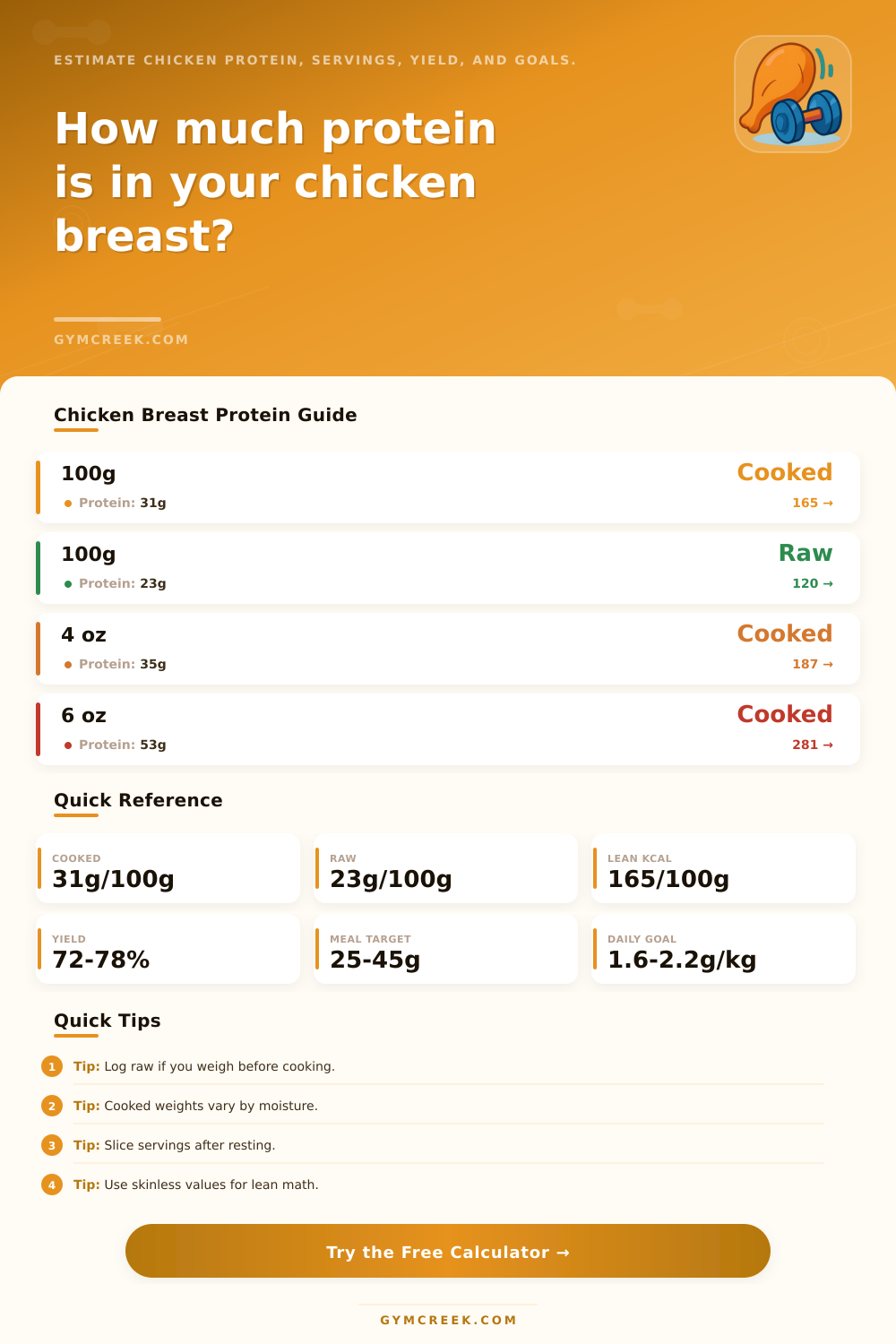
| Chicken Entry | Protein Per 100 g | Calories Per 100 g | Best Use |
|---|---|---|---|
| Cooked boneless breast | 31 g | 165 kcal | Meal logging after cooking |
| Raw boneless breast | 23 g | 120 kcal | Batch logging before cooking |
| Chicken tenderloin | 30 g | 155 kcal | Lean portions and strips |
| Skin-on breast meat | 29 g | 190 kcal | Higher-fat entries |
| Canned drained breast | 27 g | 140 kcal | Quick pantry servings |
| Cooking Method | Typical Yield | Protein Change | Calculator Handling |
|---|---|---|---|
| Grilled or pan seared | 74% | Concentrates per gram | Standard cooked density |
| Baked | 76% | Moderate moisture loss | Slightly higher yield |
| Poached or boiled | 82% | Less drying | Higher cooked weight |
| Air fried | 72% | More moisture loss | Lower cooked weight |
| Slow cooked shredded | 78% | Mixed retained liquid | Batch-friendly average |
| Goal Context | Protein Target | Chicken Portion | What It Means |
|---|---|---|---|
| General fitness | 1.2 g/kg | 100-140 g cooked | Basic daily coverage |
| Lean muscle | 1.6 g/kg | 130-180 g cooked | Common lifting target |
| Cutting phase | 2.0 g/kg | 160-220 g cooked | Higher satiety target |
| High training | 2.2 g/kg | 180-240 g cooked | Athlete-level intake |
| Formula | Variables | When To Use | Output |
|---|---|---|---|
| Cooked protein | Cooked g x density | Weighed after cooking | Total protein |
| Raw equivalent | Cooked g / yield | Compare raw batch logs | Raw grams |
| Cooked yield | Raw g x yield | Weighed before cooking | Cooked grams |
| Goal coverage | Protein / target | Meal planning | Percent of goal |
💡Tips
Perhaps you’ve had some raw chicken on hand and asked yourself: Is it too high in calories? How much protein is there? The problem arises because the numbers you see on the packaging aren’t necessarily the same as the ones you’ll get at the table. When you cook something like chicken, it lose water, fat, and sometimes dignity, leaving it shrunk relative to its original size.
Your usual habits for keeping track don’t work anymore. After all, the number you read on the package isn’t how much you’re eating, right? It’s cooked. Enter in how much you cooked and how much it weighs, then let the calculator do the math and find out whether that 150-gram meal is really 200-grams of raw chicken (or less!).
Why Cooked Chicken Weights Are Different
There is one catch: the ratio between protein density and water retention. When you weigh chicken raw (for example), you’re weighing it with all of its own moisture. This moisture will boil off during the cooking process and contribute nothing nutritionally to the chicken’s ability to repair muscle. What happens when heat boils away the water? It concentrates whatever’s left behind.
In other words, 100 grams of cooked chicken has a heckuva lot more protein in it then 100 grams of raw chicken. That doesn’t make any sense until you remember that you’re concentrating protein. All you have to do is make sure you recorded what state of “chicken-ness” your meat was in when you weighed it; the tool will adjust accordingally.
Few recognize the importance of cooking style. While poached meats stays moist and flavorful, air frying sucks out nearly all liquid. If you don’t know this difference, it will slightly change your weight-to-protein ratio in a way that adds up throughout the day. For example, a shriveled breast retains far less water than its plumper counterpart, making it more protein-heavy for each ounce. Without knowing any fancy math, use the chart below to gauge the impact of various styles (hint: they vary). Recognize the pattern and you’ll become more accurate.
Many people omit extra fat in their macro split calculations. Whether it’s oil, marinade, etc., those calories aren’t included in chicken but instead just add on top. They don’t contribute to your protein goals, they’re simply sitting on top of it. By separating out these variables, you avoid any hidden calorie creep and can still use whatever cooking method you want, all while accurately tracking your protein intake. That’s the reason for this distinction in the input fields. These added fats gets isolated away from core protein numbers so they don’t skew your macronutrient ratios.
Second: Your body weight plays a role in determining how much of that protein actualy counts toward your daily target. An intense athlete requires more than someone who is sedentary. Based off typical fitness goals (from just maintaining weight to building muscle), this estimates how much you’re covering. That way you know whether lunch was a main event or a snack; because knowing that number as a percentage of your day makes the gram count more meaningful.
Another way to improve usability is letting the meat rest once it is cooked. If you let it rest, then the juices have time to redistribute before you cut into it, keeping all the juice on the board instead of in your meat. This keeps weight and texture the same, so the portions are more predictable. It is a little detail, but it’s important if you are looking to nail exact numbers.
Perfect isn’t as important as consistent method when tracking a protein like chicken. You can only compare data if you use the same method every time, stay with it to weigh either your raw or cooked meat. This makes the math easy to convert, you should of tried this before. As long as you understand how weight changes, the numbers will start to click and the nerves will subside.