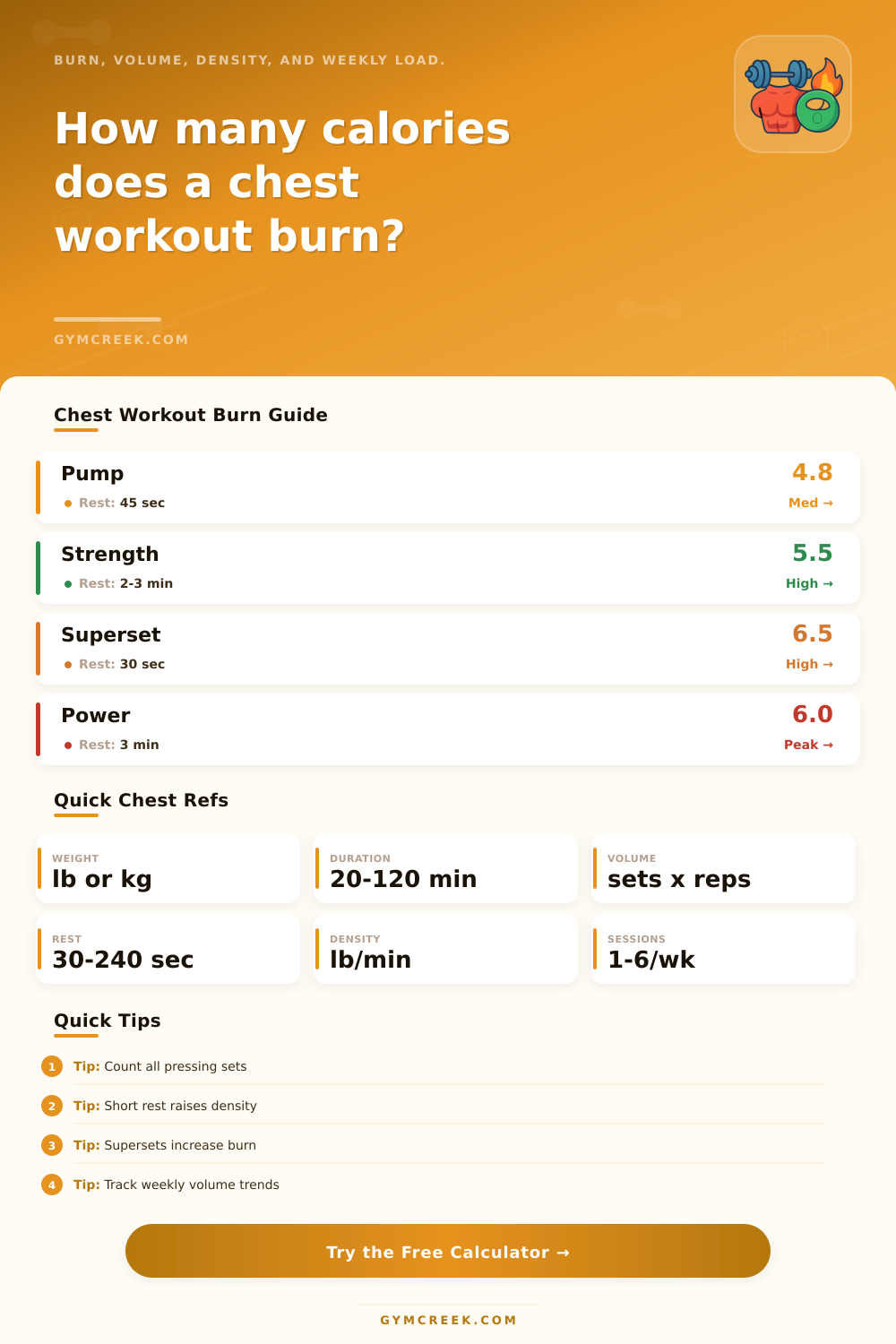
Chest Workout Calories Burned Calculator
Estimate calories burned, pressing volume load, training density, weekly burn, and hypertrophy load from body weight, session length, pressing sets, rest periods, exercise mix, load intensity, supersets, and weekly frequency.
📌Chest Workout Presets
Presets load realistic combinations of weight, duration, pressing volume, average load, rest time, exercise mix, intensity, supersets, and weekly chest sessions.
⚙Calculator Inputs
Chest workout calorie snapshot
Enter your chest workout details to estimate energy cost, pressing volume, training density, weekly burn, and hypertrophy stimulus.
📊Chest Training Metrics
📘Reference Tables
| Workout style | Typical MET | Rest pattern | Best use |
|---|---|---|---|
| Technique bench practice | 3.5-4.5 | 90-180 seconds | Skill, form, bar path, and controlled reps. |
| Hypertrophy press session | 4.8-5.8 | 60-120 seconds | Moderate loads, more total reps, and repeatable effort. |
| Superset chest pump | 5.8-7.0 | 30-75 seconds | Higher heart rate, higher density, and shorter session length. |
| Heavy bench focus | 5.0-6.2 | 150-240 seconds | Strength work where load is high but rest lowers density. |
| Session signal | Low | Moderate | High |
|---|---|---|---|
| Pressing volume load | Under 8,000 lb | 8,000-20,000 lb | 20,000+ lb |
| Effective chest sets | 4-8 sets | 9-15 sets | 16+ sets |
| Hypertrophy load score | Under 55 | 55-85 | 85+ |
| Weekly chest frequency | 1 session | 2 sessions | 3+ sessions |
| Mix | Calorie effect | Volume note | Density note |
|---|---|---|---|
| Barbell bench emphasis | Moderate | Easy to track exact load. | Longer rest can lower density. |
| Dumbbell and incline mix | Moderate-high | Stabilizers add effort. | Good density with shorter setup. |
| Machine and cable work | Moderate | Stable reps and controlled fatigue. | Fast transitions improve density. |
| Circuit chest pump | High | Lower load but more continuous work. | Supersets raise burn quickly. |
| Metric | Formula | Inputs used | What it means |
|---|---|---|---|
| Calories | MET x kg x hours | Weight, time, intensity, mix | Estimated session energy cost. |
| Volume load | Sets x reps x load | Pressing sets, reps, load | Total external pressing work. |
| Density | Volume / minutes | Volume load, duration | How much work fits into the session. |
| Hypertrophy load | Sets x intensity x density | Sets, rest, supersets, mix | Training stimulus score, not a medical measure. |
💡Practical Tips
A chest workout calories burned calculator allow you to calculate the number of calories that you will burn during a chest workout. Many individuals wonder why some chest workouts seems to leave them feeling more physicaly depleted than others, despite the fact that those individuals may have performed the same type of workout. The structure of a chest workout can include factor like the weight that is used in the exercises, the length of rest periods between sets of exercises, and the type of exercises that you perform during the chest workout.
The calculator can account for each of these factors to determine the number of calories that will be burned during the workout. The inputs into the chest workout calories burned calculator will include factors like your body weight, the length of your chest workout, the number of pressing sets and the number of exercises performed within each pressing set, the average load that you perform within each pressing set, your rest time between pressing sets, the mix of exercises that you perform during the chest workout, the average intensity of those exercises, the percentage of superset that are performed during the chest workout, and the number of times that you will perform your chest workout each week. Each of these factors will impact the number of calories that are burn during your chest workout.
How the Chest Workout Calories Calculator Works
The outputs of the chest workout calories burned calculator will include information about the number of calories that will be burned during each chest workout session, the load and density of your training, the total number of calories that you will burn each week as a result of performing chest workouts, a hypertrophy load score that provides a number representing the intensity and volume of the chest workouts, the weekly burn for tracking your activity throughout the week, and information regarding your recovery between chest workout sessions. The results of the chest workout calories burned calculator are estimates only, as there are a variety of factors regarding your actual performance of chest exercises that the calculator cant account for. These factor may include factors like the potential for grip fatigue with the use of dumbbells, or the effort that is required to perform the eccentric portion of the lifts.
However, you can use reference tables to provide insight into the expected difference in the calorie burn and training density between different types of chest workouts. For instance, a chest workout that includes heavy weights and long periods of rest will have different results than a chest workout that include the use of dumbbells and cables with shorter periods of rest between sets of exercises. The results of the chest workout calories burned calculator can help an individual to make decisions regarding the structure of their chest workout routines.
For instance, if an individual wishes to increase their work capacity, their results will help to indicate the number of exercises that will need to be performed in each pressing set to accomplish this goal. If an individual wishes to gain muscle, their results will help to indicate any changes to the hypertrophy load score that will be necessary to accomplish this goal. Different goals will require the use of different values for factors like rest time, the percentage of superset exercises, and the types of exercises that is performed during the chest workout.
Thus, the chest workout calories burned calculator will allow an individual to test out different structures of their chest workouts prior to dedicate time to performing those exercises. As such, the chest workout calories burned calculator will remove some of the guesswork that an individual may have to perform in creating an effective chest workout, but it will not be a replacement for coaching or self-awareness about there strengths and weaknesses in performing chest exercises. Thus, if an individual designs their chest workouts with their goals in mind, the calories that are burned, the number of sets of exercises that are performed, and the type of stimulus that their chest muscles experiences will align with the goals of those individuals.