Cheerleading Calorie Calculator
Estimate cheer practice calories from stunt, tumbling, and dance split, full-out routines, jump count, total duration, rest ratio, athlete role, body weight, and adjusted MET logic.
📌Presets
Each preset loads a realistic cheerleading session and recalculates calories from active minutes, rest, role demand, skills, jumps, and full-out density.
⚙Calculator
Practice calorie result
Enter your session details, then calculate to see the MET-adjusted estimate.
📊Cheer Metrics Grid
🧮Formula Cards
Calories = MET x 3.5 x body weight in kg / 200 x minutes. Active and rest minutes are calculated separately.
Split MET = stunt share x stunt MET + tumbling share x tumbling MET + dance share x dance MET, normalized to 100 percent.
Full-out density and total jump count add a capped intensity boost, because repeated routines and explosive jumps raise oxygen demand.
Mifflin-St Jeor BMR plus the selected activity multiplier estimates TDEE, then the cheer session is compared with that daily total.
📘Reference Tables
| Cheer block | Base MET | Higher when | Lower when |
|---|---|---|---|
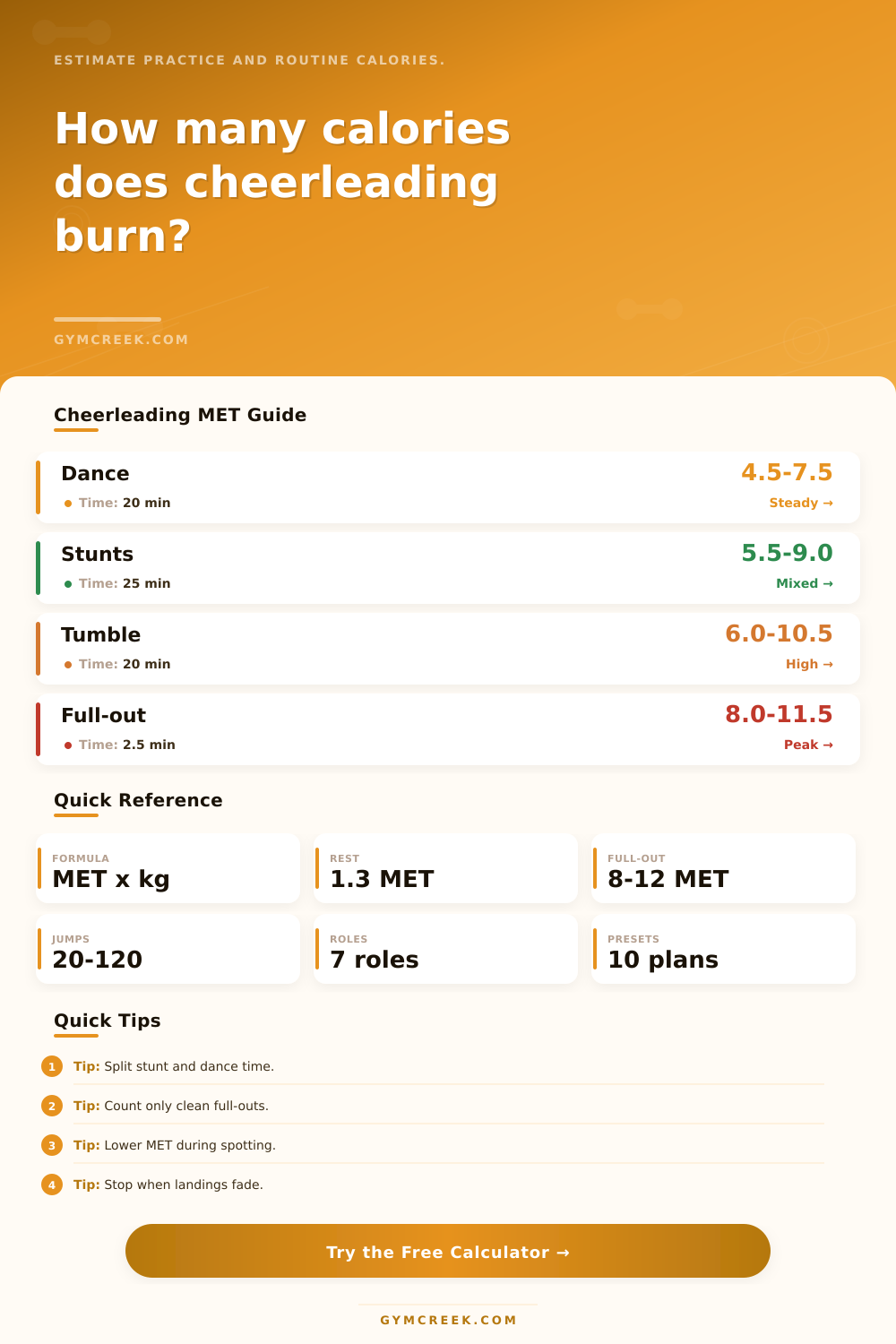
| Dance and motions | 4.5-7.7 | Fast counts, sharp arms, jumps | Marking, slow cleaning |
| Stunts and pyramids | 5.6-9.4 | Repeated loads, elite skills | Walk-throughs, long resets |
| Tumbling | 6.1-10.9 | High-volume passes | Technique drills only |
| Full-out routine | 8.0-11.5 | Complete competition effort | Marked counts or half-outs |
| Role | Multiplier | Typical demand | Notes |
|---|---|---|---|
| Flyer | 1.08 | Core, balance, dismounts | Demand rises with elite body positions. |
| Main base | 1.10 | Loads, catches, grips | High during repeated stunt reps. |
| Back spot | 1.05 | Lift assist, catch timing | Can vary by stunt group. |
| Tumbler | 1.12 | Explosive passes | Highest with short rest between passes. |
| Practice type | Duration | Rest ratio | Expected load |
|---|---|---|---|
| Sideline rehearsal | 45-75 min | 20-35% | Moderate steady burn |
| Stunt block | 60-120 min | 25-45% | Spiky, grip-heavy burn |
| Tumbling block | 45-90 min | 30-50% | High bursts with resets |
| Competition full-outs | 90-150 min | 20-40% | High session average |
| Jump count | What it means | Calculator effect | Watch for |
|---|---|---|---|
| 0-25 | Light jump exposure | Small boost | Warm landing mechanics |
| 26-75 | Normal practice volume | Moderate boost | Toe touch fatigue |
| 76-150 | Conditioning volume | Large capped boost | Knee valgus or low chest |
| 151+ | Very high volume | Maximum boost | Reduce if form breaks |
💡Calculation Tips
Some people view cheerleading as routine at a game. But it’s an intense combination of endurance, power and holds. It drains you in ways that other forms of cardio machines don’t. You might finish a practice feeling like you ran a marathon. Yet when you look down at your watch you have only been moving for 20 minutes. Why? Cheerleading doesn’t burn energy steady. It does so in spikes. Because you know how to feel that burn, you can fuel correctly and recover smarter. That way you won’t give in to the burnout that plagues many squad every season.
To do that math, there’s a tool for that (it’s right here). Most fitness trackers gets it wrong because they assume movement is steady. That’s not cheer. A practice consist of short bursts of intense activity. These are mixed with coaching time, water breaks, and resetting to another formation. To account for that variability, the calculator prompt you to enter your rest ratio.
Why Cheerleading Burns So Many Calories
Why does that matter? Because even when we’re resting, our bodies is burning calories. We just burn fewer calories than we do during periods of hard work. Under-estimating your rest will make you think you’ve burned more calories then you have. Over-estimating how hard you worked will cause you to over-estimate what you’ve burned. Get it right, and you’ll end up with an accurate snapshot of how many calorie you’ve burned.
The type of position you play also makes a big difference. Being a flyer means staying tight in your core and fighting gravity as you’re thrown up into the air… This requires heavy work from your stabilizer muscles. Being a base require generating tremendous force to catch and to throw. It’s constant work for shoulders, back and legs. Tumbling involves explosive ground contact that spikes heart rate immediately. To consider these differences, the calculator has built-in multipliers for each role.
It isn’t simply a question of how much motion you perform; rather, it’s a question of how intensely your body must work to control that motion. Two dancers performing the exact same number of movements (say, a “marking” sequence) will burn very differently from one another: a tumbler running full passes burns a lot more then a dancer marking counts, despite an identical amount of time on the clock.
There’s also the hidden variable of jump volume. Although pikes, hurdlers, and toe touches all look nice, they use a lot of engagement from the glutes and hamstrings. Every time we jump it’s a bit of a cost to our metabolism, so it starts to add up fast throughout a whole practice. That’s why there’s a jump count on the reference table on this page that affects overall estimate.
Frequency matters as much as height of jump. If you’re repeating high jumps without proper rest then you’ll break down in form (which can be risky). By tracking your volume, you can start noticing if you’re pushing yourself too hard.
Full-out routines are where the rubber hits the road. Here’s the deal, this is the place where you go all out with the routine to full competition speed. It wears you out… and that’s why it has a high MET value on the calculator. Counting only real full-outs in your estimation is key. Half-outs (or marked runs) don’t have the same metabolic impact as full outs. The number that pops up is only good if you’re honest about how hard you worked.
The burn for that day is only part of the story. So is the overall load. Session by session burn gets you fit. However, consistency in training build fitness, and it could of burned you out if you don’t fuel it enough. The week’s session multiplier lets you know how many calories you’re burning overall (surplus/deficit) so you can meal-plan accordingly for your toughest days. It will also help you see if you aren’t eating enough to match what you burn, especially if you are losing weight without trying, feeling tired all the time, or noticing other changes.
Numbers aren’t gospel; they’re a guideline. Listen to your body first. It doesn’t matter what the caloric count says if your catches feel late and your landings feel heavy. Always choose safety over spreadsheets.