
The neck are a body part that dont receive much attention until it begins to suffer from neck stiffness or pain. Individuals often experience neck stiffness when they wake up from sleep and pain after sitting in front of there computers screen for many hours. While individuals may believe that neck pain are a normal part of life, neck pain isnt a normal part of life.
The cervical spine perform various tasks constantly and require specific movement to enable the upper body to perform its functions correctly. The seven vertebrae that make up the cervical spine carry the weights of the head every day that passes. These same vertebrae are required to support a significant amount of weight of the head.
Simple Neck Exercises and Posture Tips
When individuals has poor posture, their heads drift forward. The more farther that their head is from its proper position, the more load that is placed on the neck muscles and ligaments. Therefore, individuals use specific exercise are used to reverse the effect that poor posture have on the cervical spine.
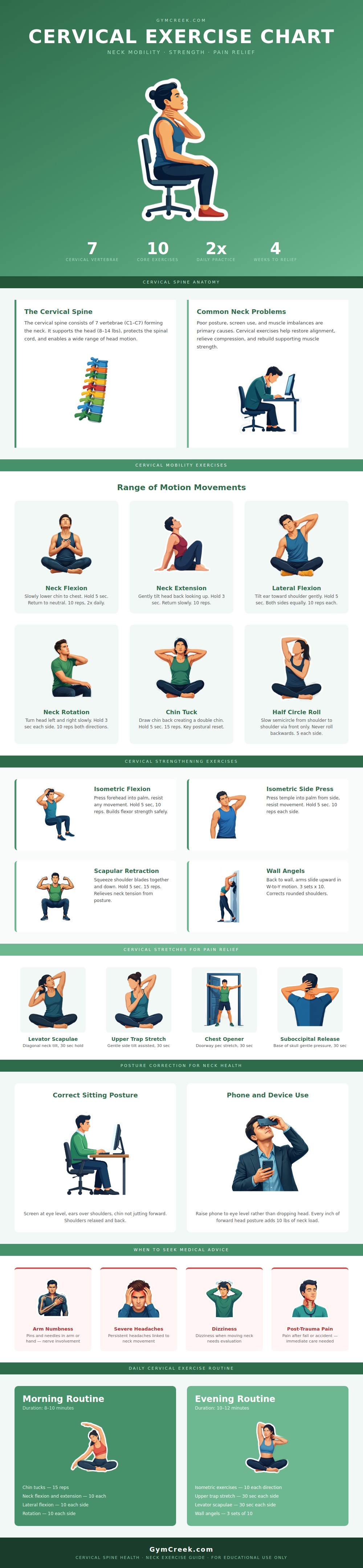
Mobility exercises should be completed before perform strength exercises. Mobility exercises warm up the muscles and prepare the joints for the exercises to follow. Mobility exercises include flexion, extension, side bends, and rotations of the neck.
An individual can perform a mobility exercise like the chin tuck exercise. This particular exercise is beneficial because it works to counter the forward head posture that many individuals develops. Additionally, individuals can also perform a slow half-circle roll with there head.
However, when rolling the head, individuals should only roll their head forward and to the side. Rolling the head backward can compress the neck muscles. Now that the individual’s neck is warmed up, the strengthening exercises can be performed.
Isometric neck exercises can be used to build the strength of the neck muscles. Isometric exercises dont require any special equipment. Additionally, individuals can perform scapular retractions or wall angel to build the strength of their shoulder muscles.
Individuals often have rounded shoulders when they have neck tension. These types of exercises will change how the individual’s head sit in relation to their body throughout the day. If performed regularly, these exercises will lead to the individual no longer jutting there chin forward when reading print.
The neck muscles that can be stretched include the upper trapezius and levator scapulae muscles. These muscles becomes tight with too much time spent sitting at the desk. Additionally, an individual can stretch out the pectoral muscles using a doorway chest opener exercise.
These muscles may be tight in the upper body yet cause the neck to develops tension. Lastly, a suboccipital muscle can be released at the base of the skull. This muscle becomes tense and contributes to the development of tension headache.
Tension headaches begin at the base of the skull. The individual’s habits will ultimately determine if the exercises described are effective for the individual. For example, when using a phone, individuals should raise the phone to eye level instead of allowing their head to drop to view the screen.
Another posture habit that should be followed is ensuring that the screen is at the correct height from the desk. The screen should be at a height where the individual’s ears are stacked over their shoulder. Now that the proper habits have been discussed, the individual has a much betterer chance of seeing a benefit from the neck exercises.
Consistency in performing the exercises is more important than the intensity with which the individual performs the described exercises. For example, individuals should perform two session of neck exercises every day. Each session should be short in length and may be performed in the morning or the evening.
Individuals may notice a gradual improvement in their neck after performing the described exercises. For example, after a few week of performing these exercises, an individual may find that their neck does not become stiff after long drive. Another benefit may be felt after one month of regularly performing neck exercises.
After one month, an individual may experience a decrease in the baseline tension that their neck muscle exhibit. The goal of these neck exercises is for the individual to reach a point where they no longer notice the presence of tension in their neck muscles. Certain symptom will require the attention of a medical professional.
For example, if an individual experiences tingling in their arms, or if they feel dizzy when moving their neck, they should seek medical help. Additionally, if an individual experiences neck pain following a fall, they should seek medical help as well. By being aware of these symptoms, the neck exercises can remain safe for the individual.
