Cassette Range Calculator
Compare cassette spread, lowest climbing gear, highest speed gear, cadence needs, and climb power demand for road, gravel, touring, trainer, or mountain bike setups.
📌Presets
Presets load realistic cassette and chainring combinations, then calculate gear range, rollout, climb cadence, speed ceiling, and FTP demand.
⚙Calculator
Cassette range snapshot
Enter your chainrings, cassette, wheel size, cadence, and climb target to compare the gearing.
📊Fitness Metrics Comparison Grid
📑Reference Tables
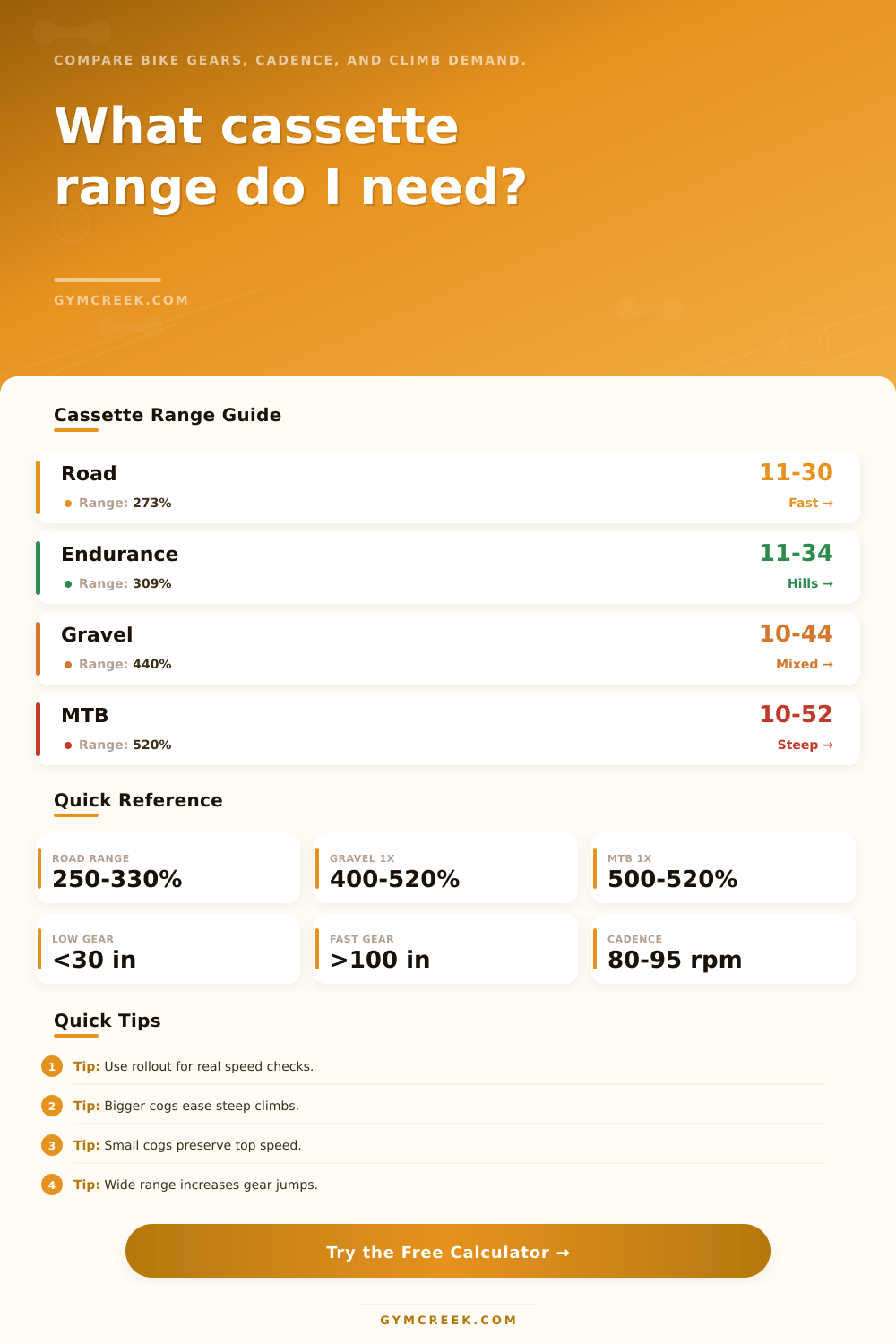
| Cassette Type | Common Size | Range | Best Use |
|---|---|---|---|
| Close road | 11-25 or 11-28 | 227-255% | Flat racing and smooth cadence steps |
| All-road | 11-30 or 11-34 | 273-309% | Rolling routes and moderate hills |
| Gravel 1x | 10-42 or 10-44 | 420-440% | Mixed surfaces with fewer front shifts |
| Adventure 1x | 10-50 or 10-52 | 500-520% | Bikepacking, dirt climbs, and wide terrain |
| MTB wide | 10-51 or 10-52 | 510-520% | Technical climbing and trail riding |
| Lowest Gear Inches | Feel | Typical Rider | Use Case |
|---|---|---|---|
| Under 20 in | Very easy | Loaded or steep terrain | Bikepacking, MTB, long climbs |
| 20-27 in | Climb friendly | Most endurance riders | Long paved climbs and gravel |
| 28-35 in | Moderate | Fit road riders | Rolling roads and short grades |
| 36-45 in | Hard | Strong riders or flat routes | Fast road and trainer work |
| Over 45 in | Very hard | Special cases | Flat events or restricted setups |
| Setup | Low Pair | High Pair | Expected Tradeoff |
|---|---|---|---|
| Compact road 2x | 34 x 32 | 50 x 11 | Balanced climbs and speed |
| Subcompact gravel | 30 x 36 | 46 x 11 | Lower climbs, less sprint gear |
| Gravel 1x | 40 x 44 | 40 x 10 | Simple shifting, wider jumps |
| MTB 1x | 32 x 52 | 32 x 10 | Huge climbing range, lower top speed |
| Touring triple | 24 x 34 | 48 x 11 | Very broad range with front shifts |
| Formula | Variables | Output | Use |
|---|---|---|---|
| Cassette range | large cog / small cog x 100 | Percent | Rear spread comparison |
| Gear inches | wheel inches x ring / cog | Inches | Low and high gear size |
| Rollout | wheel circumference x ring / cog | Distance | Speed and cadence checks |
| Climb cadence | speed / low rollout x 60 | RPM | Low gear practicality |
| Climb power | gravity + rolling + aero | Watts | Fitness demand at grade |
💡Tips
This is the kind of hill where you think it won’t be hard to get up… But it’s looking tough from down here. Because your gearing isn’t set up for this kind of terrain, your cadence slow and your legs start to burn.
If you want to keep going, you need to understand something about cassette range. Plug in the chainring size, target speed and a couple of cog limits into the calculator. It’ll do the math for you, letting you know if you’re set up to comfortabley spin along, or if every turn of pedal is going to be a struggle.
How to Pick the Right Gears for Your Bike
The biggest cog is always the main focus for most riders: It’s what determines their ability to get started on a climb. Unfortunately, that is usualy not true. If you keep your small ring the same size, a large rear cog increase low-end torque, but decreases distance between big and little cogs. You’ll be able to climb better, but won’t have as much top-end speed.
That’s why the tool calculates the total range percentage. It shows you the trade-off visually; where your speed ceiling is at ninety revolutions per minute. This will help you find that sweet spot where you don’t spin-out on the flats and are able to climb without standing.
Those inputs is more important than they seem at first. For example, although your cassette hasn’t changed, adding 20 lbs of gear will dramatically change the power demand calculation. Tire selection is also an input to the calculator, which accounts for rolling resistance based off the surface you ride on and the width of your tires. Slick road tires will show different efficiency numbers differant than a gravel setup.
Larger jumps between your gears (often associated with wider range cassettes) can lead to greater fluctuations in your cadence when shifting around in center of the cassette. Is that worth sacrificing for broader coverage on less predictable trails versus smooth steps on known routes? That is your decision.
The rule of thumb is to ride between 50 percent range on road rides and more than 100 percent on mountain bikes, according to reference tables. That’s a good place to start, but again, it all comes down to where you live and how fit you are. For example, if you’re riding flat roads as a strong cyclist, you may want a tight range so you can maintain higher speeds and shift frequently. Conversely, if you’re riding a heavily loaded touring bike up some steep hills, you’ll need the large range to avoid fatiguing too quick.
You can play around with target speed and climb grade in the tool. It will approximate the scenario to help determine if your functional threshold power is enough for what you intend to do. If it says you’re working harder then you should given your fitness, then you know it without having purchased any components yet, perhaps a bigger cassette and/or a smaller chainring are the ticket.
Your gear selection isn’t about isolated cogs; it’s about a system designed to match your effort with road ahead. Whether you’re crawling up a mountain pass or sprinting for a light, you want a set-up that lets you keep your flow. By visualizing the extremes with the calculator, you can make an informed decision instead of guessing from internet forums. It converts tooth counts into real world results such as cadences required and roll-out distances.
After viewing a 22% change in range and understanding its impact on climbing cadence, the choice becomes a lot more clear. Cogs stop being isolated chunks of metal and become part of a whole system. The perfect cassette is one you don’t notice at all. With a bike set up properly for you, you hop on and go.
You won’t think about power-to-weight ratio or gear inches when you’re climbing. That’s stuff you see on your screen after the fact. While you are actualy out riding, you should of be able to enjoy the ride.