Cardiovascular Endurance Calculator
Estimate VO2max, endurance percentile band, heart-rate zones, recovery score, and training guidance from field-test and heart-rate inputs.
Your cardiovascular endurance result
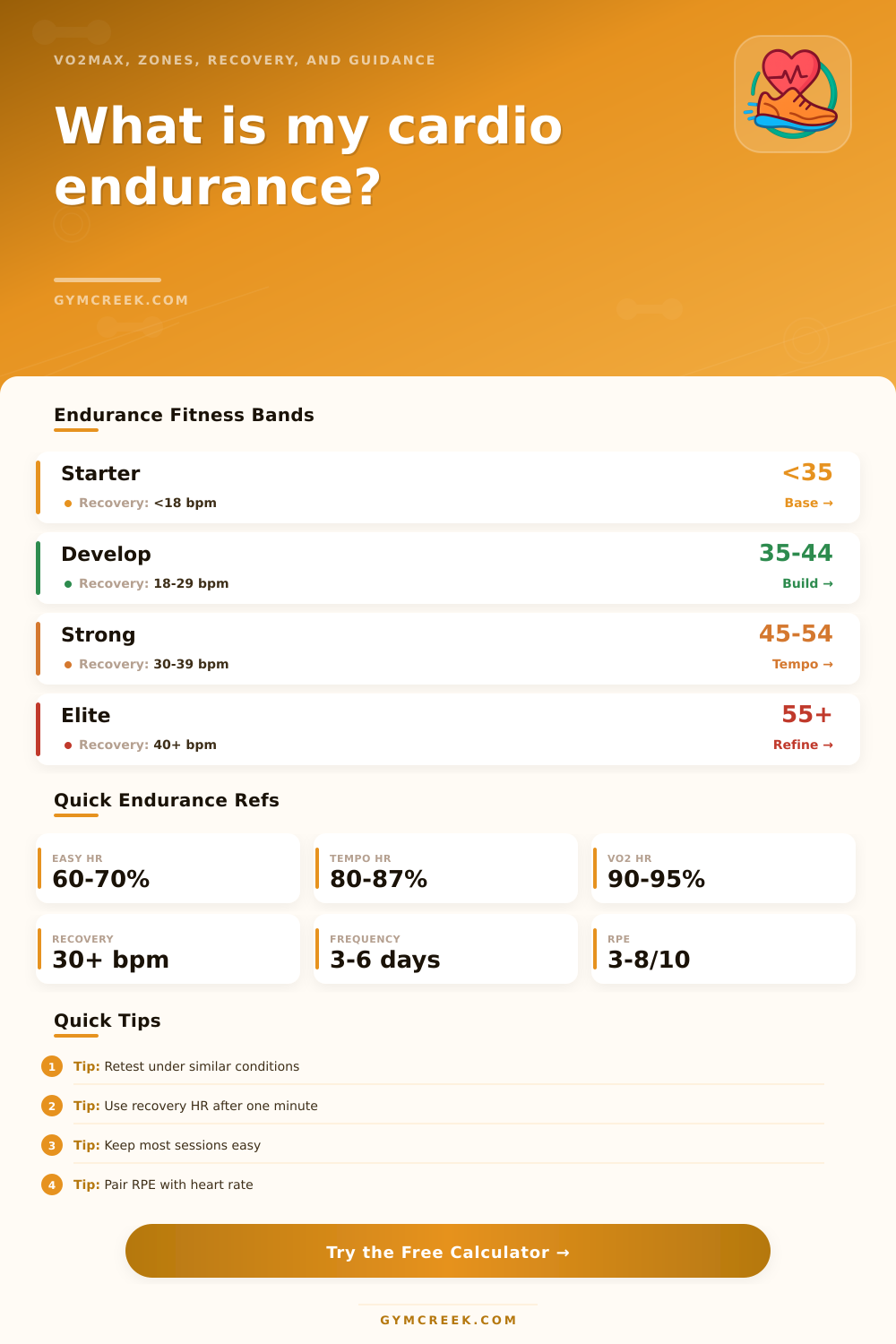
| Endurance band | Approximate VO2max | Percentile signal | Training interpretation |
|---|---|---|---|
| Starter | Under 35 ml/kg/min | Lower fitness band for most adults | Build consistency with easy aerobic work and low injury risk. |
| Developing | 35 to 44 ml/kg/min | Recreational fitness range | Progress frequency first, then add light tempo exposure. |
| Strong | 45 to 54 ml/kg/min | Above average endurance range | Use structured threshold and VO2 sessions with recovery days. |
| Competitive | 55 to 64 ml/kg/min | High recreational or competitive band | Refine intensity distribution and repeat field tests carefully. |
| Elite | 65+ ml/kg/min | Very high endurance band | Small changes matter; avoid stacking high-intensity fatigue. |
| Zone | % HR reserve | Primary feel | Common endurance use |
|---|---|---|---|
| Zone 1 recovery | 50% to 60% | Very easy breathing | Recovery days, warm-ups, cool-downs, and low-stress volume. |
| Zone 2 aerobic | 60% to 70% | Conversational effort | Base miles, long easy sessions, and sustainable weekly volume. |
| Zone 3 steady | 70% to 80% | Focused but controlled | Steady endurance blocks when total stress is managed. |
| Zone 4 threshold | 80% to 90% | Hard sustainable effort | Tempo intervals, threshold runs, climbs, and race-specific work. |
| Zone 5 VO2 | 90% to 100% | Very hard effort | Short intervals for trained athletes with enough recovery. |
| Method | Inputs used | Formula basis | Best fit |
|---|---|---|---|
| Cooper 12-minute run | Distance in meters | VO2max = (meters - 504.9) / 44.73 | Runners and field athletes who can run continuously. |
| 1-mile run | Time, age, sex, and HR context | Velocity-based field estimate adjusted for age and sex. | General athletes with a reliable all-out mile time. |
| Rockport walk | 1-mile walk time, HR, age, sex | Rockport equation without body-weight adjustment. | Beginners or return-to-training users who prefer walking. |
| Manual VO2max | Entered VO2max estimate | Direct input from lab, watch, or previous field test. | Users with an existing tested or device-derived estimate. |
| Signal | Range | Score effect | Training response |
|---|---|---|---|
| 1-minute HR recovery | Under 18 bpm drop | Lower recovery score | Keep intensity conservative and retest when rested. |
| 1-minute HR recovery | 30 to 39 bpm drop | Strong recovery signal | Add quality work only if sleep and soreness are stable. |
| RPE load | 8 to 10 | Higher strain deduction | Limit hard days and protect easy aerobic sessions. |
| Frequency | 3 to 6 days/week | Best consistency range | Match volume increases to recovery score and training goal. |
Cardiovascular endurance are the ability of a person to sustain physical effort over a period of time. Cardiovascular endurance is determined by the quality of an aerobic system of the body. Cardiovascular endurance determines how long a person can keep going before fatigue set in.
Additionally, cardiovascular endurance is related to the amount of oxygen that a person can use and how quick their heart rate drops after exerting themself. There is several different inputs that the calculator can use to determine cardiovascular endurance. Such inputs include age, sex, resting heart rate, and the results of a specific test.
What is cardiovascular endurance and how to measure it
Age and sex can help to determine an individual’s maximum heart rate, as well as where to place their results in comparison to others with similar characteristic. Resting heart rate can be used to determine the baseline of an individual’s heart rate. An individual with a low resting heart rate have a strong aerobic base.
Additionally, low resting heart rates can be the result of genetics and recovery of the body from exertion. There are different methods to measure cardiovascular endurance. For instance, a twelve minute run test can help to determine an individual’s ability to maintain a hard pace for a period of time.
Additionally, a one-mile run can help to determine peak velocity, while a walking test can help to determine the cardiovascular endurance of an individual who is just starting to exercise. This calculator will take the information that you enter into the calculator to determine an individual’s VO2max value, which is a measurement of their fitness level. These heart rate zone allow an individual to determine at what level they should be exerting themselfs when engaging in cardiovascular exercise.
The lower zones allow for an individual to perform their exercises but not drain their energy for the remainder of the day. Additionally, using the upper zones allows for individuals to increase their ability to sustain hard work. Most individuals benefits from training most of the time in the easy heart rate zone as this leads to an increase in the volume of exercise an individual can perform.
This calculator allows for individuals to determine the difference between easy aerobic work and threshold work to allow for an individual to plan their exercise routine rather than guessing at the effectiveness of different level of effort. Recovery of cardiovascular endurance is a necesary component of cardiovascular endurance. Recovery can be determined by how quickly an individual’s heart rate drop after they have finished performing an exercise.
A drop in heart rate indicates that the body is clearing the metabolic byproduct that result from exercising. This drop in heart rate, along with training frequency and body efforts, the calculator can use to determine an individual’s recovery score. If an individual’s recovery score is low, they should decrease the intensity of their exercise until their sleep, soreness, and stress levels decreases.
While the score that the calculator provides will guide an individual’s exercise routine, the schedule that is suggested to an individual is not a rigid routine. Many individuals make the mistake of treating each exercise routine as a test of their cardiovascular endurance. If an individual pushes themself too hard during the majority of their exercise routine, their recovery score will drop, which will prevent their endurance score from improving.
Additionally, many individuals make the mistake of ignoring how external conditions affects their scores. For instance, exercising in high heat will raise an individual’s heart rate, even if they are not pushing themself too hard. In these case, an individual should retest their cardiovascular endurance under similar conditions.
The goal that you choose will determine the response of the numbers that is displayed on the calculator. For instance, an individual returning from a break from cardiovascular exercise will need to gain more volume in the easy heart rate zone before they can begin to incorporate threshold exercises. Additionally, an athlete preparing for a race will incorporate threshold exercise into their routine once their recovery score is solid.
While the calculator does not replace the decision of a coach, it does remove the need for an individual to utilize different formulas within the body to determine their training routine. An individual’s cardiovascular endurance will improve if they find a balance in their routine over many week. The calculator will make that balance more easy for an individual to see.