Carb To Protein Ratio Calculator
Build a carb-to-protein ratio from body size, training load, goal phase, current intake, meal count, and workout timing so daily macros stay practical.
◎Presets
Presets load realistic carb and protein settings for common training days. Adjust any field to match your current phase.
⚙Calculator
Carb to protein ratio snapshot
Enter your inputs and calculate the ratio.
▦Ratio Metrics
▣Reference Tables
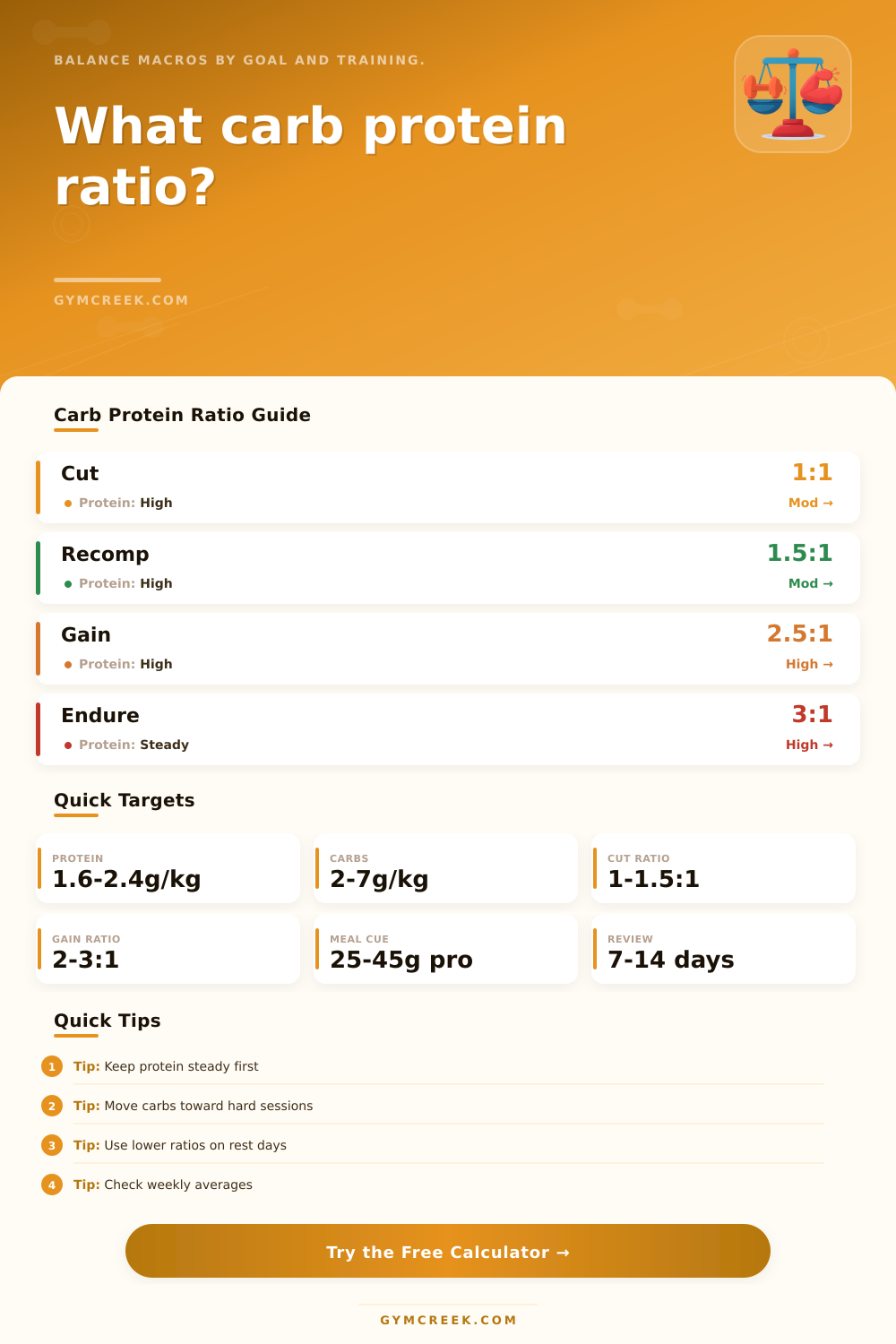
| Goal phase | Common carb:protein ratio | Protein cue | Carb cue |
|---|---|---|---|
| Fat loss | 0.8:1 to 1.5:1 | Higher, steady protein | Carbs placed around training |
| Body recomposition | 1.2:1 to 2.0:1 | High enough for lean mass | Moderate training fuel |
| Lean muscle gain | 2.0:1 to 3.0:1 | High but not excessive | Higher to support volume |
| Endurance or sport | 2.5:1 to 4.5:1 | Steady recovery baseline | Primary fuel target |
| Training context | Protein target | Carb target | Use when |
|---|---|---|---|
| Rest or light activity | 1.6 to 2.0 g/kg | 1.5 to 3.0 g/kg | Lower energy demand |
| Strength training | 1.6 to 2.2 g/kg | 2.0 to 4.0 g/kg | Most lifting blocks |
| Hard mixed training | 1.8 to 2.4 g/kg | 3.0 to 5.0 g/kg | High-volume or intervals |
| Long endurance day | 1.6 to 2.2 g/kg | 4.0 to 7.0 g/kg | Long sessions and sport |
| Meal type | Protein cue | Carb cue | Ratio note |
|---|---|---|---|
| Breakfast or first meal | 25 to 45 g | Goal dependent | Keep protein anchored |
| Pre workout | 20 to 40 g | Higher if tolerated | Carbs often lead |
| Post workout | 25 to 50 g | Moderate to high | Useful refill window |
| Rest-day meal | 25 to 45 g | Lower or moderate | Ratio usually tighter |
| Formula piece | Inputs | Used for | Notes |
|---|---|---|---|
| Mifflin-St Jeor | Age, sex, height, weight | BMR context | General calorie baseline |
| Activity multiplier | BMR and activity | TDEE context | Shows energy fit |
| Macro factors | Body weight and g/kg or g/lb | Protein and carb targets | Main ratio calculation |
| Macro calories | Protein 4, carbs 4, fat 9 | Fat-floor check | Flags crowded macros |
◇Tips
Macronutrient tracking isn’t a fixed structural task. You can use a calculator to handle the math, but you should set your protein target between 1.6 and 2.4 grams per kilogram of body weight.
Instead of guessing, you should set a protein floor first and then adjust your carb ratios based off your training. Don’t give every gram a specific purpose. That carb:protein ratio sounds so overwhelming because there are two numbers and it seems like one ought to be more important than the other. It’s not. It’s simpler than that.
How to Change Your Food for Your Workouts
View each training day as an independent event different than a blurry picture of your weekly average. Whether or not you lift weights, your body require protein to repair tissue. The amount of carbs you need shifts depending on what you actualy do during the week. Carbs is fuel for effort. What you do with the week changes their value.
You can plug in your goal phase and body weight into calculator and it does the rest. The beauty of the plan comes from understanding what those numbers represent.
One thing many newbies do wrong is adjust their protein up or down to accommodate more carbs or the opposite. Protein are an essential nutrient for retaining muscle, but there’s also a ceiling for how much your body can convert into immediate energy. So you should of set your protein as a starting point first. Depending on activity level, a solid range is 1.6-2.4 grams per kilogram body weight.
From this baseline, the other carbs you eat are flexible space in your daily calorie budget. When you choose what kind of day you’re on, this opens the door. Why eat a heavy dose of glycogen in support of a light walk? Or vice versa? If you always ate the same ratio, odds are one day you’ll be bloated (low effort) while next you’ll be sluggish (high). By changing the workout carb share you dial-in the balance to give yourself a little more wiggle room.
Essentially: a percent of your total carbs gets moved into meals around your training. Sounds like technical stuff but it’s simply applying common sense with time. Fuel up on the days you burn it.
That’s not to say there aren’t folks who becomes fixated on the specific number for their exact ratio. Does it matter? Is 2:1 preferable to 2.5:1? While consistency will take you further then ratio in terms of getting enough protein, in practice, I’m going to bet the answer most of the time isn’t very different from what works best for you.
If you’re cutting fat, a leaner ratio will keep hunger at bay while maintaining insulin sensitivity. If you’re seeking more size or endurance capacity, then nudging that ratio up means having the fuel to train harder. This leads to better adaptation, which is the entire purpose behind playing around with these numbers in the first place.
And note that those totals per day reflect meal breakdowns too. For increasing muscle protein synthesis during the day, protein ought to be spread out among four or five meals. Carbs can be more flexible (and timed around workout sessions). And these are just the starting line, not the finish tape.
Tolerance and digestion differ widely from individual to individual. Some people love carb-heavy breakfasts; others crashes by lunchtime. For the first couple of weeks, I recommend treating it like an experiment. Use the scale for reference only and pay attention to how you feel. Are you tired all the time post-workout? Increase the carb ratio. Do you feel bloated and retain water? Back off a bit.
The calculator will serve as a good starting point that won’t force you to blindly guess, but in the end your body hold the answers. You’re looking for your “sweet spot“, having sufficient energy to maximize performance without compromising your physique progress. It’s not really a math problem anymore. It becomes rhythmic.
Learn to tell when you can coast through an easier day with less and when your heavier sessions requires some extra fuel. And that ratio is simply a way to guide you there, so you don’t overeat one day and starve yourself the next. When you dial it in, you stop computing and start working. That’s the difference between endless tweaking and consistent progress.