Carb Timing Calculator
Plan pre workout, intra workout, and post workout carbohydrate targets from your body weight, session demand, timing window, and digestion tolerance.
📌Presets
Each preset loads a realistic training scenario and immediately recalculates the carb timing plan.
⚙Calculator
Carb timing snapshot
Enter your session details and calculate a timing plan.
📊Timing Metrics
📑Reference Tables
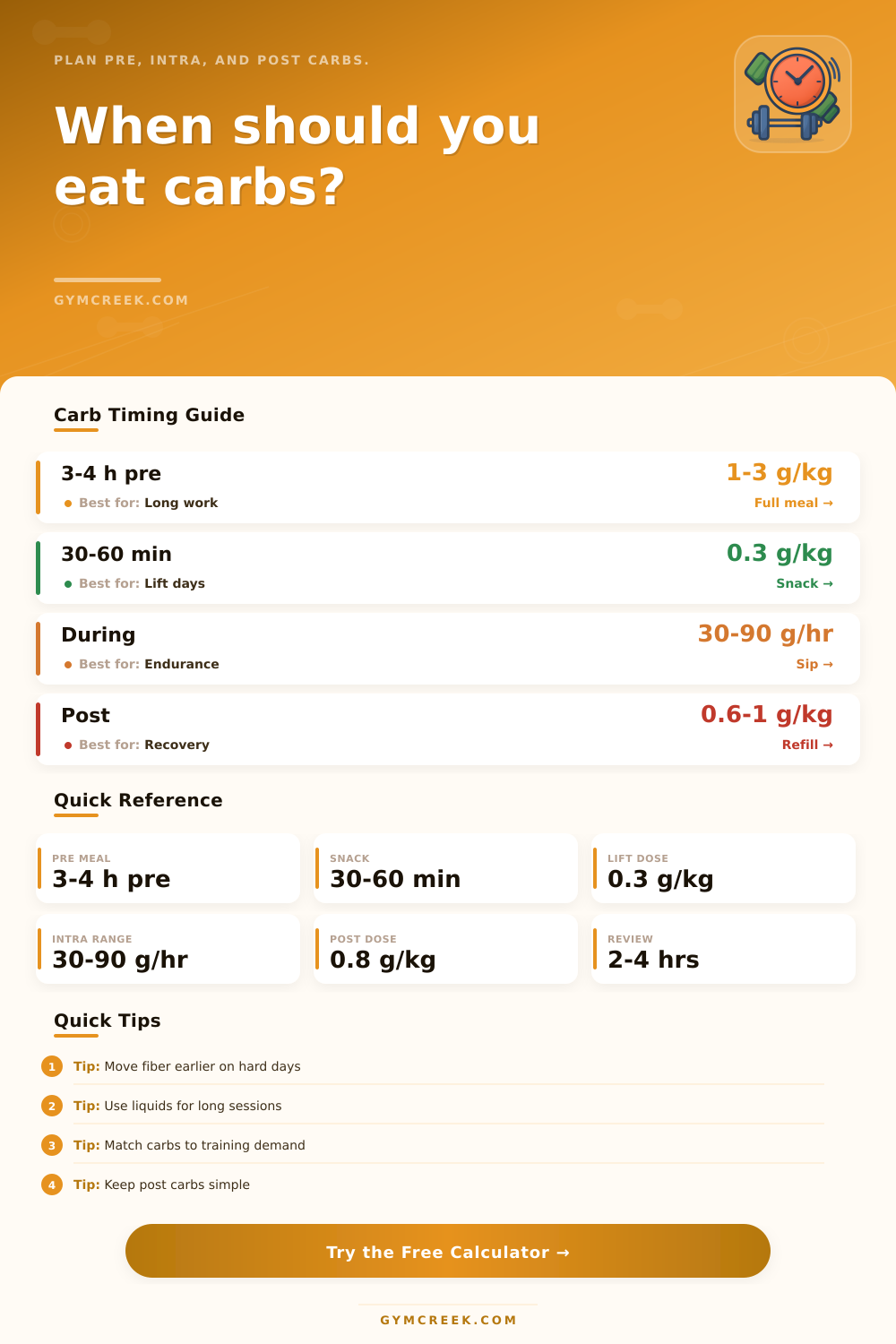
| Timing window | Carb target | Best use | Digestion note |
|---|---|---|---|
| 3 to 4 hours pre | 1 to 3 g/kg | Long endurance, match play, two-a-days | Normal meal with lower fat if intensity is high |
| 90 to 150 minutes pre | 0.6 to 1.2 g/kg | Lifting, conditioning, mixed training | Moderate fiber and familiar foods |
| 30 to 60 minutes pre | 0.2 to 0.5 g/kg | Early sessions or top-off snacks | Simple, low-fiber, easy to digest |
| During training | 30 to 90 g/hr | Sessions past 75 minutes or repeated work | Use fluids, gels, chews, or small bites |
| Session type | Demand factor | Intra target | Post priority |
|---|---|---|---|
| Strength training | Lower to moderate | 0 to 20 g/hr | Moderate unless training again soon |
| Hypertrophy lift | Moderate | 10 to 30 g/hr | Moderate to high for volume blocks |
| Endurance session | High | 30 to 90 g/hr | High if longer than 90 minutes |
| Two-a-day training | Very high | 30 to 75 g/hr | High and early after session one |
| Daily carb level | g/kg body weight | Typical goal | Timing cue |
|---|---|---|---|
| Lower carb | 1 to 3 g/kg | Fat loss or rest day | Place most carbs around training |
| Moderate carb | 3 to 5 g/kg | General lifting and mixed sport | Split pre and post evenly |
| High carb | 5 to 7 g/kg | Endurance or hard blocks | Include intra workout carbohydrate |
| Very high carb | 7 to 10 g/kg | Long events or rapid refill | Use several smaller feedings |
| Formula piece | What it uses | Why it matters | Output |
|---|---|---|---|
| Weight conversion | lb or kg to kg | Sports nutrition dosing is usually g/kg | Body mass basis |
| Demand score | Type, intensity, duration | Raises carbs for longer or harder sessions | Timing multiplier |
| Meal gap modifier | Time until training | Large meals need more time to clear | Pre carb cap |
| Recovery allocation | Goal and next-session need | Targets glycogen refill without overloading | Post carb target |
💡Tips
It’s six in the morning and there you are in the kitchen with a banana in one hand and a barbell waiting in the garage. You don’t wonder if you’ll need the energy for your deadlifts: What you worry about is that this banana might sits in your gut like a stone as you chase heavy weight plates. That’s a difference between “I know I’m supposed to eat carb” and “I can time my carbs so they helps me.”
Most athletes treats carbs like a bucket number. They fill the bucket the same way every single day, regardless of what they do or how hard they work. It results in bloat on rest days but leaves energy on the table when it matters most.
How to Time Your Carbs for Better Energy
Once you enter in what kind of session you’re doing and how much you weigh, calculator above will crunch it for you. By connecting your personal demand with exact intake windows, it eliminates guessing. You begin by identifying what type of exercise you’re performing, is it a long endurance event (longer than 75 minutes), or something like a grueling strength block where stored muscle glycogen is your primary source?
From a metabolic perspective, these are not equivalent events. While prolonged aerobic exercise (running, riding) depletes circulating glucose far more quickly, strength training use primarily stored glycogen. Because of this difference, the calculator will change your during-workout target accordingly. For hypertrophy lift, maybe you simply require a gentle trickle throughout your workout. For a two-hour ride or run, demand skyrockets to avoid bonking.
Most people neglect the one variable that gets your attention when it stings: digestion tolerance. Thirty grams of complex starch fifteen minutes prior to a sprint interval might be the perfect macro split on paper, but your gut doesn’t agree. Here’s how the calculator compensates for this. You input your tolerance level, which allows for pushing more carbs into first meal (pre-workout) and keeping the last snack light and easy to digest.
In other words, real life is copied; a big breakfast three hours out is less risky than a hefty shake ten minutes from going to work. It honors how stomach empties; you don’t want fuel churning in your belly, you need it circulating in your blood. We don’t give timing windows enough credit. If I eat 30 minutes before exercise versus two hours, that food is used differently.
If I eat a meal three-to-four hours before exercise, my body can process it normally including fat and fiber. Closer to the start time, the rules become stricter, meaning simple sugars are preferred due to their speedy entry into our blood stream (without needing to do much chemical work). On the page, you’ll see a clear reference table that details exactly when your food needs to change (based off the clock). High fiber near workout time is a recipe for gastrointestinal distress. It’s not a big change but it’s HUGE when it comes to power output and comfort level.
Finally we have post workout nutrition. It refills the tanks you just drained. Speed of recovery is key here (if your next training session will be imminent). Depending on your overall goals, it gives you some of your carb allotment for the day during this time frame. Peaking for performance? You’d like to top off glycogen stores as much as possible. Cutting fat? You may lean towards protein with less carbs.
Match the intake to the expenditure. Overeating after a light session waste calories. Undereating after a hard session stalls adaptation.
What is the take-home message? Carb timing is ultimately a way to feel good while doing hard work. It translates airy nutrition talk into something you can use in your day. You will know exactly what to eat, how much, and when to eat to support the work ahead of you. You should of not wonder whether you’ve eaten enough but instead be clear on the fuel you need. So you can concentrate less on your belly and more on the race or run or lift at hand.
The banana in your hand is a choice made on purpose instead of as an afterthought.