Carb Calculator
Estimate daily carbohydrate grams from body size, training load, goal calories, protein, fat, fiber, and meal timing, then compare your result with sport-specific carb ranges.
📌Presets
Each preset fills a complete macro profile so the calculator changes calories, protein, fat, carb grams, and workout timing together.
⚙Calculator
Carb snapshot
Enter your body size, goal, and macro targets to estimate daily carbohydrate needs.
📊Fitness Metrics
📑Reference Tables
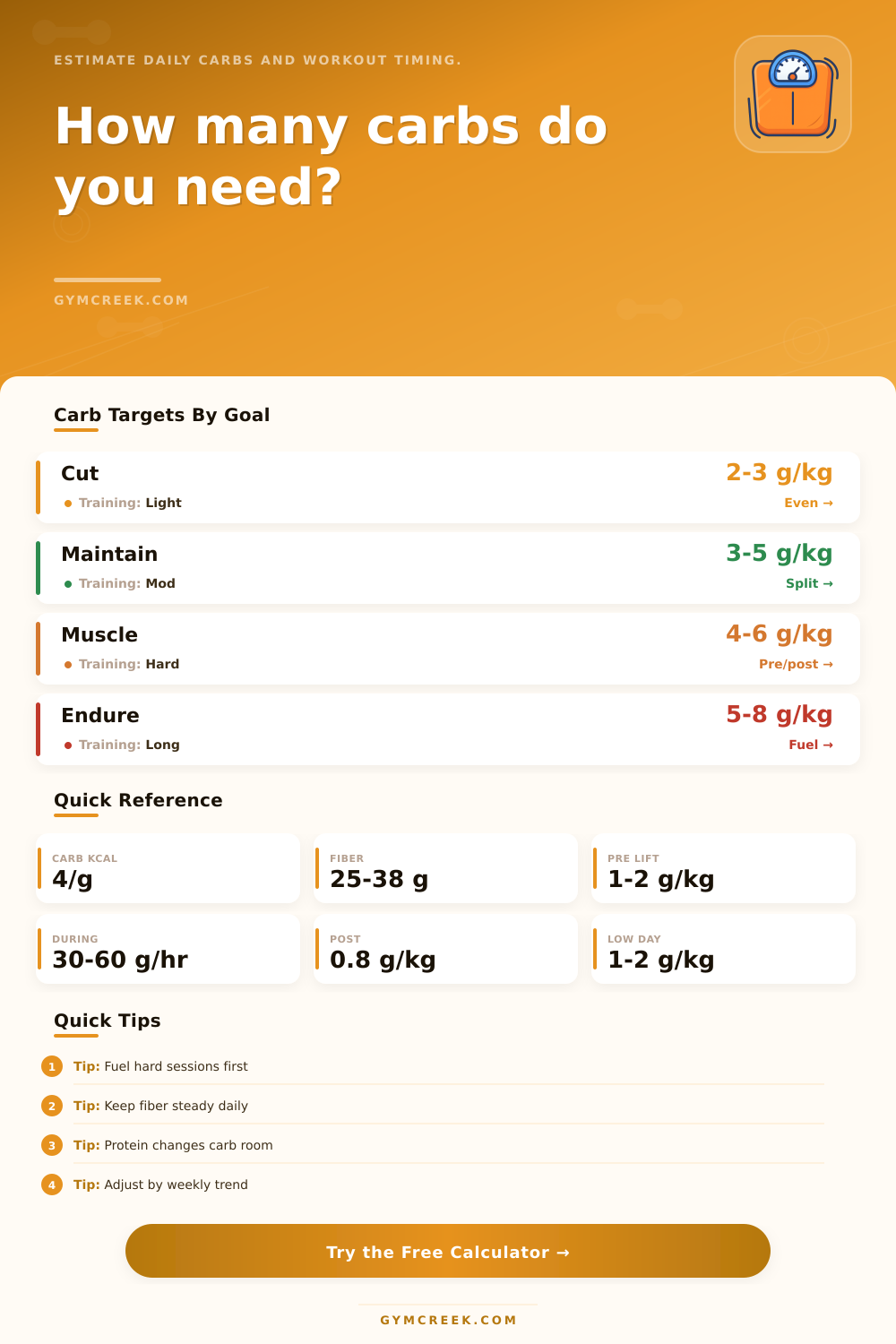
| Goal | Daily range | Best fit | Watch point |
|---|---|---|---|
| Lower-carb day | 1 to 2 g/kg | Rest, light walking | Hard training may feel flat |
| Fat loss | 2 to 3 g/kg | Deficit with lifting | Keep protein adequate |
| Maintenance | 3 to 5 g/kg | Regular gym training | Match weekly weight trend |
| Performance | 5 to 8 g/kg | Long or repeated sessions | Fuel before fatigue hits |
| Window | Amount | When useful | Calculator use |
|---|---|---|---|
| Pre-workout | 1 to 2 g/kg | 2 to 4 hours before | Raises priority on hard days |
| During training | 30 to 60 g/hr | Sessions over 75 minutes | Duration-based estimate |
| Post-workout | 0.6 to 1 g/kg | Same-day recovery | Higher with multiple sessions |
| Even spread | Total divided | Rest or short sessions | Meal split fallback |
| Step | Formula | Output | Why it matters |
|---|---|---|---|
| BMR | Mifflin-St Jeor | Resting kcal | Energy baseline |
| TDEE | BMR x activity | Daily kcal | Goal adjustment base |
| Protein | kg x g/kg | Protein grams | Protects lean mass |
| Carbs | Remaining kcal / 4 | Carb grams | Fits full macro budget |
| Profile | Training | Likely range | Timing focus |
|---|---|---|---|
| Desk lifter | 45 to 60 min lift | 2.5 to 4 g/kg | Pre and post meals |
| Hybrid athlete | Lift plus intervals | 4 to 6 g/kg | Workout window |
| Distance runner | 75 plus minutes | 5 to 8 g/kg | During-session fuel |
| Rest day | Steps and mobility | 1.5 to 3 g/kg | Fiber and satiety |
💡Tips
Carbohydrates is vital for the feeling that a person experiences during training. Carbohydrates determine a person’s rate of recovery. Additionally, carbohydrates influence the movement of a persons weight in the desire direction.
There is no universal target for carbohydrates that will work for all individual. Such a target might not work for the individual with you specific intake. You must find the correct number of carbohydrates for your total intake, for the demands of your training schedule, and to ensure you have enough energy to continue training.
How to Find the Right Amount of Carbs for Your Training
Once you understand the factors that influence the number of carbohydrates that your body require, your decisions regarding carbohydrates will be much more simpler. One of the first measurements of your body that is used to calculate the amount of carbohydrates that you should consume daily is your body weight. Your body weight is used to determine the amount of fuel that your bodys muscle can use.
Your weight in pounds or kilogram is entered into the calculator. The program converts this number to a usable format. Your carbohydrate total gets compared to the common carbohydrate range that are required for various goals.
This comparison ensures that you have the proper amount of carbohydrates based off your goals. The specific number of grams of carbohydrates is less important than whether or not you can sustain that amount at the beginning of your carbohydrate intake. The type of training and the length of your training session can alter the amount of carbohydrates that you need.
A sixty-minute session of strength training will require a different amount of carbohydrates than a ninety-minute interval training session. Additionally, a strength training session will require a different amount of carbohydrates than a long run. The difference in training types will alter the amount of carbohydrates that you need prior to training, during training, and after training.
The training type and length variable within the calculator account for these variables. The timing recommendation adjust automatically to account for the changes in training requirements so that the total amount of carbohydrates still equals the total calorie target. The targets for carbohydrate intake will also include protein and fat targets.
Carbohydrates, protein, and fat all take up the total calories that you allot to yourself each day. If you allot two grams of protein per kilogram and thirty percent of calories to fat, there will be less room for carbohydrates within your total calorie allotment. This is because protein and fats is taking up that space for energy.
Many body lifter will find that the amount of carbohydrates that is calculated for them is lower than they might initially expect, since protein and fat has taken up the majority of there energy. By adjusting any of the three numbers, the other two will change accordingly. This is why all three numbers are within the same section of the calculator.
The goal that you select for your body impact the total number of calories that you will consume each day. If your goal is to lose fat, your calorie allotment will be lower. Additionally, your carbohydrate allotment will also be lower.
If your goal, however, is to gain muscle, your calorie allotment will be higher. This calculator does not determine whether any of these goal are realistic. Rather, it will calculate the number of carbohydrates that will work within the parameter of your current goal.
Separate from the carbohydrates that you select for intake is the amount of fiber that you consume daily. Although fiber does not alter the total grams of carbohydrates that are calculated for you, your fiber target will provide a second benchmark for the type of carbohydrates that you consume. If you select a target of thirty grams of fiber per day, you will need to ensure that the carbohydrates that you consume has fiber within them.
If the carbohydrates that you select do not contain fiber, you may need to incorporate vegetables, fruits, or whole grain into your diet so that you dont experience any digestive issue and to meet your fiber target. The number of meals that you consume within a day and the timing of those meals can influence the carbohydrates that are allotted to each meal. If you train later in the day, you may wish for the carbohydrate allotment for the evening meals to be higher than those consumed during the morning or afternoon meal.
Additionally, an individual who trains in the morning might want to consume the majority of their carbohydrates during the morning meals. While the calculator will not force any specific number of meals with carbohydrates, the carbohydrate allotment can be split between meals so that they are consume at the appropriate times of the day. Your body-fat percentage will be used in the calculation of the amount of carbohydrates that you should consume each day.
Your body-fat percentage can help to determine your lean body mass. Your lean body mass will help to determine the amount of protein that you should consume each day. Although your body-fat percentage is only an estimate of your lean body mass, the percentage ensure that your protein target remains in an appropriate range for your body fat levels.
This value will be especially important for individuals with very low or very high body fat percentages so that their protein target and carbohydrate target remain balanced. The reference tables that are provided within the body of this program will help to show what the calculated carbohydrates should look like for various goals. These tables are an estimate and are not exact.
The tables show the range of carbohydrates that different individual with similar goals use in their diets. Your calculated carbohydrate amount can be compared to this range to determine whether your carbohydrate target is within the normal range for individuals with your goals. Some of the most common mistake that individuals make with this calculator are locking the protein at two grams of protein per kilogram and lockinging the fat at twenty-five percent of total calories.
The issue with this setting is that many individuals find it impossible to consume enough carbohydrates to meet their dietary goals. Other common mistakes are to select an endurance training setting for an individual lifting session. This will cause an overdose of carbohydrates for the individual.
These different variable help to ensure that any alteration to one will adjust the others to reflect the changes that are made. The final way in which an individual can determine if the number of carbohydrates that is calculated for them is the correct number is by assessing the trend in the body over time. If the individual’s weight, strength, performance, and rate of recovery is moving in the desire direction, the carbohydrate number is likely the correct number for that individual.
If any of these factor shift over a period of more than two weeks, one of the inputs within the calculator should of been altered so that the other numbers adjust to reflect the change. The calculator for carbohydrates removes the need for any arithmetic for individuals to begin to test the carbohydrate and training goals that they have establish for themselves.