Canoeing Calorie Calculator
Estimate calories burned while canoeing by combining body size, route distance, moving pace, solo or tandem workload, paddle cadence, water conditions, wind, canoe load, and portage share.
📌Presets
Each preset loads a realistic canoe trip profile and recalculates the session estimate.
⚙Calculator
Canoeing calorie snapshot
Enter route, boat, cadence, water, wind, load, and portage details to estimate total canoeing calories.
📊Fitness Metrics
🧮Formula Cards
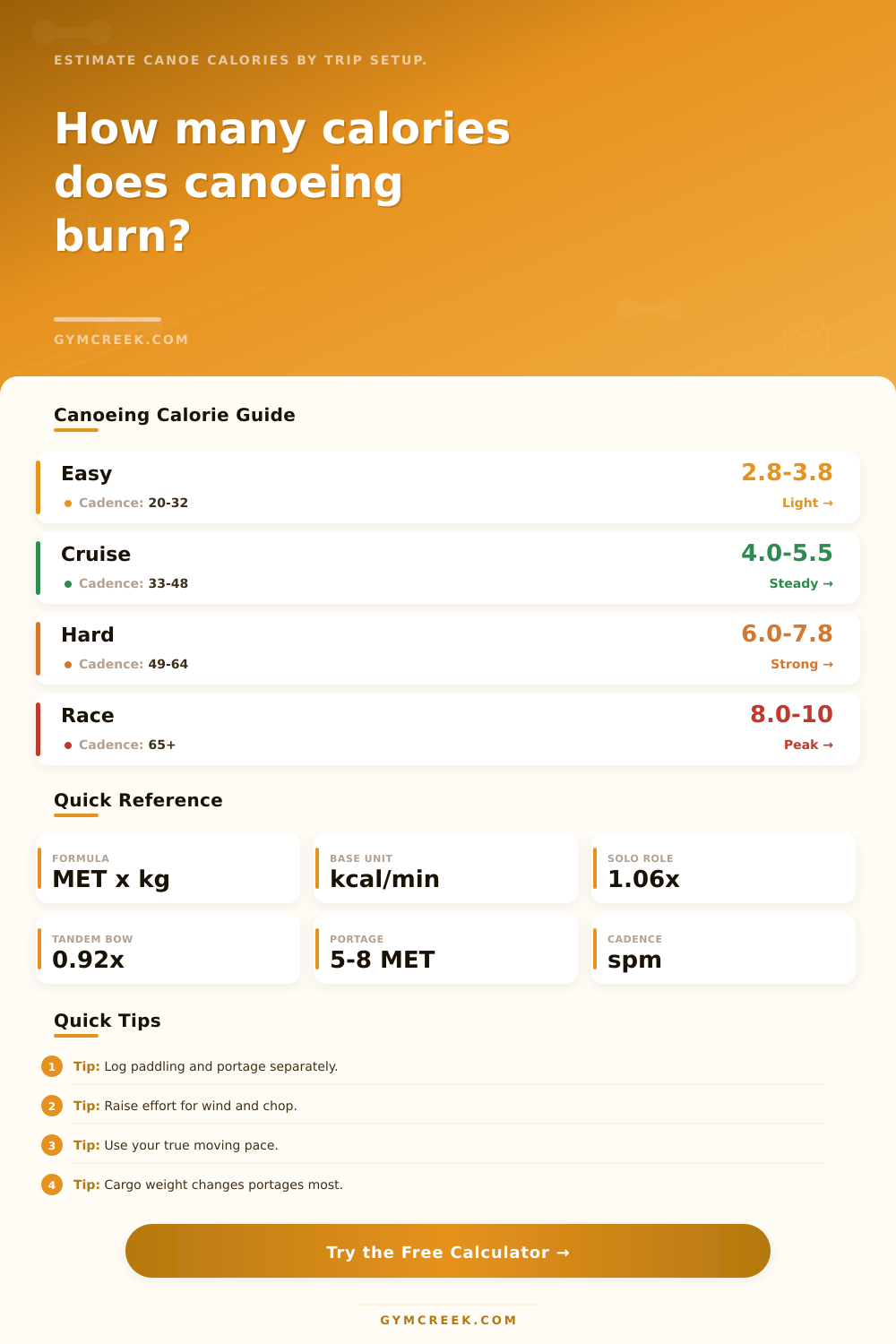
Calories per minute = MET x 3.5 x body weight in kg / 200. This drives paddling, rest, and portage estimates.
Base canoe MET is modified by boat role, cadence, water, wind, load share, and technique efficiency.
Portage MET starts from walking with carried load, then rises when your share of canoe and pack weight is higher.
Mifflin-St Jeor BMR estimates baseline energy, then activity level converts it to TDEE for a session share.
📑Reference Tables
| Canoe Scenario | Base MET | Typical Pace | Best Use |
|---|---|---|---|
| Easy recreational paddle | 3.2 MET | 1.5-2.5 mph | Short relaxed trips |
| Steady touring canoe | 4.8 MET | 2.5-3.5 mph | Day touring |
| Brisk fitness paddle | 6.4 MET | 3.5-4.8 mph | Conditioning |
| Hard upstream effort | 7.8 MET | 2.0-4.0 mph | Current work |
| Race pace intervals | 9.2 MET | 5.0+ mph | Marathon sets |
| Cadence Zone | Strokes/Min | Modifier | Meaning |
|---|---|---|---|
| Drift and steer | 10-24 | 0.88x | Low output |
| Easy cruise | 25-38 | 0.96x | Relaxed pace |
| Touring rhythm | 39-52 | 1.00x | Steady work |
| Fitness push | 53-68 | 1.09x | High output |
| Race bursts | 69+ | 1.18x | Peak rhythm |
| Condition | Modifier | Calories Effect | Notes |
|---|---|---|---|
| Current assist | 0.86x | Lower | Downstream travel |
| Flat water | 1.00x | Baseline | Calm lake |
| Mild chop | 1.07x | Higher | More correction |
| Headwind | 1.10-1.25x | Higher | Power demand |
| Technical river | 1.18x | Higher | Steer and brace |
| Formula | Variables | Output | When Used |
|---|---|---|---|
| MET kcal | MET, kg, min | Calories | Main estimate |
| Route time | Distance, pace | Minutes | Moving split |
| Portage MET | Load, share | Carry burn | Land carries |
| Mifflin BMR | kg, cm, age | Baseline | Daily context |
💡Tips
When you hop in your canoe and start paddling, you might discover it take a lot of effort to move the boat. You might think it doesn’t take much work because it looks easy from the shore. It does, especialy if the conditions aren’t ideal. The calorie burn in paddling is real, but how many depends heavily on the conditions.
Distance = effort is the assumption of most paddlers. That’s wrong. If I paddle five miles downwind on a flat, glassy lake and then turn around and paddle back upwind into rough waves, that last trip took 10 times longer than the first one even though the distance traveled was the same.
Why Paddling Is Harder Than You Think
After entering your individual variables into the calculator above, all the math are done for you. No more guesstimating if your outing was a walk in the park or a true work-out. That estimate is based off something called MET values (metabolic equivalent of task). In short, METs are a comparison of exertion when moving versus sitting idle.
So three to four METs might be a leisurely pace on a boat. This is moderate exercise. Speed things up, add some wind resistance, and bring along some extra gear and the METs goes up. Your starting burn rate accounts for your age, gender, body weight, and environment. So instead of assuming one flat number for the whole trip, it assumes varying levels of intensity and comes out closer to reality.
What about boat set up? When going solo, all the work is yours. When you are out in a tandem canoe, the bow paddler will typically set the cadence, whereas the stern paddler handles much of the drive and steering. The calculator accounts for that.
It also takes into account cargo weight. A light day trip canoe rig with little but water, food, and maybe a tent is not as heavy as an expedition craft packed for an extended stay on the water. This adds drag that you has to overcome with each stroke, slowing you down. And if you end up carrying this overland, the burn rate spikes dramatically. Because it’s short, heavy, and challenging, portages tend to be some of the hardest parts of the trip. Unless you take them into account, it looks like you used less energy than you actualy did.
Water and wind conditions are wild cards. An easy paddle in calm water may become a grind in windy water. Similarly, a hard paddle feels easier with a tailwind, but harder with a headwind. You can choose conditions such as: difficult river navigation; rough water; or calm water. Each condition you select apply a multiplier to your base effort.
Technical swimming involves continuous correction strokes. These little movements add up. Even though you aren’t sprinting, they elevate your heart rate and engage your core.
Your cadence also plays a role. Shorter glides/higher stroke rate maintain higher intensity. Longer glides/lower stroke rate provide opportunity for recovery. Tracking your strokes per minute will help fine tune the estimate.
That’s why knowing your nutrition plan is so important. Under-estimating how much you’ll burn means you’re likely going to hit the wall, not great if you want to keep good dexterity and judgment while on the water. It’s safer to over-estimate, but that’s not very efficient. You’ll probably end up carrying more food than needed. That increases your pack weight and the vicious cycle continues.
The calculator breaks this vicious cycle. Now you have a target. Adjust your pack list accordingly. If you think it will be higher then expected, you could select a shorter trip, or just go lighter. If you think it will be higher than expected, you could bring along an extra snack.
Don’t skip out on recovery time. Being at a campsite floating around and waiting for others use calories too. Not zero, but low. Even resting on the water counts toward your total energy budget for the trip. And it shows how much of your total daily energy you burned paddling.
Was it a big part of an active day? It might have been just a small part of an active lifestyle. How much you did know will help you fit in other things. Paddle hard first thing in the morning and maybe take it easy later? Or do more in the afternoon and go light earlier?
On the page are some quick references to compare against. These are the benchmark tables. They show the ranges of MET that should be expected at various levels of effort. So, plug in a number based on what you think you do (then sanity check). If you say race pace but input a low speed then the tool knows something isn’t right and flags it. Feed in consistent data, get consistent results.
And don’t worry about perfecting it either. We just want to have a general idea of where we stand. Knowing that helps us perform better. It also keeps us safer. And finally it allows the next trip out to be even more fun because you’ll be paddling with a sense of purpose. Paddling to fuel with a purpose. You will head to the dock confident in how you did.