Calories per Pound Calculator
Compare daily calories per pound of body weight, food calories per pound, goal-adjusted intake, and the estimated calorie gap behind weight change.
📌Calories Per Pound Presets
Presets fill body stats, intake, bodyweight trend, and a sample food so the calculator can show both bodyweight calories and energy density.
⚙Calculator Inputs
Calories per pound snapshot
Enter body weight, calories, food serving data, and a weight trend to compare ratios.
📊Metrics Grid
📑Reference Tables
| Goal | Typical Kcal/Lb | What It Suggests | Check Against |
|---|---|---|---|
| Fat loss | 8 to 12 | Moderate deficit for many adults | Energy, training, hunger |
| Maintenance | 13 to 17 | Stable body weight range | Two-week average scale trend |
| Muscle gain | 16 to 20 | Common controlled surplus range | Waist, performance, gain rate |
| High activity | 18 to 24 | Endurance or hard training weeks | Recovery and weekly workload |
| Food Density | Kcal Per Lb | Kcal Per 100 g | Common Pattern |
|---|---|---|---|
| Very low | Under 300 | Under 66 | Watery vegetables and broth foods |
| Moderate | 300 to 800 | 66 to 176 | Fruit, potatoes, lean mixed meals |
| Dense | 800 to 1200 | 176 to 265 | Grains, meats, compact meals |
| Very dense | Over 1200 | Over 265 | Nuts, oils, sweets, dry snacks |
| Scale Trend | Energy Meaning | Best Use | Caution |
|---|---|---|---|
| Loss | Estimated deficit | Validate fat-loss pace | Water can exaggerate early drops |
| Stable | Near maintenance | Find personal TDEE | Use at least 10 to 14 days |
| Gain | Estimated surplus | Control lean-gain speed | Food timing can mask fat gain |
| Rapid swing | Mixed signal | Flag noisy data | Sodium, carbs, stress, digestion |
| Formula | Variables | Output | When To Use |
|---|---|---|---|
| Calories per lb | Daily kcal / body lb | Bodyweight ratio | Compare intake to body size |
| Mifflin-St Jeor | Age, sex, height, weight | BMR estimate | Baseline maintenance math |
| Energy density | Food kcal / food lb | Kcal per lb food | Compare serving volume |
| Trend energy | Weight change x kcal/lb | Daily gap | Audit real-world intake |
💡Tips
If this sounds familiar, then maybe you’ve noticed that despite tracking food, the scale doesn’t budge. Everything looks right on paper, you’re working out hard and eating all the right stuff. Maybe you blame yourself: you’re broken. Or maybe you assume it’s in your biology, bad luck! But the solution here is often as simple as doing some math wrong.
Specifically, you shift focus from total calories to calories per pound of body weight. That’s because it makes those numbers more concrete (and relevant for your physiology). A three hundred pound person doesn’t burn energy at same rate as a hundred pound person. It make no sense to tell them both to eat two thousand calories. The first would starve, while the second wouldn’t even notice a difference. To give you the same advice is generic.
Why You Should Track Calories Per Pound
The calculator above does this math for you. Rather than giving generic advice, it translate your inputs into a personalized ratio. All you have to do is input your current weight, height, sex and age. Next, choose an activity multiplier based off how much you move throughout an average week. Afterward, plug in your average daily intake and any recent body weight changes within a seven to fourteen day window.
The tool uses the Mifflin-St Jeor equation to estimate your basal metabolic rate. It then applies your activity level to determine your total daily energy expenditure. Lastly, it divide your intake by your body weight. What you get out of it is two separate numbers, which do two separate things for you.
One is the calories per pound of bodyweight. This tells you whether what you’re eating puts you into a surplus (too many calories), maintenance zone (the right amount for your size), or a deficit (not enough calories). And then the second one is the “food serving” number, which is the number of calories contained in every pound of actual food. That’s important, because we eat by volume.
The distinction is vital because volume eating relies heavily on low-density foods. And so when we talk about low-density foods, this is what we mean. For example, a scoop of peanut butter and a bowl of leafy greens weigh about the same. Yet the leafy greens contains only a fraction of the calories. When you want to feel full but also drop some fat, reducing that food density number do more than just reducing portion sizes.
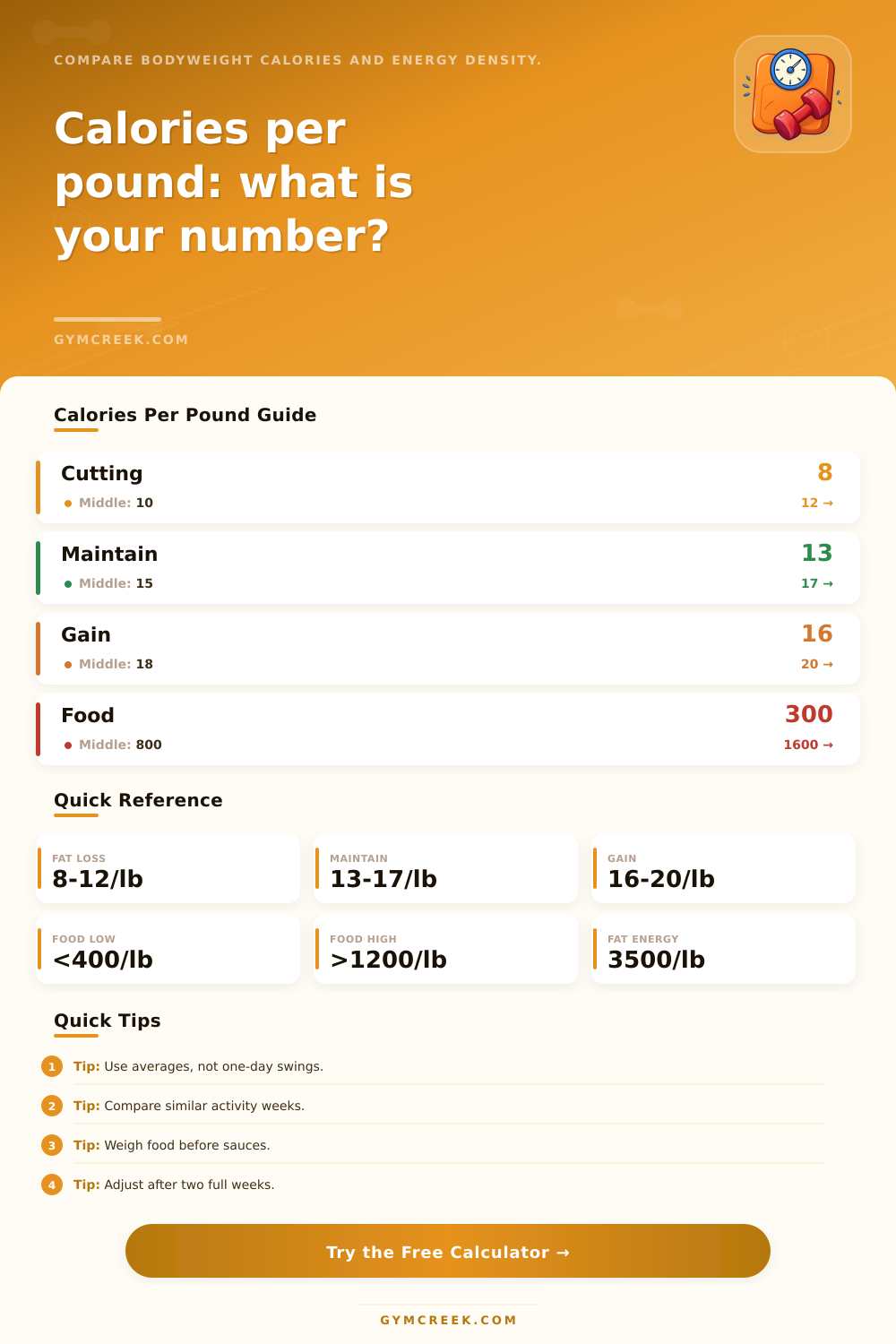
When it comes to most adults seeking sustained, slow fat loss, they wants somewhere between eight and twelve calories per pound. Older, more sedentary individuals tend towards the low end of that range. When looking to build muscle, a small surplus tends to be between sixteen and twenty calories per pound. Anything much greater than that risks storing more fat instead of growing muscle. Check out this table on the page to get an idea of this visually.
So now you can compare your current intake against those markers and see where you sit. Keep in mind, though, that scale weight changes a lot. It depends on how hydrated you are, what’s in your digestive tract (timing), what you ate last, and whether or not you’re retaining sodium. Never base anything on a one-morning weigh-in. Always average at minimum two weeks worth of data. That will help eliminate the noise and provide you with a true picture of what’s actualy occurring metabolically.
The calculator has a trend gap function. This function use your most recent weight changes to determine how far off you are eating, assuming about 3,000 to 3,500 calories equals a pound of weight gained or lost. For instance, if it calculates you should of lose two pounds and you’ve only dropped half a pound then it’ll highlight this and make you check your tracking or recalculate your activity level. Early results will be hidden by water weight, so wait it out! Don’t cut things back drastically instead make minor tweaks.
Once you learn it, you’re not obsessively counting calories anymore, you’re controlling where your metabolism takes you. You go from guesswork to measurement. That’s true whether you want to add lean mass or lose some stubborn fat, having an exact amount of fuel to feed yourself for each pound of bodyweight means no more guesswork. It makes sense out of a messy pile of numbers and puts you on an action plan.
So pull out your number and compare it with these standard ranges. Now tweak your intake to match the trend gap. Then let the numbers tell you what to do next. It’s about precision, not intensity. Focus on consistency, not perfection. Dial-in your personal number and everything else will fall into place.