Calories Burned Climbing Stairs Calculator
Estimate calories from stair climbing using body weight, stair height, floors, duration, load, and intensity, with MET and vertical-gain cross-checks.
📌Stair Workout Presets
Presets load realistic stair scenarios. Edit any field after loading one, especially floors, duration, and stair height.
⚙Calculator Inputs
Stair calorie snapshot
Enter your stair session to estimate active calories, gross calories, vertical gain, and intensity.
📊Fitness Metrics Grid
📑Reference Tables
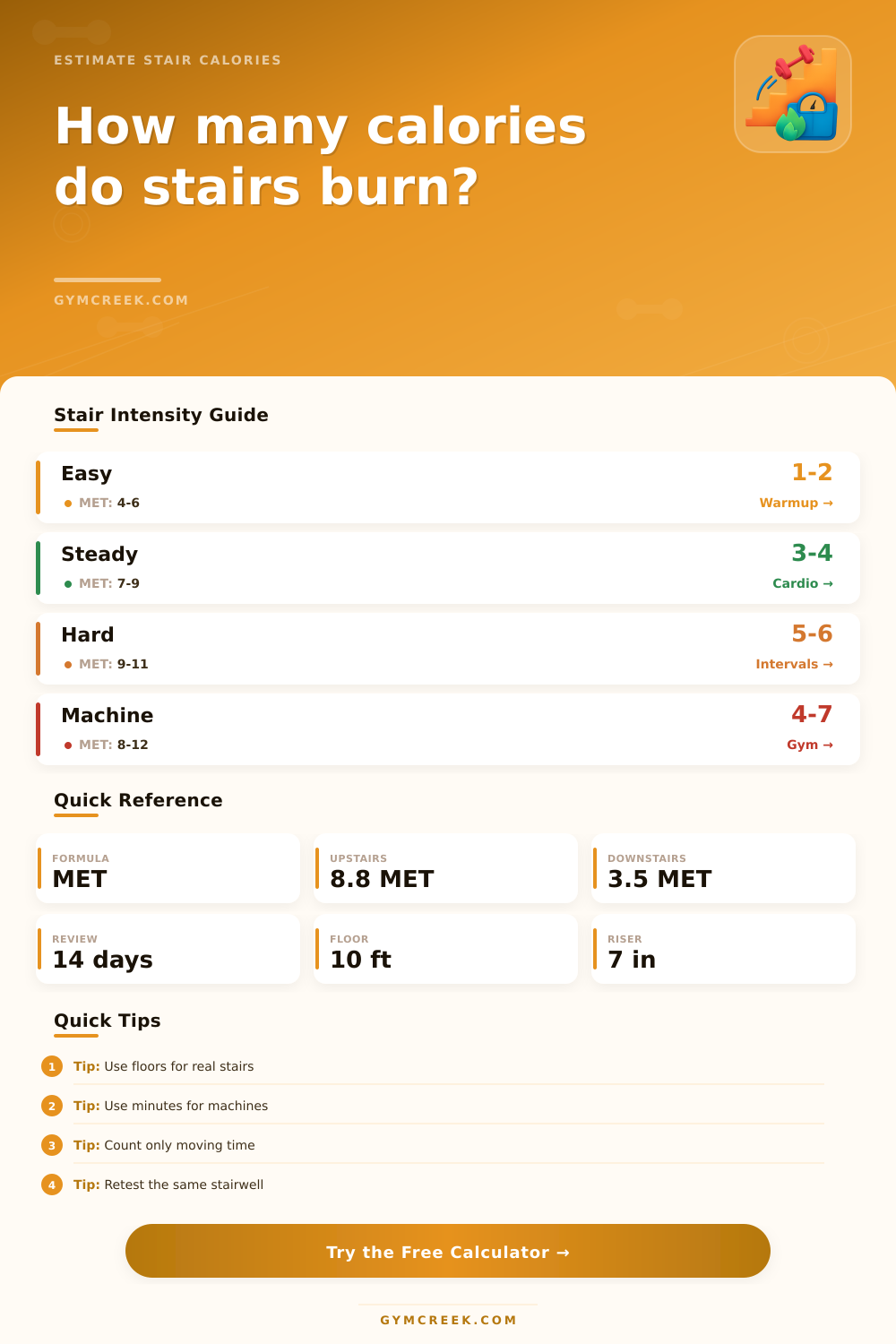
| Stair activity | Base MET | Best match | Calculator adjustment |
|---|---|---|---|
| Walking downstairs | 3.5 | Descending flights | Lower mechanical cost |
| Easy stair climbing | 4.0-6.0 | Slow office or recovery climbs | Easy effort or low pace |
| Climbing upstairs | 8.8 | Steady stair climbing | Default up-only mode |
| Stair climber machine | 9.0 | Continuous gym machine work | Machine mode baseline |
| Fast stair intervals | 10.0-12.0 | Hard repeats or stadium climbs | Interval mode and pace bumps |
| Pace | Floors per minute | Likely feel | Use case |
|---|---|---|---|
| Very easy | Under 1.5 | Comfortable breathing | Recovery or breaks |
| Steady | 1.5-3.0 | Warm but controlled | General fitness |
| Brisk | 3.0-5.0 | Hard breathing | Cardio conditioning |
| Fast | 5.0 plus | Interval effort | Short repeats |
| Setting | Steps per floor | Riser height | Vertical gain |
|---|---|---|---|
| Office building | 14-18 | 6.5-7.5 in | 8-11 ft per floor |
| Apartment stairs | 12-18 | 7-8 in | 7-12 ft per floor |
| Stadium section | 20-35 | 6-8 in | 10-20 ft per repeat |
| Stair machine | Displayed | Machine set | Use machine floors |
| Formula | What it estimates | Inputs | When to use |
|---|---|---|---|
| MET calories | Gross exercise energy | MET, kg, minutes | Main calorie estimate |
| Active calories | Calories above resting | (MET - 1), kg, minutes | Workout tracking |
| Vertical work | Mechanical climb cost | Mass, gravity, height | Cross-check floors |
| Mifflin-St Jeor | BMR context | Weight, height, age, sex | Daily calorie context |
| Activity multiplier | TDEE context | BMR and activity | Compare with daily needs |
💡Tips
When you walk up stairs, you’re lifting your own bodyweight up against gravity. And that burns some calories. At least, that is how it looks (as a fairly simple exercise in physics).
But those stadium bleachers aren’t the same as staircase leading to your apartment. Not by a long shot. Your speed matter. The height of the steps matters. Even the total amount of vertical gain matter. To know exactly how many calories you’re torching, you must take into account shape of your climb. And generic estimations never do.
Why This Calculator Is Better Than Others
Enter your stair dimensions, duration, and weight. The calculator then does math for you. No need to guess about how height of each riser affects your metabolic cost. Most common calculators makes assumptions about a hypothetical “average” step height. But stairs aren’t all made equal. A short, shallow step in an office building might need more steps per floor than a tall, steep riser in an aging apartment complex. Even though the overall vertical gain would of been equivalent, they’d have different metabolic costs because energy use follows both movement frequency (the number of steps) closely as well as elevation gain (rise). To account for that difference, the tool allows you to enter in your own individual riser height and steps per floor. Then, it spits out a result that’s tailored to your unique environment instead of some average one.
It also matters that your workout is intense. Sprinting up multiple flights before resting will cause a very different metabolic response than climbing steadily at a conversational pace. To reflect this in the tool, I’ve built an “effort” multiplier that adjusts the MET value according to how hard it feel. When you’re in the moderate to high range where you’re breathing hard but able to speak in fragments, then you’re burning way more fuel per minute than you would during a leisurely climb. Many people only consider number of floors they climb and vastly underestimate effect of their pace. The former tells you distance; the latter tell you cost. Without considering the latter, you’ll overestimate your activity and be surprised when you don’t meet expectations.
Another overlooked factor is load. Carrying a pack or wearing a weighted vest increases mechanical work you do with each step. It changes how your muscles recruit force to perform the same function with added weight. The calculator takes this into account by having an additional load field so you can model weight bearing tasks such as rucking or tool carrying without basing it solely on bodyweight. This is very helpful if you are training for any activity that has a heavy demand on load bearing endurance. This is particularly useful for those training for specific physical demands where the goal is not just cardio but also load-bearing endurance.
The chart on the page explains it further via the metabolic equivalent reference table where various activities maps onto metabolic equivalents. From here you pick the appropriate base then adjust up/down from there based off your own factors.
Rest periods are a silent saboteur. Counting stair walks for 10 mins and rest on landing for 15 mins as 25 mins of exercise? That is wildly inflated. The tool distinguishes between active moving time, vs. Rest. It calculates the calories you burn during those moments where your body’s doing the work. Precision leads to accurate habit building. You start to value the quality of movement more than the amount of time spent on the stairs.
One of the best methods I’ve found for blending strength work with cardio exercise is stair climbing. There’s no equipment needed, and it can be performed virtually anywhere with a staircase. Where stair climbing becomes difficult is that it can be tricky to know exactly how hard you’re working, or how to improve over time. With a focus on load, pace and vertical gain (not merely counting floors) stair climbing transforms a boring act of getting somewhere into something you can measure as a form of training stimulus. They’re not exact numbers by any means, but they serve as an outline to help quantify how much you’re pushing yourself.
Soon enough you realize that stairs makes a noticeable difference in your legs over several weeks of steady, measured effort. You also begin to understand what those steps mean in terms of exertion. And that awareness. THAT’S the real win.