Calorie Surplus Calculator
Estimate a practical surplus from maintenance calories, body weight, training schedule, appetite tolerance, activity changes, and your gain timeline.
⚡Surplus Presets
Presets fill all inputs and immediately calculate a sample plan.
⚙Calculator Inputs
Surplus plan
Enter your numbers to estimate a gain-focused calorie target.
📊Metrics Grid
📑Reference Tables
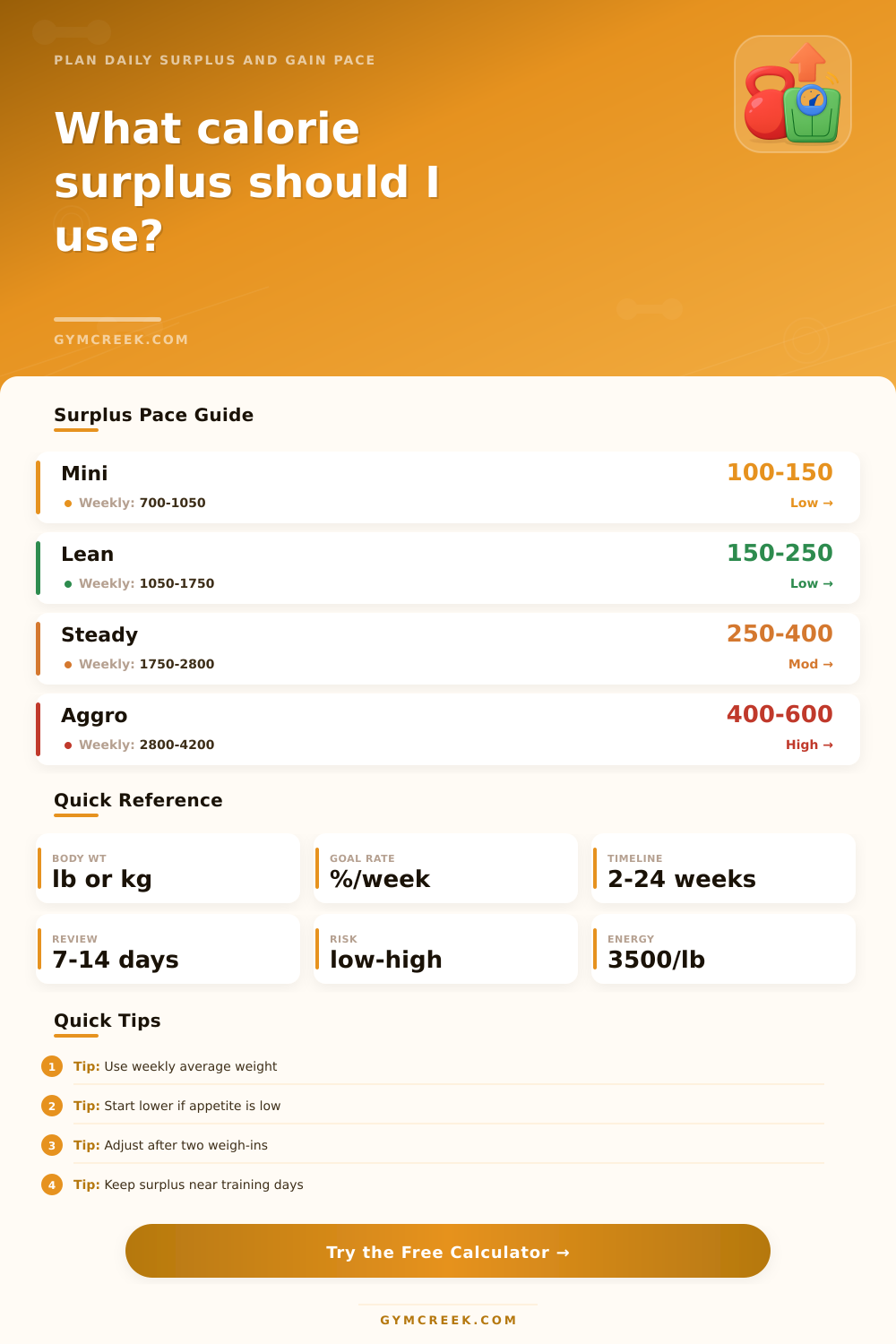
| Band | Daily surplus | Gain rate | Use case |
|---|---|---|---|
| Low | 100-250 | 0.1-0.4% | Lean bulk |
| Moderate | 250-450 | 0.4-0.7% | Most lifters |
| High | 450-650 | 0.7-1.0% | Hardgainer |
| Very high | 650+ | 1.0%+ | Short phase |
| Profile | Rate | Timeline | Note |
|---|---|---|---|
| Advanced | 0.1-0.25% | 12-24 wk | Slowest |
| Intermediate | 0.25-0.5% | 8-20 wk | Balanced |
| Novice | 0.5-0.75% | 8-16 wk | Productive |
| Hardgainer | 0.75-1.0% | 6-12 wk | Monitor waist |
| Checkpoint | If gain is low | If on track | If gain is high |
|---|---|---|---|
| Week 1 | Hold | Hold | Hold |
| Week 2 | Add 100 | Hold | Cut 100 |
| Week 4 | Add 150 | Hold | Cut 150 |
| Monthly | Recheck TDEE | Repeat | Reset rate |
| Step | Formula | Input | Output |
|---|---|---|---|
| Gain target | Wt x rate | Body wt | lb/wk |
| Energy | Gain x 3500 | lb/wk | kcal/wk |
| Daily | Weekly / 7 | kcal/wk | surplus |
| Target | TDEE + add | activity | kcal/day |
💡Tips
A calorie surplus occur when an individual consume more calories then their body burn each day. While a calorie surplus are required to gain muscle, too larger of a surplus or maintaining a surplus for too long can lead to increased body fat. To avoid gaining fat and still gain muscle, an individual must determine the apropiate amount of calorie they need to consume and for how long they should consume these calories.
A calorie surplus calculator can help an individual determine the amount of calories they should consume each day to create the appropriate surplus to encourage muscle gain while avoid fat gain. The calculator takes into consideration an individual’s body weight, the number of calories they needs to maintain their current weight, the intensity of their training program, and their level of appetites. Many individuals attempt to create a calorie surplus through guesswork to determine how many calorie they should consume each day.
How to Use a Calorie Surplus Calculator to Gain Muscle Without Gaining Fat
However, individuals who add too many calorie to their surplus might gain too much body fat, and those who add too few calorie to their surplus might not gain any muscle. A calorie surplus calculator remove the guesswork for individuals by calculating the calories they should consume each day. The calculator can determine these calories by considering the individual’s training schedule.
Individuals who trains more often can consume more calories without gaining too much body fat. The calorie surplus calculator also consider an individual’s appetite. Individuals with low appetites can consume fewer calorie than those with higher appetite.
The calculator display three main piece of information for users: the amount of calories they should consume daily to create a surplus, the amount of calories they should consume weekly, and the projected change in their body weight. These three piece of information allow individuals to see the impact of the size of the surplus on the rate at which they gain weight. Large daily surpluses will result in rapid gain of body weight and muscle.
However, very large daily surpluses require monitoring to avoid the gain of body fat. In cases where an individual is gaining the amount of weight the surplus calculator indicate they should, the calculator also include an adjustment schedule. If an individual’s weight does not change after two week, the schedule recommends increasing the number of calories consume by the individual by a small amount rather than a large amount to encourage the gain of body weight.
The reference table provided to individuals who utilize the calculator display the number of calories that should be consumed to gain a specific amount of weight each week. These tables allow individuals to determine whether they want to gain their body weight at a lean or aggressive rate. These tables also indicate how often the individual should monitor their weight and what they should do if their weight change too quickly or too slowly.
Individuals must monitor their weight regular because their maintenance calories can change due to alteration in their activity, job, or sleep schedules. It is common for individuals to use the calorie surplus calculator to establish the target calories they should consume each day but then to ignore the calculator once they have established that target. The calorie surplus calculator calculate the calories an individual should consume based on their initial body weight and activity level.
However, as their body weight increase, the number of calories they consume should be adjusted. Every four to six week, individuals can use the calculator to determine their new target calories to ensure the surplus they create match their current body weight. The calorie surplus that is created for muscle gain also have a relationship with an individual’s recovery schedule.
A calorie surplus will only result in the gain of muscle if the individual also consume enough calories to support their training and has a low level of stress in their lives. If an individual does not consume enough sleep, the surplus of calorie will only result in increased fatigue. Although the calorie surplus calculator does not calculate an individual’s sleep cycle, the calculator can display the number of calorie an individual should consume each day.
If the target for that individual’s calorie surplus is already very high, they may need to adjust their sleep and recovery cycles instead of increasing the calories they consume. Individuals should focus on the weekly average of their body weight rather than the daily weigh-in they perform to track their progress. The reason behind this emphasis on the weekly average of body weight is that individual’s weigh-ins can fluctuate dramatic from day to day due to water weight, sodium consumption, and glycogen level.
A successful calorie surplus is one that the individual can sustain, create the body weight gain that the individual desires, and can be easily adjusted if their body weight is not changing at the rate they desire. To start the calorie surplus process, individuals should consume the calories calculated by the surplus calculator. After two week, individuals can adjust the calories they consume if necessary to continue creating a surplus of the amount that will result in the gain of muscle.