Calorie Partition Calculator
Split calories across protein, fats, carbs, training days, rest days, and workout meals using body stats, goal phase, activity, and weekly training structure.
◎Presets
Presets load realistic calorie partition setups and calculate instantly.
⚙Calculator
Calorie partition snapshot
Enter your inputs and calculate the split.
▦Fitness Metrics
▣Reference Tables
| Goal | Protein target | Fat floor | Carb role |
|---|---|---|---|
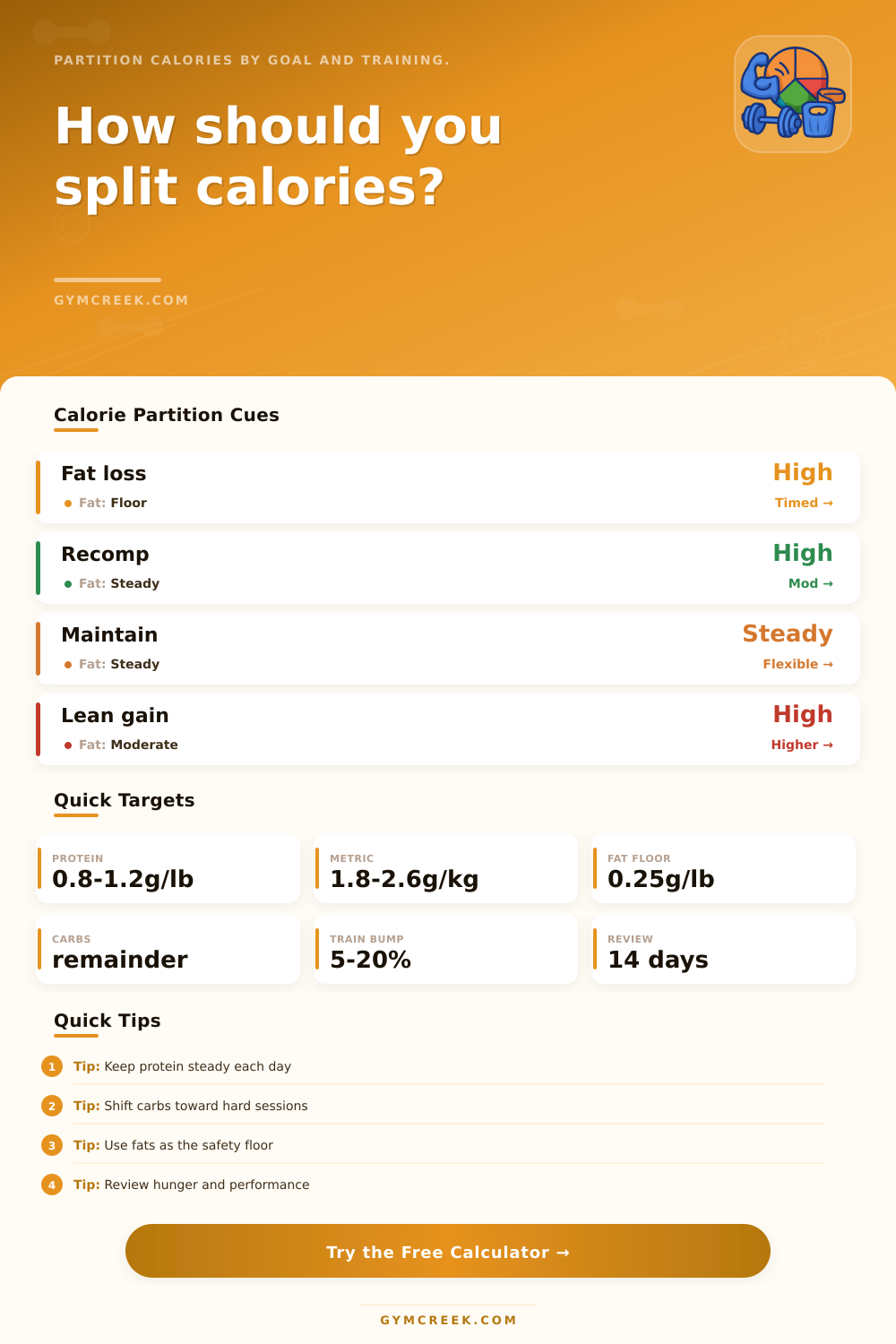
| Fat loss | 0.9-1.2 g/lb or 2.0-2.6 g/kg | 0.25-0.35 g/lb or 0.55-0.75 g/kg | Performance remainder |
| Recomposition | 0.8-1.1 g/lb or 1.8-2.4 g/kg | 0.28-0.40 g/lb or 0.60-0.90 g/kg | Moderate timing bias |
| Maintenance | 0.7-1.0 g/lb or 1.6-2.2 g/kg | 0.30-0.45 g/lb or 0.65-1.00 g/kg | Flexible remainder |
| Lean gain | 0.8-1.0 g/lb or 1.8-2.2 g/kg | 0.30-0.45 g/lb or 0.65-1.00 g/kg | Training fuel priority |
| Training days | Best bump | Rest day cue | Use when |
|---|---|---|---|
| 0-2 days/week | 0-8% | Keep steady | Low training frequency |
| 3-4 days/week | 5-15% | Small calorie dip | Most lifting weeks |
| 5-6 days/week | 8-20% | Moderate dip | High volume blocks |
| 7 days/week | 0% | No rest split | Daily sport practice |
| Window | Calorie share | Protein cue | Carb cue |
|---|---|---|---|
| Pre workout | 10-20% of day | 25-40 g | Moderate carbs |
| Post workout | 15-25% of day | 25-50 g | Higher carbs |
| Long session | 25-45% of day | Evenly split | Highest priority |
| Rest day | No workout share | Keep steady | Lower if needed |
| Formula | Inputs | Used for | Notes |
|---|---|---|---|
| Mifflin-St Jeor | Age, sex, height, weight | BMR estimate | Good general baseline |
| Katch-McArdle | Lean body mass | BMR alternate | Used when body fat is entered |
| Activity multiplier | BMR and activity | TDEE estimate | Sets calorie starting point |
| Macro calories | Protein 4, carbs 4, fat 9 | Partition check | Carbs receive the remainder |
◇Tips
When you’re controlling things by tracking calories, you quickly realize calories aren’t created equal. In terms of how your body works, consuming 2k cal of cheese will have a different effect on your body than if you consume it as a mix of chicken breast and pasta. Your body responds both to how many calories you take in AND whats contained within those calories.
That’s why partitioning is important. It helps you create a clear structure for meeting a daily goal. It takes into account your training intensity and your need for recovery. Without it, most people will stop at the grand number and go into the rest of the week confused about their hunger cues and energy levels.
How to Use a Macro Calculator
After establishing your activity level and baseline stats, the calculator do all the work. It eliminates the guesswork of matching carbohydrate supply with fat floors and protein requirement. Simply input your height, weight, age, and actual training frequency, and it spits out a split that accounts for how your body work. That’s important; the fuel needs of a person lifting heavy weights four times per week differ from those of a sedentary office worker.
If you’re attempting to maintain your current physique, the tool will modify the macro distribution accordingaly. There’s a good reason why protein comes first in this equation: When you’re in a calorie deficit, it help protect lean mass and it gives you building blocks to help with muscle repair. One of the smartest things you can do for yourself is keep protein consistent on both rest days and training day. This way, whether you spent the morning lifting weights or sitting on the couch, your body has the necessary nutrients it need.
You’ll notice that the calculator locks your protein number in place for calculation purposes, since that’s one of the biggest mistakes people make. They let their protein intake vary widely from day-to-day depending on how hungry they feel.
Next, we will look at fats. Dietary fat is required for best hormonal health; which means dipping too far below this line will cause your body to release more cortisol, resulting in diminished recovery capacity. To prevent this, the tool has a bottom-line for you to hover at or above. Eat enough fat to help your body make hormones, but not so much that it crowds out actual fuel-producing carbs (the kind used during high-intensity performance). It’s a fine line, particularly under calorie restriction.
Whatever’s left over gets taken up by carbohydrates. They’re the most adjustable source of energy. Hard-training athletes wants those glycogen stores full. So they shift some excess carb intake towards training days (and keep it lighter on rest days). That aligns your fuel supply with demand, increasing exercise performance during workouts while minimizing needless body-fat storage during off-days. You can adjust this “bias” within the calculator to provide maximum support to your toughest efforts.
Consider this: Think of it more like a template than gospel. Every week will vary in terms of training intensity, hunger levels, life events. Use tool’s included reference tables to see how changing the ratios based off your goal affects the results. For example, this shows why the numbers change during a lean gain phase versus a recomp phase.
After about two weeks on the split, reflect on how you felt. Do you notice that performance has suffered? Maybe increase your overall calorie intake a little and move some of those carbs toward training days. But it has to be sustainable. Perfect split on macros but not being able to maintain it more than a few days doesn’t help anyone.
Pay attention to how you feel: when are you hungry? When do you have lots of energy? Tweak those percentages a little bit to match your life, instead of trying to force your life into fitting around these numbers. At some point you’ll end up at a partition that feels right, that works for your day-to-day life while also helping you reach whatever physical goals you might have.
THAT is where calorie counting can truly work over time.