🔥 Most Accurate Calorie Deficit Calculator
Mifflin–St Jeor BMR + TDEE & personalized deficit for safe, sustainable weight loss
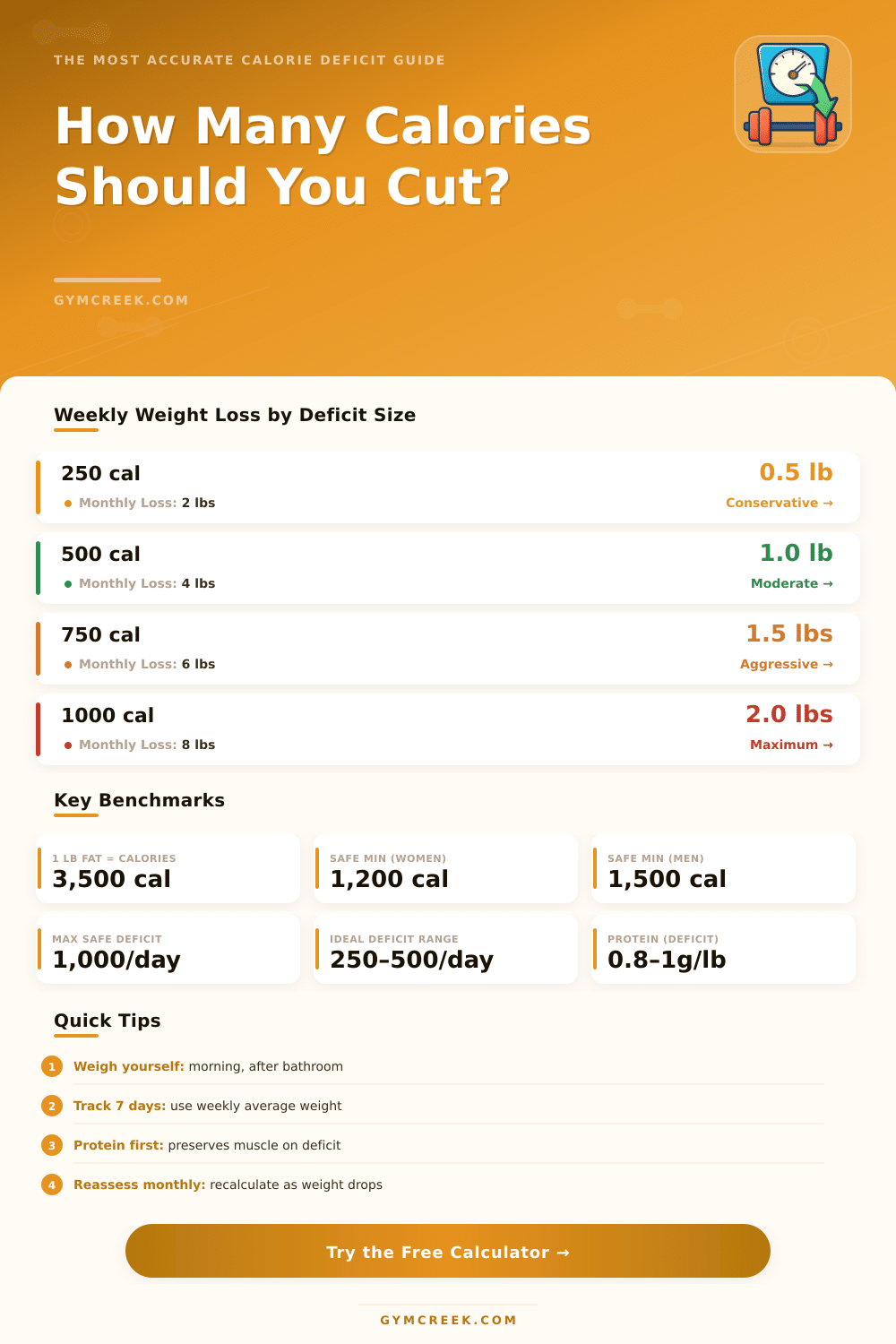
| Daily Deficit | Weekly Loss (lbs) | Monthly Loss (lbs) | Classification | Best For |
|---|---|---|---|---|
| 100–200 cal | ~0.2–0.4 lbs | ~0.8–1.6 lbs | Very Conservative | Maintenance phase, small adjustments |
| 250 cal | ~0.5 lbs | ~2 lbs | Mild | Beginners, athletes, small goals |
| 500 cal | ~1 lb | ~4 lbs | Moderate ✨ | Most people, sustainable long-term |
| 750 cal | ~1.5 lbs | ~6 lbs | Aggressive | Short-term, close supervision |
| 1000 cal | ~2 lbs | ~8 lbs | Maximum Safe | Clinical settings, high starting weight |
| >1000 cal | >2 lbs | >8 lbs | Unsafe ⚠️ | Not recommended — muscle loss risk |
| Activity Level | Multiplier | Description | Examples |
|---|---|---|---|
| Sedentary | 1.2 | Little/no exercise | Desk job, TV, walking very little |
| Lightly Active | 1.375 | 1–3 days/week | Casual walks, light gym 1–2x/wk |
| Moderately Active | 1.55 | 3–5 days/week | Gym 3–5x/wk, recreational sports |
| Very Active | 1.725 | 6–7 days/week | Daily intense training, labor job |
| Extra Active | 1.9 | Physical job + 2x/day training | Athletes, military, manual laborers |
| Category | BMI Range | Body Fat % (Men) | Body Fat % (Women) |
|---|---|---|---|
| Underweight | <18.5 | <6% | <16% |
| Normal / Healthy | 18.5–24.9 | 6–17% | 16–28% |
| Overweight | 25–29.9 | 18–24% | 29–35% |
| Obese Class I | 30–34.9 | 25–30% | 36–41% |
| Obese Class II | 35–39.9 | 31–35% | 42–46% |
| Obese Class III | ≥40 | >35% | >46% |
| Diet Style | Carbs % | Protein % | Fat % | Best For |
|---|---|---|---|---|
| Balanced | 40% | 30% | 30% | General health, sustainable dieting |
| Low Carb | 20% | 40% | 40% | Insulin sensitivity, steady energy |
| High Protein | 30% | 40% | 30% | Muscle preservation on deficit |
| Ketogenic | 5% | 30% | 65% | Rapid fat loss, appetite control |
| Mediterranean | 45% | 20% | 35% | Heart health, long-term adherence |
Calorie deficit appears when the body burns more calories than it receives. Really it is that much simple cause. When fewer calories enter than the body spends, then follows weight loss.
DISCLOSURE: This post may contain affiliate links, meaning when you click the links and make a purchase, I receive a commission. As an Amazon Associate I earn from qualifying purchases.

In that case the body turns to fat reserves, to cover the missing energy that it requires.
How a Calorie Deficit Makes You Lose Weight
Imagine the body as machine. It requires energy, so it burns it every day. Even during sitting still the whole day, the body still uses calories.
For a typical woman around 1 500 calories, and for men about 2 000. So, if someone burns 2 000 calories and eats only 1 700, that creates a deficit of 300 calories.
The simple math works like this: daily eaten calories minus daily burned calories equal the Calorie deficit. To lose one pound, you need a total deficit of around 3 500 calories. A daily deficit of 500 calories helps a person lose about one puond during a week.
That deficit can happen by eating 250 fewer calories daily and burning an extra 250 through exercise.
To find the right daily numbers, count how many calories the body needs just to keep its current weight. Online calculators and apps can help with that. When the number for keeping weight is known, reduce what you eat by 200 to 500 calories under it to form a normal deficit.
A deficit of 250 calories, which matches half a pound a week, works four some folks.
For instance, if someone needs 2 500 calories daily to keep their weight and eats only 2 000, that makes a 500 Calorie daily deficit. Over one week it adds up to 3 500 calories, which matches one pound lost. Here it really matters to carefully track the food.
Weighing it on a kitchen scale helps to reach correct counts. A spoonful of peanut butter does not always weigh what folks assume.
It is better to have a healthy diet with fewer calories, but rich in nutrients, than to simply go hungry. Choosing foods like whole grains, lean proteins and healthy fats helps to stop hunger between meals. Also drinking lots of water is important.
Too low cutting of calories can cause loss of muscle tissue, which is bad, because muscles are the most active parts in the body and theyburn calories.
Exercise helps weight loss, because it creates a bigger deficit. Even so, depending only on exercise is not the best method. Too big a Calorie deficit can hurt the metabolism, hormones and mood over time.
It is smarter to eat at a level that allows you to keep or grow your activity, while you stay in deficit. When the body becomes slimmer, the deficit itself should shrink. Patience really matters here.