Calorie Cycling Calculator
Build a weekly calorie target with higher intake on demanding training days and lower intake on easier days while keeping the weekly average aligned with your goal.
◎Presets
Presets load realistic calorie-cycling setups and recalculate instantly.
⚙Calculator
Calorie cycle snapshot
Enter your stats and calculate the weekly calorie distribution.
▦Fitness Metrics
▣Reference Tables
| Goal style | Weekly bias | High days | Low day feel |
|---|---|---|---|
| Fat loss cycle | Deficit | 1-3 | Noticeable |
| Recomposition | Small deficit | 2-4 | Moderate |
| Maintenance | Neutral | 2-4 | Gentle |
| Lean gain cycle | Surplus | 3-5 | Small dip |
| Activity | Multiplier | Typical week | Cycle note |
|---|---|---|---|
| Sedentary | 1.20 | Desk based | Keep low mild |
| Light | 1.375 | Steps plus lifts | 2 high days |
| Moderate | 1.55 | Train 3-5 days | Best fit |
| Very active | 1.725 | Daily training | Use mod days |
| Cycle setup | High | Moderate | Low |
|---|---|---|---|
| Simple cut | 2 days | 2 days | 3 days |
| Lift focus | 3 days | 2 days | 2 days |
| Endurance | 2 days | 4 days | 1 day |
| Lean gain | 4 days | 2 days | 1 day |
| Formula | Inputs | Use when | Output |
|---|---|---|---|
| Mifflin-St Jeor | Age, size | Most users | BMR |
| Katch-McArdle | Lean mass | Body fat known | BMR |
| Activity factor | BMR, level | Daily needs | TDEE |
| Weekly delta | Goal rate | Cycle target | Average |
◇Tips
The old saying goes: “Consistency is key.” So you’ve probably been told to consistently consume exactly the same amount of calories each day without exception. On paper, this makes sense. To lose two pounds per month, simply create a calorie deficit (and stick to it like glue).
Unfortunately, real life doesn’t conform to linear equations. You’ll be hunched over an office chair for eight hours on some days, and then have heavy lifting sessions or long endurance workout on other days. Telling yourself these use the same amount of energy is inefficient. It doesn’t account for how much your energy output change.
How Calorie Cycling Works
For something more nuanced, there’s calorie cycling. It’s really simple: match your calories consumed with calories expended. If you’re busting it out, feed yourself accordingly. If you’re chilling, chill. Eat less. With this system, your overall weekly calorie average remain on track, but you fuel accordingly during workouts/recovery periods.
All you have to do is plug your numbers into the calculator they offer. They’ll figure out the math so you don’t have to guess at balancing high and low days. All that’s left for you is understanding what those entries mean in terms of your own week.
First, set a baseline: What’s your basal metabolic rate (BMR), or how many calories you’d burn if lying still? Your total daily energy expenditure (TDEE) are determined by your age, height, weight, and activity level. To get an even better idea of what fuel your body requires, know your body fat percentage (but that’s fine if you don’t). For a good start, basic equations will suffice.
Be truthful about your activity level. If you’re pretty sedentary but say you lead a moddern lifestyle, you’ll accidentally eat to much. After setting the baseline, you specify what the rest of your week look like. How many days are low effort vs high? A low effort day would be something like resting or taking a leisurely stroll. On the other hand, a high effort day is something like a long endurance workout or heavy lifting session.
The tool will fill in the calories according to the pattern you created, matching your desired weekly intake. It will give you a deficit on an easy day and a surplus on a hard one. And the magic is realizing that weight change comes from the average for the week, not any given day. So yes you can eat extra on Tuesday if you make up for it on other days.
The other key factor is protein. You’ll get a target from the calculator, which will depend on your lean mass. That’s important because protein build muscle when we’re gaining, but also protects muscle when we’re losing weight. In most cases, it makes more sense to keep your protein consistent every day rather than yo-yoing it up and down.
The variable source of fuel here is carbohydrates. These replenish our glycogen reserves post-workout. Shifting more carbs toward intense workout days give us extra energy in the gym to really hammer away. Often, the rest of the nutrition comes from fat. It supplies hormonal support and keeps us full.
Now you’re probably thinking: do I really need all this detail for a few pound loss? For someone who’s new to fitness then yes, simple calorie counting works fine. But once you progress, your body adjusts to consistent deficits. That’s where cycling can help. Your metabolism gets the message that food isn’t scarce; it’ll be there again soon. Psychologically, this diet is also easier because you have something to anticipate: those high days! You won’t have to feel deprived every day.
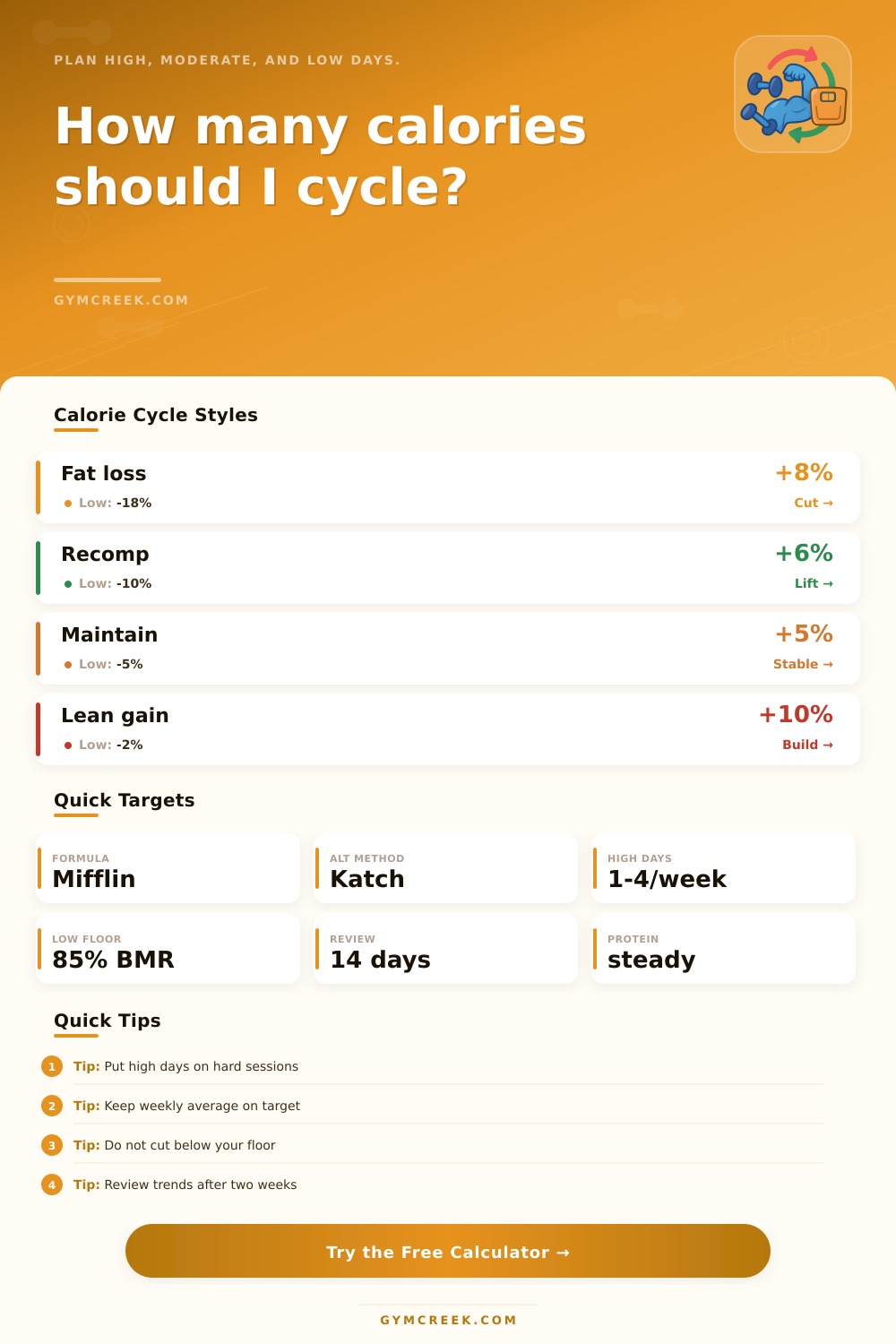
On the page, there’s a table explaining the various styles (from lean gains to aggressive fat loss), and each one has its own mix of deficit and surplus days. Don’t obsess over exact measurements. They’re rough estimates; they aren’t hard science. Use the starting values given by the tool. Monitor your energy levels and weight for a couple of week. Bump up your calories if you’re feeling beat-down during high days. Check your low day intake if the scale isn’t budging. Little tweaks goes a long way.
It’s about creating a rhythm that feels sustainable, one that complements your training instead of competing with it. You’re constructing a biological system. And it has to work with you. Yes, consistency remains key. But now there is room for flexibility. That’s the big plus.