
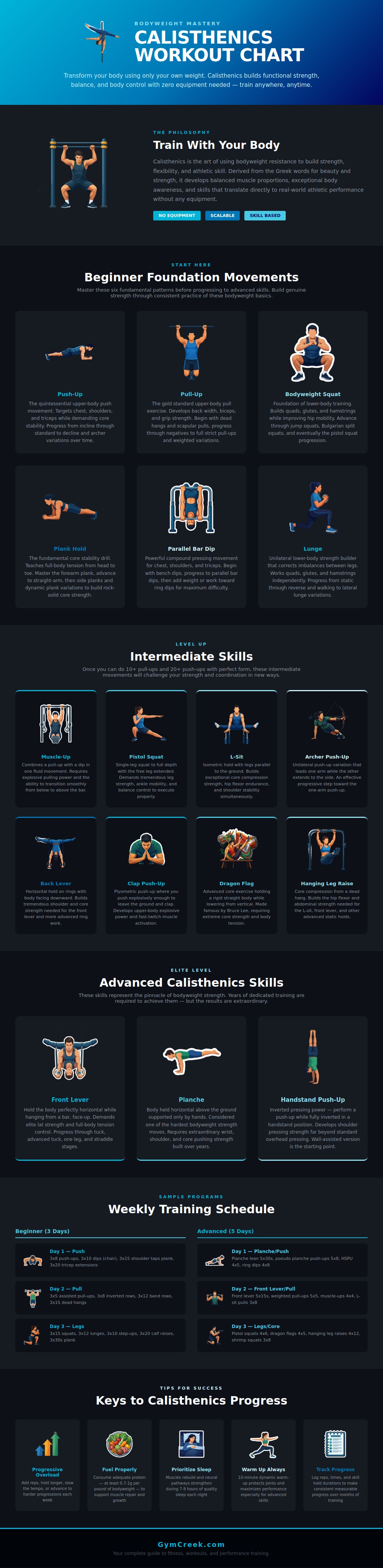
Calisthenics are the name given to a form of exercise that uses a person’s body weight as the resistance for the movements. No gym membership or weight racks is required for individuals performing calisthenics exercises. Some of the benefits of calisthenics is that individuals can significantly increase their strength using minimal equipment, such as a pull-up bar.
There is a specific progression for calisthenics exercises, from the easiest to the most challenging. To begin calisthenics exercises, individuals must start with basic exercises. Performing basic exercises allow individuals to learn how their body functions as a single unit.
Learn Calisthenics Step by Step
Some of the most common basic calisthenics exercises include push-ups, pull-ups, squats, planks, dips, and lung jumps. These types of exercises are beneficial to perform because they enable individuals to strengthen multiple joint and muscle groups at the same time. Performing a variety of these exercises enable individuals to create a solid foundation for more challenging calisthenics exercises.
If individuals skip to more challenging exercises without mastering these basic exercises, they may struggle with more challenging exercises, such as handstands or lever due to a lack of a solid foundation. Once individuals have mastered the basic calisthenics exercises, they can begin to learn intermediate exercises. Some of these exercises include muscle-ups, pistol squats, L-sits, and back levers.
These exercises require more strength than the basic exercises and need more precise body position. For this reason, it take more time to learn these exercises than the basic exercises. The small step that individuals take to improve their skills in these exercises over time will lead to better performance in intermediate calisthenics exercises.
For instance, an individual may take many month to learn how to transition their body when performing a muscle-up, or how to ensure that there hips is high when performing an L-sit. More challenging calisthenics exercises exist, which is classified as the most advanced calisthenics movements. Some of these exercises include front levers, planches, and handstand push-ups.
These exercises require many year of training to learn how to perform these exercises proper. Following the suggested progression of calisthenics exercises from basic to intermediate to advanced will ensure that an individual have the strength necessary to perform the most advanced movements. Without having the proper strength, an individual will struggle and become frustrated when attempting to learn these more harder exercises.
To effectively perform calisthenics exercises, individuals of all levels require specific schedules. Beginners may follow a three-day calisthenics schedule, performing only one type of calisthenics exercise every day. Three days are a sufficient period for beginners to rest their muscles between calisthenics session.
More advanced calisthenics athletes may perform calisthenics exercises five days a week. Five-day schedules can be divided into push days, pull days, and leg days for those more advanced in calisthenics skill. Performing calisthenics five days a week will allow an individual to focus on specific physical attribute without overexerting their body each day.
Additionally, rest days are necessary for the nervous system and joint to rest. If an individual perform calisthenics too often without allowing their body time to rest, they will stall in their calisthenics progress. Long-term results from performing calisthenics depend on specific habit.
One of the most important calisthenics habit is the principle of progressive overload. Progressive overload is a training principle that requires an individual to challenge themself with calisthenics exercises that become more difficult over time. Some ways to challenge themselves includes increasing the number of repetition of an exercise, increasing the length of time to hold an exercise, or performing more challenging variation of the same exercise.
Furthermore, an individual must incorporate proper nutrition and sleep when performing calisthenics exercises. An individual must incorporate protein into their diet as it enable their body to repair itself. Additionally, sleep is necessary for the brain to learn the exercises that the body remembers.
Proper warm-up are necessary prior to performing calisthenics exercises as this will prevent injury to the shoulders and wrists of the calisthenics athlete. Calisthenics as a system is simple due to the minimal equipment required for individuals to perform the exercises. Aside from a calisthenics pull-up bar and a flat surface for the body to perform on, there is no other equipment necessary to perform calisthenics exercises.
The fewer the tool required to learn calisthenics, the more critical an individual must adhere to a proper progression schedule for their benefit. By following the proper progression, an individual will see steady improvement in their ability to perform the same type of calisthenics movement.
