Calisthenics Calorie Calculator
Estimate calories burned from calisthenics using body weight, MET intensity, reps, rounds, work density, rest time, and exercise style.
📌Calisthenics Presets
Each preset combines a real calisthenics style with MET, rep density, rest time, and bodyweight load share so the burn estimate changes by workout type.
⚙Calorie Inputs
Calisthenics calorie snapshot
Enter a session to estimate calories from METs, reps, body weight, and rest time.
📊Fitness Metrics Grid
📑Reference Tables
| Calisthenics Type | Base MET | Body Load Share | Best Use |
|---|---|---|---|
| Mobility flow | 3.0 | 35% body weight | Warm-up or recovery |
| Push-up work | 4.6 | 64% body weight | Upper-body endurance |
| Pull-up or row work | 5.8 | 85% body weight | Strength and pulling |
| Squat and lunge circuit | 5.2 | 78% body weight | Leg volume |
| Core and plank session | 3.8 | 45% body weight | Trunk control |
| Full-body circuit | 6.5 | 72% body weight | Mixed conditioning |
| Burpee or HIIT work | 8.5 | 90% body weight | High burn intervals |
| Skill practice | 4.2 | 60% body weight | Handstands or rings |
| Weighted vest work | 7.0 | 100% body weight | Loaded calisthenics |
| Intensity | MET Change | RPE Range | Session Feel |
|---|---|---|---|
| Easy | -20% | 2-4 | Can talk easily |
| Steady | -8% | 4-6 | Breathing rises |
| Moderate | Baseline | 6-7 | Focused circuit |
| Hard | +15% | 7-9 | Short phrases only |
| Near-max | +28% | 9-10 | Interval effort |
| Scenario | Example Work | Likely MET | Calorie Pattern |
|---|---|---|---|
| Skill practice | Holds, rests, attempts | 3.5-5.0 | Lower but technical |
| Strength sets | Pull-ups and dips | 4.8-6.5 | Moderate with rests |
| Density circuit | Push, pull, legs, core | 6.0-8.0 | High continuous burn |
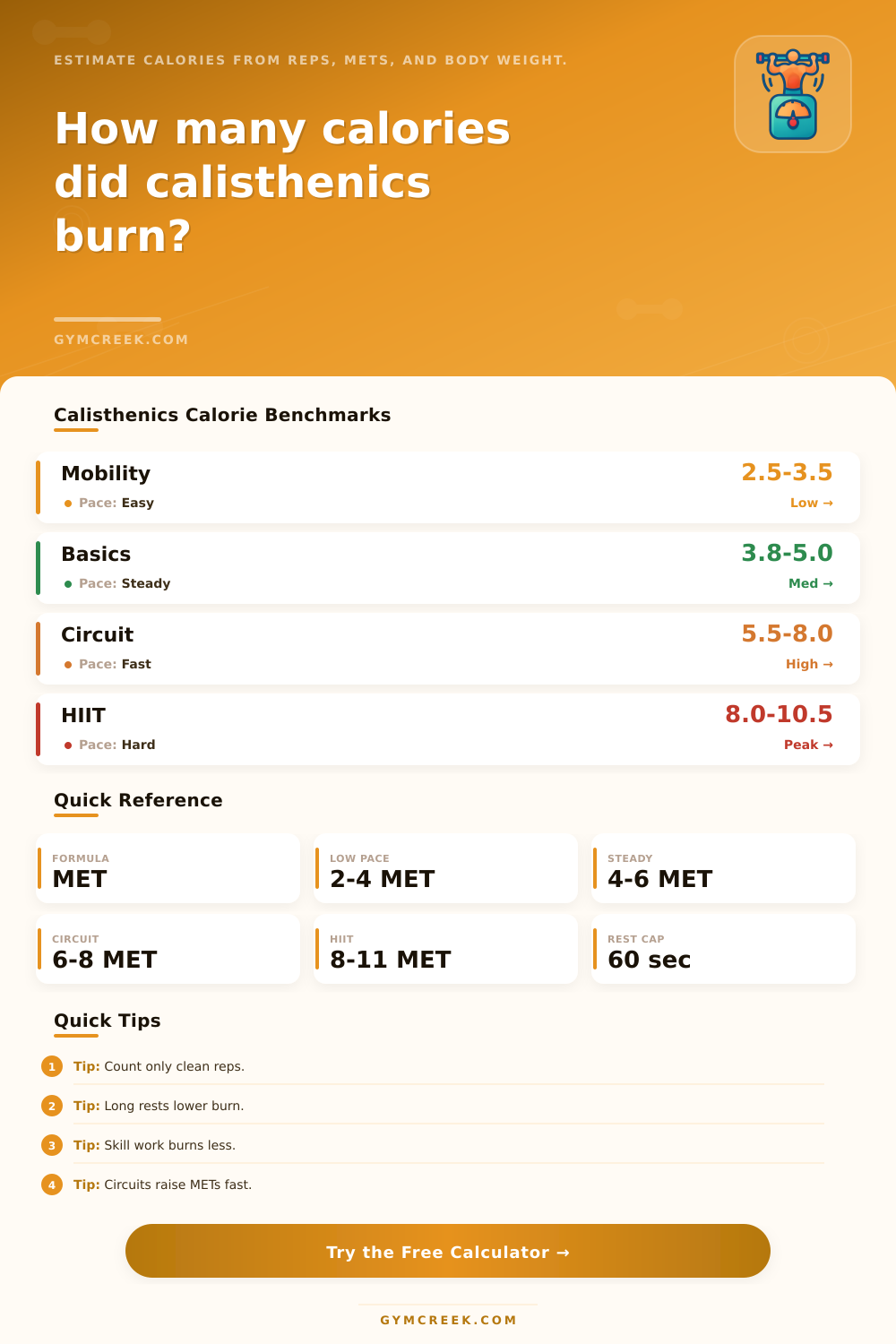
| HIIT finisher | Burpees and jumps | 8.0-10.5 | High plus afterburn |
| Recovery flow | Mobility and easy reps | 2.5-3.8 | Low steady burn |
| Formula | Used For | Inputs | Output |
|---|---|---|---|
| MET calories | Exercise burn | MET, kg, minutes | Session kcal |
| Rep density | Workload tuning | Reps, rounds, rest | Density score |
| Mifflin-St Jeor | BMR context | Age, sex, height, weight | Daily baseline |
| Rest adjustment | Active rate | Rest seconds, rounds | Active minutes |
| Afterburn factor | Hard sessions | MET and RPE | Extra kcal range |
💡Tips
Using just your body weight and gravity, you can burn calories from comfort of your livig room. That sounds like a pretty straightforward plan. Here’s where things get confusing. Depending on how fast you move and how long you take to rest, your body will use varying degrees of energy to move your weight around. If you perform several sets of air squats versus a handful of heavy pull-ups, the energy requirements varies. The confusion usually stems from lumping all bodyweight exercises together. You won’t.
Calisthenics includes a wide variety of activities including high-intensity circuits and mobility flows. They elict opposite metabolic responses. One will keep your heartrate close to your resting rate while the other will spike it into red zone. Knowing the difference between these two activity will help you understand if you’re moving towards exhaustion or recovery on a given day.
How to Use the Calorie Calculator
To do this, you simply set parameters for the texture of your session, and let the calculator perform calculations for you. You do not need to guess at coefficients which vary depending off the nature of your movements. All you have to do is set a foundation for the estimate by setting the parameters of your gender and bodyweight. Naturaly, the more you weigh, the more energy it takes to pick yourself up off ground (that’s not an opinion, it’s physics).
Next, you describe the nature of the workout. What kind of workout are you doing? How hard is it? This determines what we call the Metabolic Equivalent of Task value, otherwise known as MET. In short, MET is a multiplier of your metabolic rate. If you’re doing easy mobility work, where you’ve got lots of breathing room and minimal resistance, then the number will be somewhere around 3 METs. On the other end of the spectrum, if you’re doing burpee circuits, then you’ll be climbing into the eight or nine MET range. This means you’ll have big muscles working constantly and you’ll need to recover your heart rate very quick. That’s a massive spread. And that means the difference between sucking wind and taking casual sips from a water bottle.
The other place most people get it wrong in practice is during rest time. We see them hit start on a timer for thirty minutes and assume they worked all thirty of them. Most times we’re dead wrong. On average, the calculator compensate for the rest between rounds. Taking a minute between rounds will greatly lower the total burn rate. Even if each round was brutal, the calculator compensates for this. It brings down the total active calorie rate by an appropriate amount for total resting time.
Then there’s the issue of rep density. Performing more reps with less rest creates a metabolic drain that builds up fatigue and body temperature quicker then doing fewer reps with longer rests. It’s not just the peak effort but the continued load as well.
The other wrinkle here is skill practice. When I’m learning a new skill like a ring muscle-up or handstand, my brain is firing up the jets as hard as it can just to stay balanced and hold my muscles tight. Yet, even though it seems so damn hard, the amount of calories it’s burning might actualy be pretty minimal. You’re stopping and falling down a lot. You take time to think, get back into position, and catch yourself when necessary. There will be brief moments of intense spiking and then many minutes of doing nothing but sitting there. Even though it feels like a ton of work, the calculator takes that into account and gives the skill inputs a lower MET value. Mental effort does not equal caloric expenditure. In fact, they hardly ever match at all when exercising with your own bodyweight.
Lastly, check out that afterburn effect in the output metrics. High intensity interval training creates excess post-exercise oxygen consumption. In other words, your body continues to burn more calories for hours afterward, repairing tissues and refilling its energy reserves. Your low intensity flow doesn’t create any debt like that.
So what’s it gonna be? Do you want to stack up some rounds? Do you want to reduce your rests, select explosive movements, and go for a high number? Or would you rather dial it down to protect your joints and mobility, taking the trade-off of a lower burn for longer life? The numbers don’t make that call for you; they simply show you what you’re calling for. Most fitness isn’t all-or-nothing, don’t overemphasize one variable at the expense of others. Fitness is about focusing your effort on what matters to you. Sometimes that’s practicing a newly acquired skill. Other days, it’s shredding some calories. With this calculator as a mirror, you can see what you’re actually doing. Then you can turn the dials until your results match your intentions. Either way, the body could of scored out.