Calf Raise Load Calculator
Estimate calf raise load from bodyweight contribution, standing, seated, donkey, unilateral setup, reps, tempo, range of motion, pause, and ankle mobility.
📌Calf Raise Presets
Presets cover standing, seated, donkey, machine, dumbbell, unilateral, high-control, and mobility-limited calf raise sessions.
⚙Calculator Inputs
Calf raise load snapshot
Enter bodyweight, external load, variant, tempo, and ROM to estimate calf demand.
📊Calf Metrics Grid
📑Reference Tables
| Variant | Bodyweight Share | Main Bias | Load Note |
|---|---|---|---|
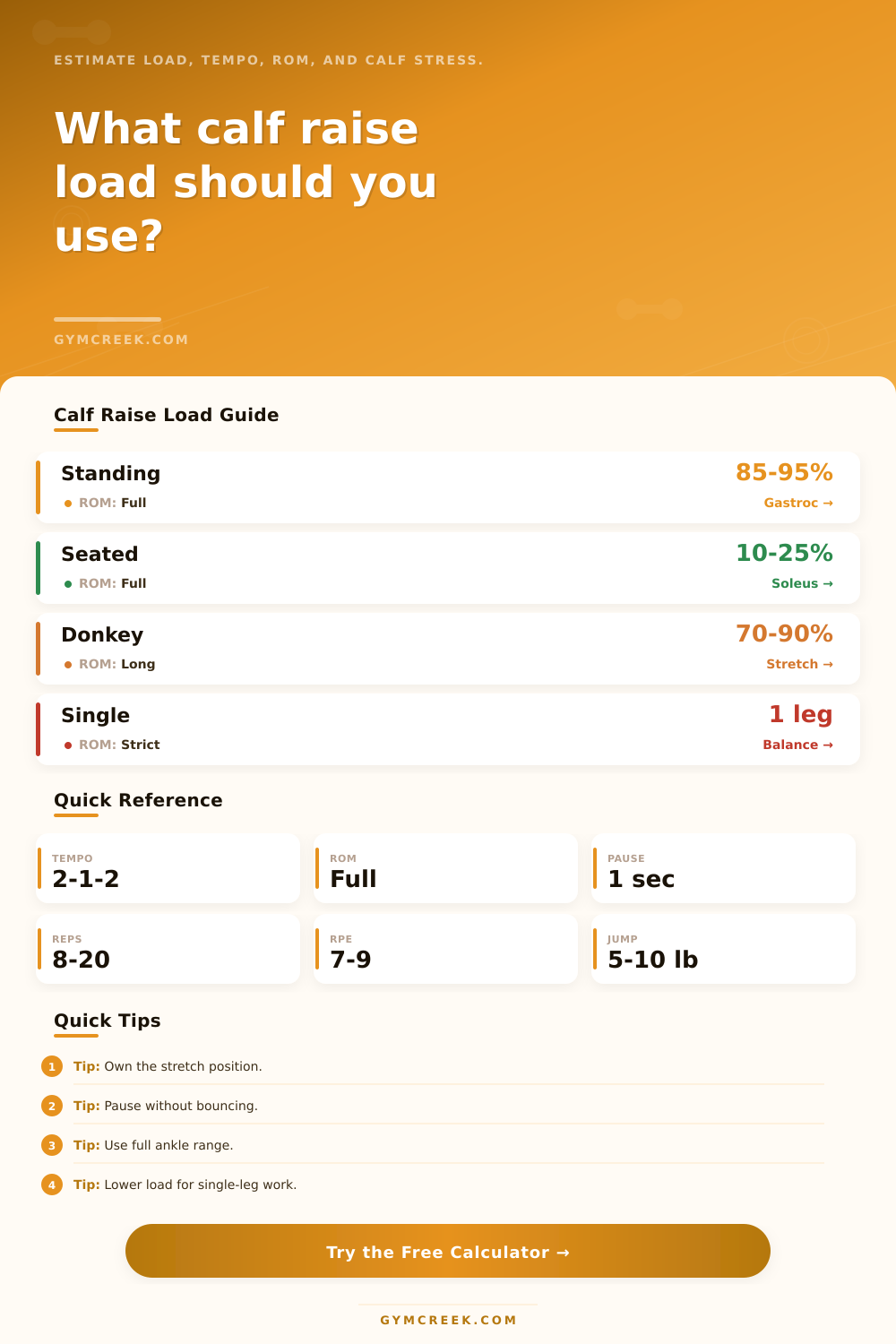
| Standing | 85-95% | Gastrocnemius | High system load |
| Seated | 10-25% | Soleus | External load matters more |
| Donkey | 70-90% | Loaded stretch | Body angle changes demand |
| Leg press | 0-15% | Stable overload | Sled angle affects feel |
| Rep Zone | Goal | RPE | Load Choice |
|---|---|---|---|
| 4-8 | Strength | 7-9 | Heavy, strict |
| 8-15 | Hypertrophy | 7-9 | Moderate-heavy |
| 15-25 | Endurance | 6-8 | Controlled pump |
| 20-35 | Tendon prep | 5-7 | Slow and smooth |
| ROM Target | Factor | What It Means | Watch Point |
|---|---|---|---|
| Short partial | 0.82 | Reduced travel | Avoid ego load |
| Mid-range | 0.92 | Controlled middle | Keep height even |
| Full ROM | 1.00 | Stretch to raise | Use same depth |
| Deficit | 1.12 | Deep stretch | Reduce bouncing |
| Tempo | Rep TUT | Stress Add | Best Use |
|---|---|---|---|
| 1-0-1-0 | 2 sec | Low | Power rhythm |
| 2-1-2-1 | 6 sec | Moderate | Hypertrophy |
| 3-2-2-1 | 8 sec | High | Position skill |
| 4-2-3-2 | 11 sec | Very high | Control block |
💡Calf Raise Tips
Calf training is something most folks do as an afterthought. They’ll grab some random weight and slap it down for a couple of sets.
Calf muscle are tough. They has to support your entire body weight when standing, running or walking. They’re used to taking a ton of stress and doing very little work. You need to disrupt this adaptation to get them to grow. And precision is key.
How to Train Your Calves Correctly
Your body weight changes depending on the exercise you do so you can’t just guess what weight to use. Now, with those two inputs (external load and variant), the calculator does the math for you, no guesswork required to determine if a standing exercise challenge the gastrocnemius or not.
Most importantly: the variant determines what proportion of your weight goes towards the work. Standing raises are a type of lever where your bodyweight is dead load. That means, when performing a standing calf raise, your calves will have to lift almost all of your bodyweight, plus whatever weight you add onto the bar.
You’ll see folks loading up standing raises, both too little and too much. Why? They forget about their bodyweight and throw on too much weight. The combined load is more than they can control which forces them to use poor form.
Perform calf raise. A seated calf raise is not the same thing; here, you’re flexing at your hips. As such, it removes the gastrocnemius and more or less isolates the soleus muscle. Your bodyweight contribution drop to roughly ten to twenty-five percent of the standing value. The primary driver of resistance becomes the external load, a hundred pounds on a seated machine doesn’t feel like a hundred pounds on a standing machine.
This is how the tool accounts for that change, and why we should trust its numbers instead of our gut feeling when doing a standing raise: we won’t underload the soleus.
Tempo is a secret ingredient that derails results. The body uses the Achilles tendon’s elastic energy for bouncing off the floor. It bypasses the muscle fibers. Bouncing trains the tendons instead of the muscles.
Your tempo dictates how much stress the calculator estimates, which favors deliberate pausing and slow eccentric movements. For example, forcing a two second descent means the muscle have to handle the weight, not gravity. Gravity does not do your lifting for you.
And people do this incorrect; they believe more weight equals more good. In fact, a lighter controlled load with a full stretch generate more muscle growth then a heavy weight used for a partial rep. You need to own the stretch position, and range of motion is critical.
Partial reps will decrease mechanical tension (shortening the movement = less tension). You may find yourself tempted to do partials if your ankle are tight, or other areas lack mobility. Don’t do that! The fix isn’t reducing range of motion; it’s lowering the weight so you can get into full stretch with good form. Does mobility limit your load? The tool will help you figure out if that’s the case.
Lifting with both sides masks asymmetries revealed by single-side work. Switching to a single-leg setup accounts for change in load distribution and lack of stability. Chances are you’ll lift less weight, but it will be more intense on each muscle fiber.
Balance out your strength with this and see how rep ranges map to things like strength vs. Tendon health (the reference tables). This will help you align your load to your training phase.
Progressive overload + full stretches + consistent tension = calves that don’t give a damn about your ego. The numbers on the screen are just the beginning; the actual work occurs within the gym.
Slow the tempo down, reach for the bottom of the stretch, and fight the temptation to bounce. Begin with the calculated load, emphasize the quality of contraction, and allow the weight to come with the form. This is how you grow ’em.
You should of used a more moddern approach to training. Actually, it’s naturaly difficult to get right without help. Your progress will depend on the furnitures in the gym too.