Calf Muscle Size Calculator
Compare left and right calf circumference against height, ankle size, bodyweight, and estimated lean mass to understand proportion and side-to-side symmetry.
📌Presets
Each preset fills a complete frame profile with height, bodyweight, calf size, ankle size, body fat estimate, and measurement context.
⚙Calculator
Calf size snapshot
Enter calf, ankle, height, and bodyweight values to calculate proportion and symmetry.
📊Fitness Metrics Grid
📑Reference Tables
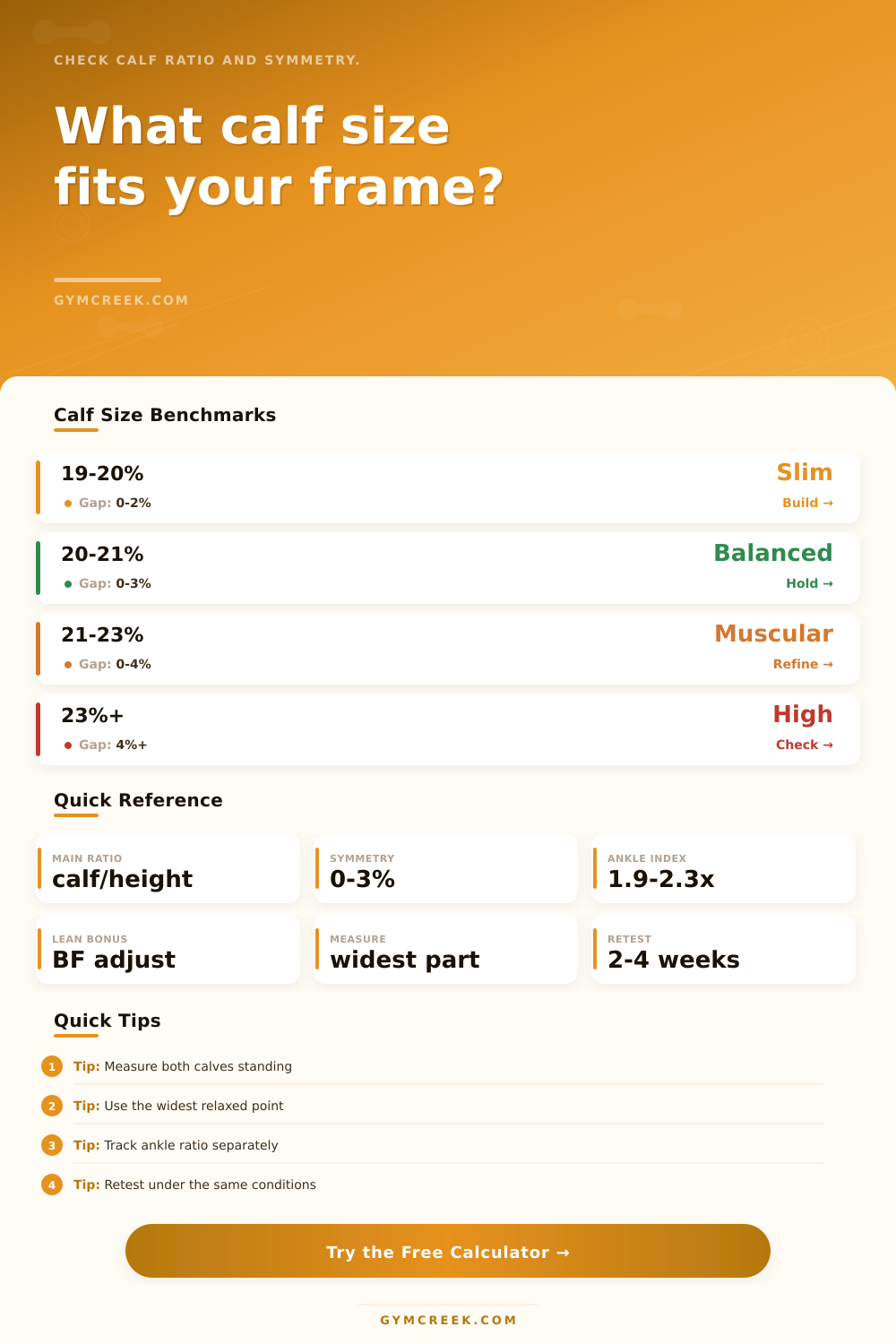
| Calf-height ratio | Band | Typical look | Tracking focus |
|---|---|---|---|
| Under 19% | Slim | Longer lower-leg line | Growth trend |
| 19-20.9% | Balanced | Proportional frame | Maintain symmetry |
| 21-22.9% | Muscular | Strong calf presence | Refine balance |
| 23%+ | High | Very prominent calves | Check context |
| Symmetry gap | Band | Meaning | Action |
|---|---|---|---|
| 0-1.9% | Even | Very close sides | Use average |
| 2-3.9% | Watch | Small visual gap | Retest later |
| 4-6.9% | Review | Clear side gap | Check history |
| 7%+ | High | Large difference | Seek guidance |
| Ankle index | Frame read | Interpretation | Note |
|---|---|---|---|
| Under 1.75x | Compact | Calf close to ankle size | Track change |
| 1.75-1.95x | Moderate | Common frame ratio | Compare sides |
| 1.95-2.25x | Defined | Strong calf taper | Good marker |
| 2.25x+ | High taper | Large calf over ankle | Check tape |
| Formula | Inputs | Output | Use |
|---|---|---|---|
| Calf-height | Calf / height | % ratio | Main frame score |
| Symmetry | Side gap / avg | % gap | Compare legs |
| Ankle index | Calf / ankle | ratio x | Frame taper |
| Lean index | Calf / lean kg | cm/kg | Mass context |
💡Tips
When most of us think about how we look when lifting, we concentrate on arm and chest size while pushing our calves to the back burner. Having big arms and a big chest are great, but you’re going to appear top heavy unless your lower legs visually balance out your upper body. Your calf genetics is notoriously stubborn, which means you need to know where you begin before you go balls-to-the-wall training.
Your raw circumference number might mislead you; a calf that measure forty centimeters may appear massive on a short individual or small on a tall one. Physique development has a lot to do with context, and you won’t know whether you’re making progress if you don’t consider this fact. Once you know your leg measurements and height, the calculator (above) does all the work for you. No need to try and eyeball it. It shows you what percent of your height is made up by your calves. This show how your calf size compares to your overall body shape. If it’s 20%, then you have more slender calves than someone who has a 25% number.
How to Measure Your Calves Correctly
It will also alert you if there is any difference between your left and right calf size. Most folks don’t pay attention to this information until they realize they’re having to push a little bit harder on one side while squatting. Old injuries or slight imbalances in everyday movement can lead to symmetry issues. By keeping track of the difference between the two sides, you’ll be able to catch it before it becomes a source of chronic pain.
Measuring your ankle is equally important. To figure out your ankle size, we compare it to your muscle belly. Then we divide your calf circumference by your ankle circumference. This give us your index number that tells us your amount of tapering. The higher the index number the more your calf separates from your bone, creating a V shape. If your ankles are larger than your calves, you’re not going to be able to change the bone structure through training. So work on getting the muscle to peak and become dense to make it look wider.
Once you know your frame type, you know what to expect. You cannot train for a body type your bones won’t allow, but you can maximize what you’ve got by working on density over sheer size. Your leg appearance will also be influenced by your body fat percentage. When there’s more fat on top of your muscles, it may mask any definition. This can make your calves look softer or more rounded instead of sharp. So the calculator factors this in so that you get an idea of what your results could of be if you were in better shape. Again, this isn’t “scale chasing”. You’re simply seeing what effect your current makeup has on the visual outcome of your efforts.
For example: Maybe you carry some extra weight and your calves is measuring big but it’s actualy due to fat storage and not muscle tissue. Knowing the difference between substance and size is what makes you look athletic instead of just looking big.
The time of day matters when taking measurements as well. You could see a difference of up to half an inch from one day to the next depending on the time of day. If you measure right after a hard workout like squats, then your reading may be higher than if you measured first thing in the morning. When monitoring your progress over time, consistency trumps precise measurement. Take all your measurements at the same time of day. Stand the exact same way during each measurement. Apply the same amount of tension with the tape. That ensures that you’re comparing apples-to-apples each time, not getting confused by day-to-day variation.
Stop gawking at raw circumference numbers. Instead get an idea of how it all fits into your overall body shape. Use this info as a check point… Where does my number fall in that range? You’ll find those benchmarks spelled out clearly on the page. This isn’t about competing with anyone else. It’s a dialogue with yourself and your journey. Knowing your baseline ratio provides a clear target to shoot for. And by “target,” I don’t necessarily mean gaining muscle, but perhaps leveling out some asymmetries.
You can be more strategic with your training based off real data instead of just doing random exercises. It’s mostly a matter of knowing what we’re really measuring. This method works because you stop using vanity metrics and start measuring in proportion. If you want to know if you’re moving in the right direction, you don’t have to guess. Just measure smart and you’ll train with purpose. The goal is always the same: building a physique that looks complete from all angles.