Caffeine Tolerance Calculator
Estimate your current caffeine adaptation, taper pace, reset length, and smarter event-day dose using habit, response, withdrawal, and sleep inputs.
📌Presets
Presets focus on tolerance patterns, not just a one-time dose: plateau, daily reliance, tapering, reset windows, and event resensitization.
⚙Calculator
Caffeine tolerance snapshot
Enter your current habit and adaptation markers to estimate tolerance and reset planning.
📊Metrics Comparison Grid
🧮Adaptation Drivers
📑Reference Tables
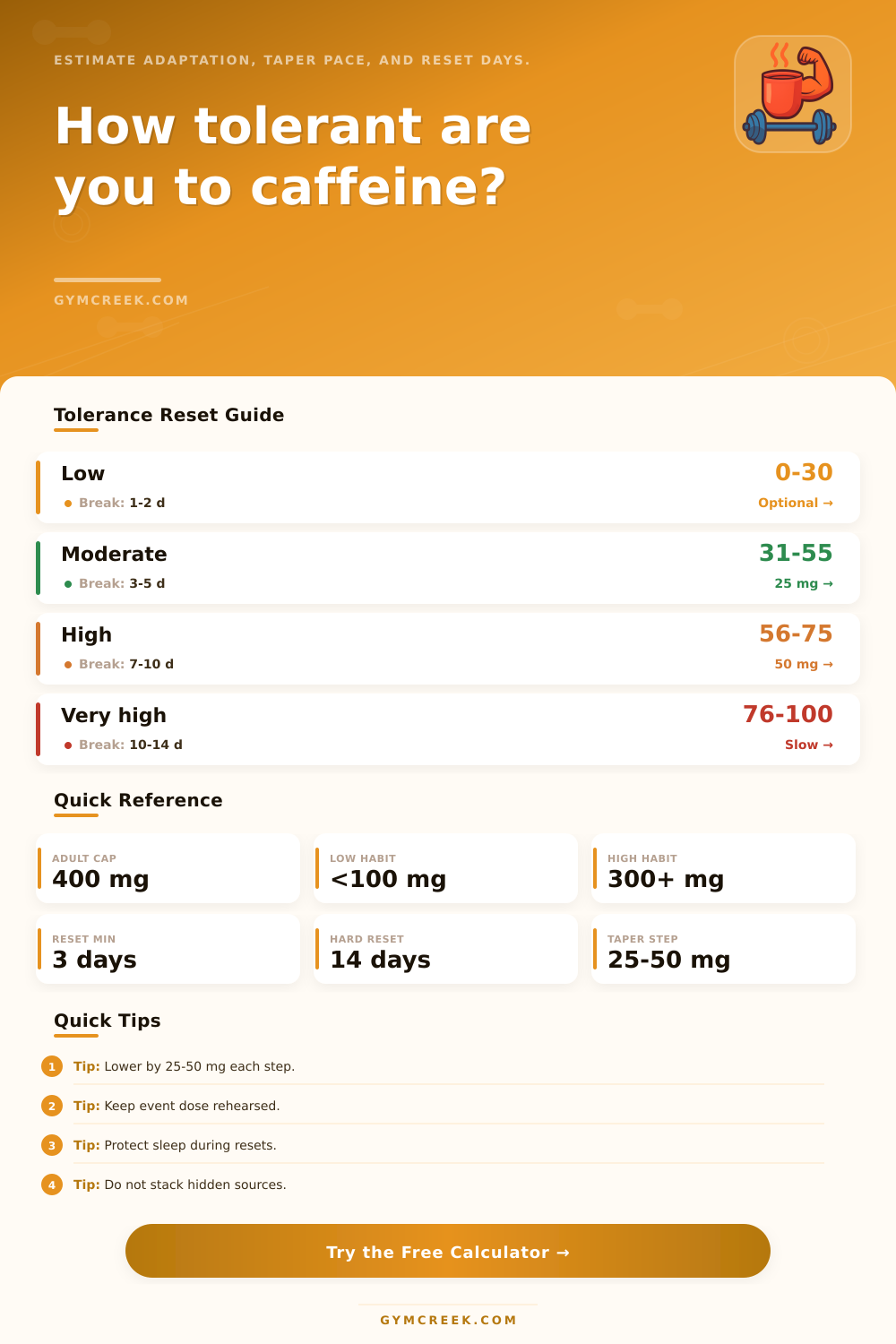
| Tolerance band | Score | Pattern | Reset idea |
|---|---|---|---|
| Low | 0-30 | Occasional use, clear effect | Keep frequency capped |
| Moderate | 31-55 | Regular use, mild drop | Mini reset or cycle days |
| High | 56-75 | Daily use, weaker effect | 7-10 day taper or break |
| Very high | 76-100 | High dose, strong reliance | Slow taper before hard reset |
| Strategy | Best for | Typical length | Tradeoff |
|---|---|---|---|
| Gradual taper | High withdrawal risk | 7-14 days | Slower but smoother |
| Mini reset | Moderate tolerance | 3-5 days | Useful between hard blocks |
| Hard reset | Event priming | 7-14 days | Fast but uncomfortable |
| Cycle use days | Maintenance | Ongoing | Needs planning discipline |
| Input | Low signal | High signal | Why it matters |
|---|---|---|---|
| Daily intake | Less than 100 mg | 300+ mg | Higher load raises adaptation |
| Use streak | Less than 7 days | 30+ days | Long streaks reduce novelty |
| Effect drop | 0-20% | 60%+ | Tracks perceived tolerance |
| Withdrawal | 1-2 of 5 | 4-5 of 5 | Sets taper aggressiveness |
| Formula piece | Calculation | Output | Use |
|---|---|---|---|
| Habit load | Daily mg per kg | Load score | Flags high routine intake |
| Adaptation index | Weighted dose, streak, drop | 0-100 score | Sets tolerance band |
| Taper step | Daily mg times taper rate | 25-100 mg | Builds cutback pace |
| Event cap | Body weight and daily cap | mg ceiling | Keeps test dose realistic |
💡Tips
Let’s say that every morning you get a little boost of energy from a cup of black coffee, which gives you some drive and focus. So you always begin each day with it. Later in the day, when you’re fatigued after work, you have another.
Soon enough, though, what used to make you feel awesome only makes you feel… normal. It goes from enhancing your performance to merely maintaining your current state. At this point, you’ve developed a tolerance to the stimulant. Your body has increased its number of adenosine receptor, which require you to consume an increased amount of substance just to maintain baseline feeling you possessed prior to consuming any coffee at all.
How to Reset Your Caffeine Tolerance
Below is a calculator to do the math for you based off your own habits. But knowing how it works can help you determine whether or not you even need a reset.
But more importantly, consistent use increase your tolerance faster then total caffeine intake. For example, if you take three hundred milligrams per day for six weeks straight, your tolerance level is going to be far greater than someone who take three hundred milligrams only on their heavy lifting days. To account for this, the tool puts a lot of weight into your consecutive use streak when calculating your score. So if you’ve been using it every day since January with no breaks, the system knows your nervous system has had enough opportunity to acclimate to regular stimulation.
That’s why so many athletes feel as though their pre-workout has stopped working after several months of daily use, it hasn’t, your body just adapted.
So when the calculator spits out a tolerance score, what does that mean? It means the calculator has given you an adaptation index. If it’s a large number, that means your receptors has been saturated and are now less receptive to higher doses. That’s why the tapering plan comes into play. Chances are going cold turkey isn’t going to work out well; the headache, brain fog and other withdrawal effects will wreck your ability to train for several days.
Fortunately, page includes a clear reference table outlining how gradual decreases of 25-50 mgs daily allow you to keep up with your training while gradually reducing your dependence on them. Your goal is to reduce the dose quickly enough to see results toward a clean slate, but slowly enough so you wouldn’t of even notice the change.
Another key element that people tend to overlook is the impact on sleep. The effects of coffee wear off after roughly five hours (the half life of caffeine). This means that half the latte you had at 3pm is still in your system as bedtime approaches. Not only does poor sleep lead to reduced recovery and higher cortisol, but it ironically leaves you feeling more fatigued the following morning. This encourages you to consume even more caffeine, leading to a vicious cycle.
The calculator takes into account the quality of your sleep so it can adjust your recommended dose cap accordingly. Even if you think you can get away with consuming caffeine all day, it’s going to recommend a lower daily amount or an earlier cutoff time if your sleep isn’t great.
A lot of folks underestimate just how long it takes to reset. It’s not really three days, at least not if you want to feel as sensitive again as you did before. For high-tolerant folks, the tool say seven-to-fourteen days is usually needed to clear adenosine receptors and return sensitivity. When you’re accustomed to getting stimulated every single day, this can seem endless.
But there’s no way around it; you have to push through the awkwardness to achieve the sharp effects of caffeine again. Caffeine should be a tool in your collection that you use strategically, not a background hum in your blood stream. Cycling it on and off occasionally preserves its potency for the days where it will really count, like race day or trying a new personal record.
In conclusion, don’t manage caffeine by avoiding it. Manage it by understanding it. Use it sparingly as a tool instead of a perk; think of it as a limited resource, not a limitless one. After taking a good break, the coffee will feel stronger when you drink it again because your body is no longer used to it.
Use only what’s needed, and pay attention to the results. Always maintain the intention of improving performance, not building a habit. You don’t want to be numb to caffeine. Cool.
But you want to wake up excited to have some? That’s cool too. Variety is the spice of life and it keeps the edge sharp. Consistency kills it.