Caffeine Calculator for Training
Estimate your caffeine dose by body weight, compare it with goal-based ranges, and see how much may still be active near bedtime.
📌Presets
Presets load realistic body weight, dose, timing, goal, sensitivity, and tolerance combinations, then calculate automatically.
⚙Calculator
Caffeine training snapshot
Enter your dose and timing to compare it with goal-based ranges.
📊Metrics Comparison Grid
🧮Source Comparison
📑Reference Tables
| Goal | Typical range | Timing | Use case |
|---|---|---|---|
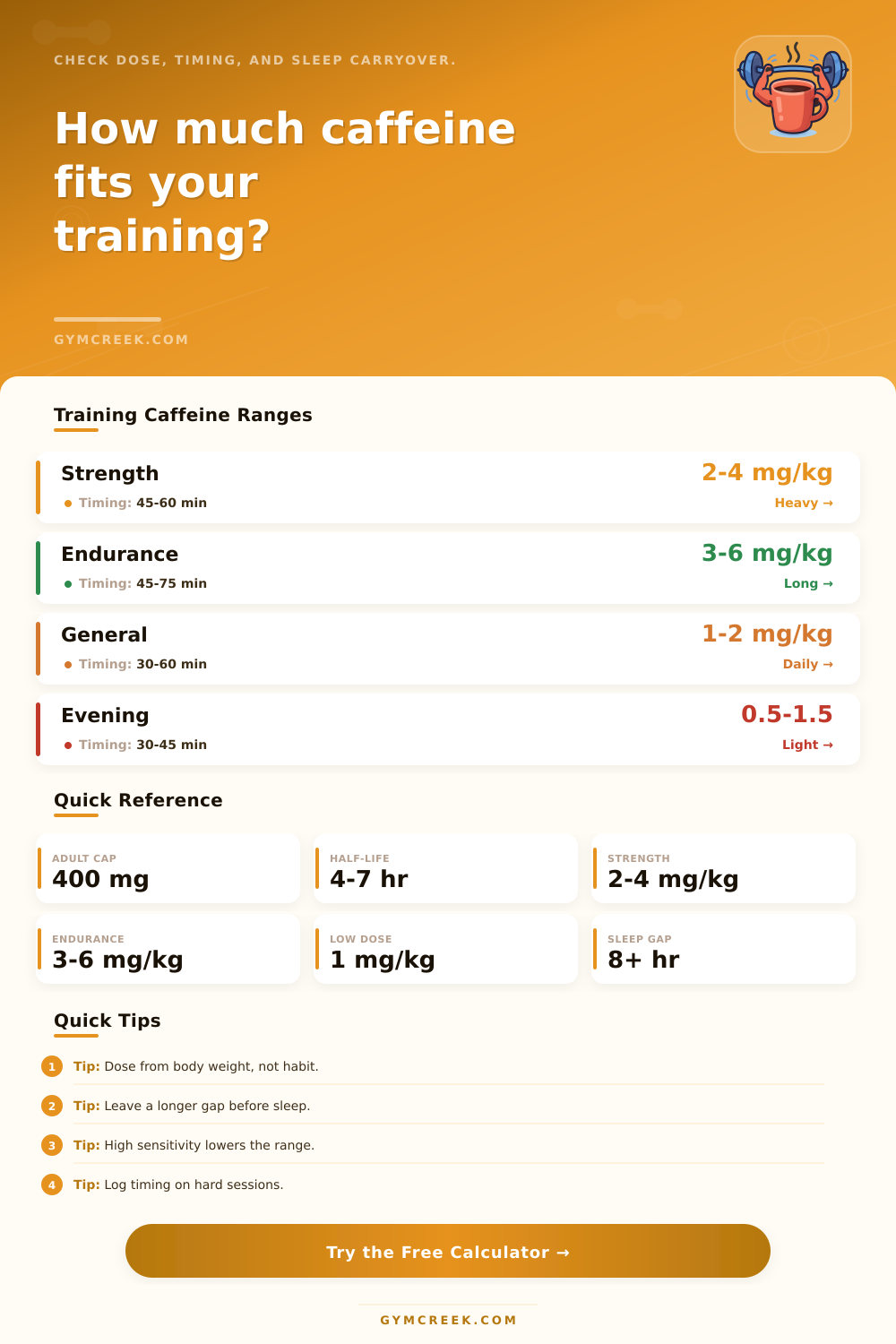
| General gym | 1-2 mg/kg | 30-60 min pre | Moderate daily sessions |
| Strength or power | 2-4 mg/kg | 45-60 min pre | Heavy sets and high focus work |
| Endurance event | 3-6 mg/kg | 45-75 min pre | Long efforts with practiced fueling |
| Evening training | 0.5-1.5 mg/kg | 30-45 min pre | Lower dose to protect sleep |
| Source | Common caffeine | Best input | Note |
|---|---|---|---|
| Coffee | 80-140 mg | mg per mug | Measure your usual serving |
| Espresso | 60-80 mg | mg per shot | Double shots count twice |
| Tea | 25-70 mg | mg per cup | Steep time changes the dose |
| Pre-workout | 150-350 mg | mg per scoop | Avoid stacking with energy drinks |
| Sensitivity | Half-life used | Range adjust | Practical cue |
|---|---|---|---|
| High | 7 hours | Lower target | Jitters or poor sleep happen easily |
| Average | 5 hours | Standard target | Normal response to moderate dose |
| Low | 4 hours | Slightly higher target | Less noticeable effect at low dose |
| Low tolerance | 5-7 hours | Start low | Use the bottom of the range first |
| Metric | Formula | Meaning | Watch point |
|---|---|---|---|
| Relative dose | mg divided by kg | Body-weight adjusted intake | Compare with goal range |
| Goal range | kg times mg/kg | Suggested low-high window | Respect total daily intake |
| Carryover | dose times 0.5^(hours/half-life) | Estimated caffeine left at sleep | Higher values may affect sleep |
| Daily cap | dose divided by 400 | Share of adult upper guideline | All daily sources count |
💡Tips
Maybe the barbell feels more heavy on Tuesday then it was on Monday. Maybe you sip your regular cup of coffee first thing in the morning and think you’re getting the same amount of caffeine. But just because the volume is the same doesn’t mean effect will be the same. Food and water affect bodyweight. Stress affects sleep quality, which change depending on day-to-day demands. If your body handles the dose less well today than it did last month (or vice versa), then the dose that resulted in your personal record then may only cause you to have a jittery week now.
For all these reasons, habit-based guessing fails. What’s needed instead is a baseline grounded on physiology, not routine. Plug in what you weigh now and how much you plan to take and let the calculator do the math for you. No more guessing at conversions or coefficients. The milligrams per kilogram of bodyweight are the key metric here.
Why You Should Use a Caffeine Calculator
Caffeine affects receptor sites that are spread all over your body. The same amount of caffeine hits a sixty-five-kilogram athlete differently than it does someone weighing ninety kilograms. Normalizing the dosage based off your own size lets you track your sessions regardless of your training phase. You’ll have real data points instead of vague feelings.
There’s also an element of timing. Everyone goes straight into their workout after drinking coffee. That’s wrong. It takes some time for caffeine to enter the brain via the blood-brain barrier and reach its highest levels in plasma. Typically, this sweet spot falls somewhere between 45-60 minutes prior to exercise. Too early and it will have dissipated by the time you hit your most intense sets. Too late and you’re still battling absorption delay as you deplete your glycogen reserves during warm-up. Aim for the spike to arrive around initial working set, not the last.
How caffeine affects your sleep and recovery Caffeine’s half-life is about five hours for most adults. What does that mean? Half of whatever amount you put into yourself will be lingering in your body after those five hours have passed. So when you gulp down a standard cup at 6pm and turn in at 10pm, you’re attempting to drift off while there’s still a large chunk of stimulant coursing through your veins. It messes up those deep sleep cycles, and it hinders tomorrow’s workout recovery. The tool calculates this leftover burden, allowing you to view whether or not that post-workout java is hurting your morning gains.
But everyone are different in their sensitivity. Your metabolism is partially genetic, which determines how fast your body breaks down caffeine using the CYP1A2 enzyme (liver enzymes). You might be able to slam two shots without feeling anything, but others gets nervous with just half a cup. That’s where sensitivity comes into play. Use the calculator to account for your own sensitivity. It’ll tweak the suggested dose range so you don’t go too far out on either extreme. For example, if you are highly sensitive, you might feel tremors or nausea at the top end of the normal dosage range instead of feeling more focused. Avoid the trial-and-error process that wrecks a solid training day by knowing your metabolic profile.
Tolerance demands honesty. The more caffeine you consume, the less it affect perception in the long term. That buzz from last week may become white noise today. Don’t constantly up the ante. There’s such a thing as too much. And that threshold is lower than you probably believe. Resetting your tolerance by cycling off caffeine for several days will recalibrate your sensitivity and make smaller doses work again. Rather than chasing diminishing returns through higher doses, it’s often wiser to reset your starting point.
Sources cause a hidden risk when they are confused. A scoop of pre-workout contains two hundred milligrams. Add another coffee in the morning and an energy drink after lunch, and you’re far past safe levels, but there’s no obvious warning until it’s too late. Each source enters the body, and all those sources has to be considered. It’s not just what you’re currently drinking; it’s everything on this chart that goes into you. Soda, tea, etc., add to your overall load (and may seem mild individually).
So, here’s what we’re aiming for: Caffeine as a tool, not a crutch. It is a precise way to increase power output and focus. Too much = burnout, too little = sleep debt, too late = injury risk (from both fatigue and jitters). Begin with small amounts and note your response. Then adjust to match your performance and recovery. Your body delivers the final word; the numbers offer only the framework. View the dose as a changing part of an equation instead of a fixed part of some ritual. Respect the math and the results will follow. You’ll feel it, too, that same barbell won’t feel so heavy anymore. You drank smarter, not more.