Caffeine Half-Life Calculator
Estimate caffeine remaining from one or two doses, compare half-life profiles, and project when your level may fall below a chosen threshold.
📌Pharmacokinetic Presets
Each preset loads dose size, elapsed time, absorption lag, half-life profile, body weight, target threshold, and sleep projection.
⚙Calculator
Caffeine decay snapshot
Enter dose timing and half-life to estimate current and future caffeine load.
📊Metrics Comparison Grid
📑Reference Tables
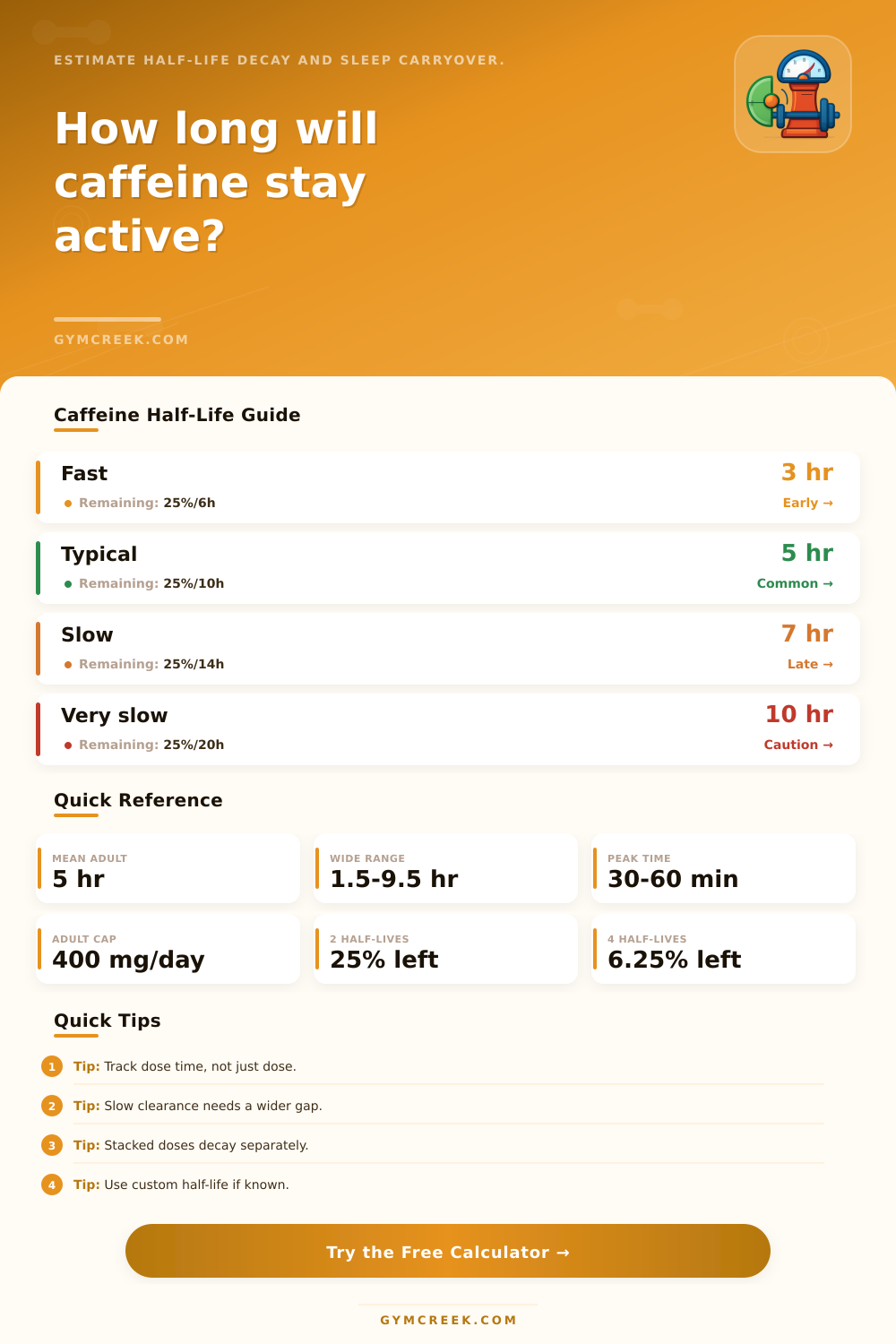
| Half-life profile | Value used | Two half-lives | Practical reading |
|---|---|---|---|
| Fast clearance | 3 hours | 6 hours | About 25% of absorbed caffeine remains |
| Typical adult | 5 hours | 10 hours | Common planning estimate for healthy adults |
| Slow clearance | 7 hours | 14 hours | Longer gap may be needed before sleep |
| Very slow | 10 hours | 20 hours | Use only for conservative what-if checks |
| Elapsed half-lives | Amount left | Example from 200 mg | Meaning |
|---|---|---|---|
| 1 half-life | 50% | 100 mg | Half the absorbed dose remains |
| 2 half-lives | 25% | 50 mg | Still noticeable for some people |
| 3 half-lives | 12.5% | 25 mg | Low but not zero |
| 4 half-lives | 6.25% | 12.5 mg | Small residue remains mathematically |
| Source | Common input | Half-life impact | Calculator note |
|---|---|---|---|
| Brewed coffee | 80-140 mg | Same decay model | Use the measured mug value |
| Espresso | 60-80 mg | Same decay model | Count each shot separately |
| Energy drink | 80-200 mg | Same decay model | Check label serving count |
| Pre-workout | 150-350 mg | Same decay model | Avoid accidental stacked doses |
| Modifier | Direction | Why it matters | Use in tool |
|---|---|---|---|
| Smoking cue | May be faster | Clearance can increase in some smokers | Try fast profile as a scenario |
| Oral contraceptive cue | May be slower | Some studies show longer half-life | Try slow or custom profile |
| Pregnancy cue | Can be much slower | Clearance may be prolonged | Use medical guidance, not this alone |
| Liver or medication cue | May change either way | Caffeine is metabolized mainly by CYP1A2 | Ask a clinician about your case |
💡Half-Life Tips
The body has rigid biological rules for metabolizing caffeine. When the energy surge subsides, you might think the caffeine is gone. Unfortunately, most folks has no idea how long it takes to clear caffeine from your system. They make a wild-ass guess based off present alertness, but that isn’t very accurate since half-life isn’t subjective. Your biological clock doesn’t care about stress levels, moods, or caffeine tolerance. Even though you “feel okay,” the math’s still unforgiving.
Caffeine has a half-life of roughly five hours on average in healthy adults, which means that the central idea behind it all is exponential decay. Five hours after you finish your cup, you’ll still have half as much caffeine in your blood as when you started. Another five hours later, you’ve lost half of what’s left. This means 25% of your starting dose is still floating around your veins which will still screw up someone with more sensitive sleeping pattern.
How Caffeine Leaves Your Body
To avoid having to mentally imagine these compound decay curves at bedtime, the calculator takes care of the math for you; just plug in your estimated dose and half-life profile and let it work its magic. While those are ballpark numbers, it’s more important for people to understand their own rate of clearing caffeine (which differ greatly between individuals). There are presets on the tool for everything from rapid (three hour) to super slow (ten hour), which actualy shows actual differences in how much one produces certain enzyme in their liver. A few factors will affect this.
Smoking induces the CYP1A2 enzyme, so it will clear caffeine quickerer. Being pregnant or taking oral contraceptives dramatically slows down the process since it also inhibits that CYP1A2 enzyme. Choosing the appropriate profile makes all the difference. If someone has a five-hour half-life, they’ll have a quarter of coffee still around after ten hours. However, someone with a ten-hour half-life will have that same quarter of coffee around after twenty hours.
The complication with stacking doses is that different caffeine sources don’t combine as if they were one big blob; each decay according to its own timeline. To get a sense of your combined load, you can add your most recent dose alongside an earlier one to see how they both contribute: You may believe it’s been eight hours since your last cup, thinking all is well. But you had a big breakfast coffee six hours ago. That’s contributing to your present wakefulness level, and if you ignore that built-up residue you’ll overestimate just how clear-headed you are. Checking your combined total helps avoid unexpected stimulation later in the day.
Another minor detail: Caffeine isn’t available at zero-time-zero; it has about a half-hour-to-one-hour absorption lag before reaching full blood volume. You can vary that lag time with the tool. This moves the beginning of the decay clock forward or backward to show exact time when levels drop beneath a desired level, such as dropping to fewer than forty milligrams. Knowing this timing lets you plan your cutoff point more accuratly instead of guessing when the effects should of worn off.
It doesn’t matter as much which specific amount of leftover caffeine remains, as long as you follow its message about sleep hygiene: shifting all your caffeine intake closer to the start of your day tends to help more then reducing the total amount by 10%. This approach provides a greater opportunity for your system to process most of the payload before you try to sleep leaving you quiet enough for a good night’s sleep.
It is also helpful to manage your expectations by viewing caffeine as a borrowed asset rather than a free energy supplement. Understanding precisely when your body issues its invoice will help you pay back that biological debt. In this case, it will help you understand when it’s coming.