Caffeine Dose For Performance Calculator
Estimate a performance-focused caffeine dose from body weight, mg/kg target, event type, start time, tolerance, sleep sensitivity, current daily caffeine, and timing window.
🏁Performance Caffeine Presets
Presets load realistic performance scenarios. Adjust the dose and timing after you know your own response in training.
⚙Calculator Inputs
Performance caffeine snapshot
Your dose, timing, daily cap, and sleep-risk flag update as inputs change.
📊Metrics Grid
📑Caffeine Rules and Reference Tables
| Dose band | mg/kg | Best fit | Caution |
|---|---|---|---|
| Minimal | 0 to 1 | Late events, sensitive athletes, first test | May be subtle |
| Low | 1 to 2 | Skill sports, low tolerance, short sessions | Still count toward daily total |
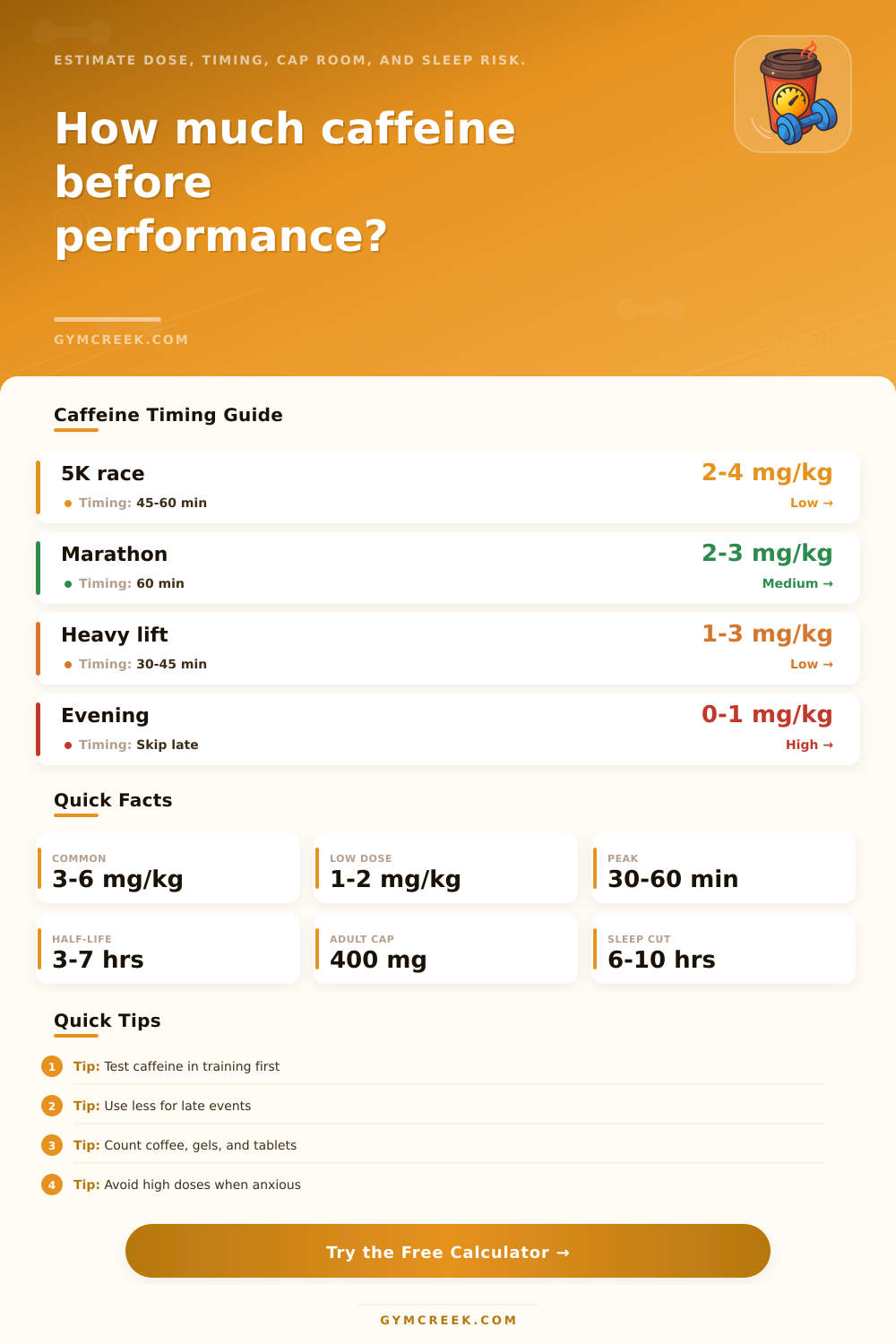
| Moderate | 2 to 4 | Most training tests and races | Watch jitters and gut response |
| High | 4 to 6 | Experienced users in key events | More side effects, no guaranteed extra benefit |
| Very high | Over 6 | Usually not needed | High side-effect and sleep risk |
| Event type | Starting window | Plan note | Watch point |
|---|---|---|---|
| Endurance race | 45 to 60 minutes | Use steady pre-start dose | Practice with fuel and fluids |
| Long endurance | 60 minutes | Consider split dosing only if trained | Total daily cap still applies |
| Strength or power | 30 to 60 minutes | Lower dose may be enough | High arousal can hurt technique |
| HIIT or intervals | 30 to 45 minutes | Avoid gut-heavy timing | Jitters can raise perceived effort |
| Skill sport | 30 to 45 minutes | Use conservative dose | Too much can hurt precision |
| Risk flag | Timing rule | Dose trigger | Meaning |
|---|---|---|---|
| Low | Before sensitivity cutoff | Under 3 mg/kg | Lower sleep disruption risk |
| Moderate | Within 2 hours of cutoff | 3 to 5.9 mg/kg | Use caution and track sleep |
| High | After cutoff | 6+ mg/kg | Likely to affect sensitive sleepers |
| Cap caution | Any time | Total over 400 mg/day | Reduce dose or skip other sources |
| Step | Rule | Inputs used | Output |
|---|---|---|---|
| Weight conversion | Metric uses kg; imperial lb is divided by 2.20462 | Body weight, unit toggle | Body weight in kg |
| Performance dose | Body weight kg x chosen mg/kg | Weight, dose target | Total caffeine mg |
| Timing plan | Event start time minus selected timing window | Start time, window | Suggested dose time |
| Daily cap | 400 mg minus current caffeine minus planned dose | Current caffeine, dose mg | Cap remaining |
| Sleep cutoff | Low sensitivity 4:30 PM, moderate 2:30 PM, high 12:30 PM | Sleep sensitivity | Timing risk threshold |
| Sleep risk | Risk rises after cutoff, near cutoff, high dose, evening event, or cap excess | All inputs | Low, moderate, or high flag |
💡Tips
Timing of caffeine is another importently factor for those who wish to prepare for a hard effort. The timing of caffeine can affect both how a person maintains there pace during the effort, as well as how they perform in the final set of interval. While people often think of caffeine as a simple substance that can be taken prior to an effort of any sort, there are actualy several factors to consider regarding caffeine, such as the amount of caffeine, the timing of caffeine, and the effect that caffeine can have upon an individual’s sleep.
Another factor to consider before taking caffeine is the body weight of an individual who will be taking the caffeine. The effectiveness of caffeine is based off the weight of the individual in kilograms. Thus, a 60-kilogram runner will experience different effect from caffeine than a 90-kilogram weightlifter.
How to Use a Caffeine Calculator for Training
This calculator help to make it more easier for individuals to determine the amount of caffeine they should take by performing the calculation after the individual enters their body weight and the target dose of caffeine they would like to take. Thus, this caffeine calculator allow for individuals to eliminate the need to manually calculate their desired dose of caffeine in milligrams per kilogram to the total amount of caffeine required to reach that dosage. The type of event that an individual will perform can affect how an individual should use caffeine.
For instance, individuals who are performing endurance races may require to take caffeine earlier in the event to provide support to those last set of intervals. However, caffeine can negatively impact the ability of individuals to perform strength-based or skill-based event because high levels of arousal can make it difficult for individuals to focus upon the technique that is required for those types of efforts. Additionally, any events that occur in the evening will require more planning from individuals to account for the length of time that caffeine remains in the system.
The same amount of caffeine that provides benefits to an individual at 9 a.m. May remain in their system at midnight. The tool account for these types of variable by indicating to individuals whether the amount of caffeine that they plan to take may disrupt their sleep. Another factor that individuals should consider is an individual’s caffeine tolerance.
Individuals that drink several cup of coffee every day may require higher amounts of caffeine to provide the same effect upon their bodies as individuals that have low levels of tolerance for caffeine. The ability of the individual to select their level of caffeine tolerance within the parameters of the calculator will allow the individual to adjust the suggested dose of caffeine to account for these difference in caffeine tolerance. One last factor that an individual should consider is the remaining cap that an individual has for thats day’s caffeine consumption.
Because caffeine can come from various source (coffee, pre-workout supplements, gels, drinks, etc.), it is important for individuals to ensure that they do not consume too much caffeine throughout the day. 400 milligrams of caffeine per day is a common daily limit for healthy adults. Consuming more than 400 milligrams of caffeine per day may lead to feeling wired, experiencing insomnia, or having a rough night of sleep.
By subtracting the amount of caffeine that an individual has consumed from their daily limit of 400 mg, the caffeine calculator help individuals to understand how much caffeine that they can still consume that day. Sleep sensitivity is another important factor in relation to caffeine consumption. Sleep sensitivity to caffeine varies from individual to individual.
Some individuals can consume caffeine at 4 p.m. And still fall asleep between 9 p.m. And 10 p.m., while other individuals may find that consuming caffeine during lunch may disrupt their sleep. This sleep risk flag allow individuals to understand whether or not their planned dose of caffeine may disrupt their sleep. The reference tables located on the page allow individuals to understand the doses and times of caffeine consumption.
These tables can be helpful in allowing individuals to understand the various doses that may work best for their bodies. Individuals dont have to consume a certain amount of caffeine, but they can attempt to consume a dose within one of the bands within these tables during a few of their training sessions. Beyond these factors, the caffeine calculator allow individuals to plan their caffeine consumption.
By altering some of the variables within the calculator, individuals can determine how different doses of caffeine and times of consumption may impact their bodies. Thus, individuals can use the caffeine calculator to prepare for different scenario, such as consuming caffeine during long runs or hard training sessions. However, the calculators recommendations are not a prescription for caffeine consumption.
Thus, individuals should use the calculator to test different amounts of caffeine during different types of low-stakes training sessions. By determining how a certain amount of caffeine impact their body, individuals will be able to use the calculator to make more informed decisions about their caffeine consumption.