Cadet Fitness Assessment Calculator
Estimate a cadet fitness assessment score from body size, aerobic performance, push-up reps, curl-up or plank performance, mobility, attendance, and readiness context.
📌Cadet Presets
Presets load realistic cadet assessment snapshots. Adjust any field to model your program, event choices, and retest target.
⚙Calculator Inputs
Cadet score snapshot
Enter event results to estimate points, readiness band, and the next event to improve.
📊Cadet Metrics
📑Reference Tables
| Band | Point range | Event floor | Typical read |
|---|---|---|---|
| Honor | 90 to 100 | All met | Competitive readiness |
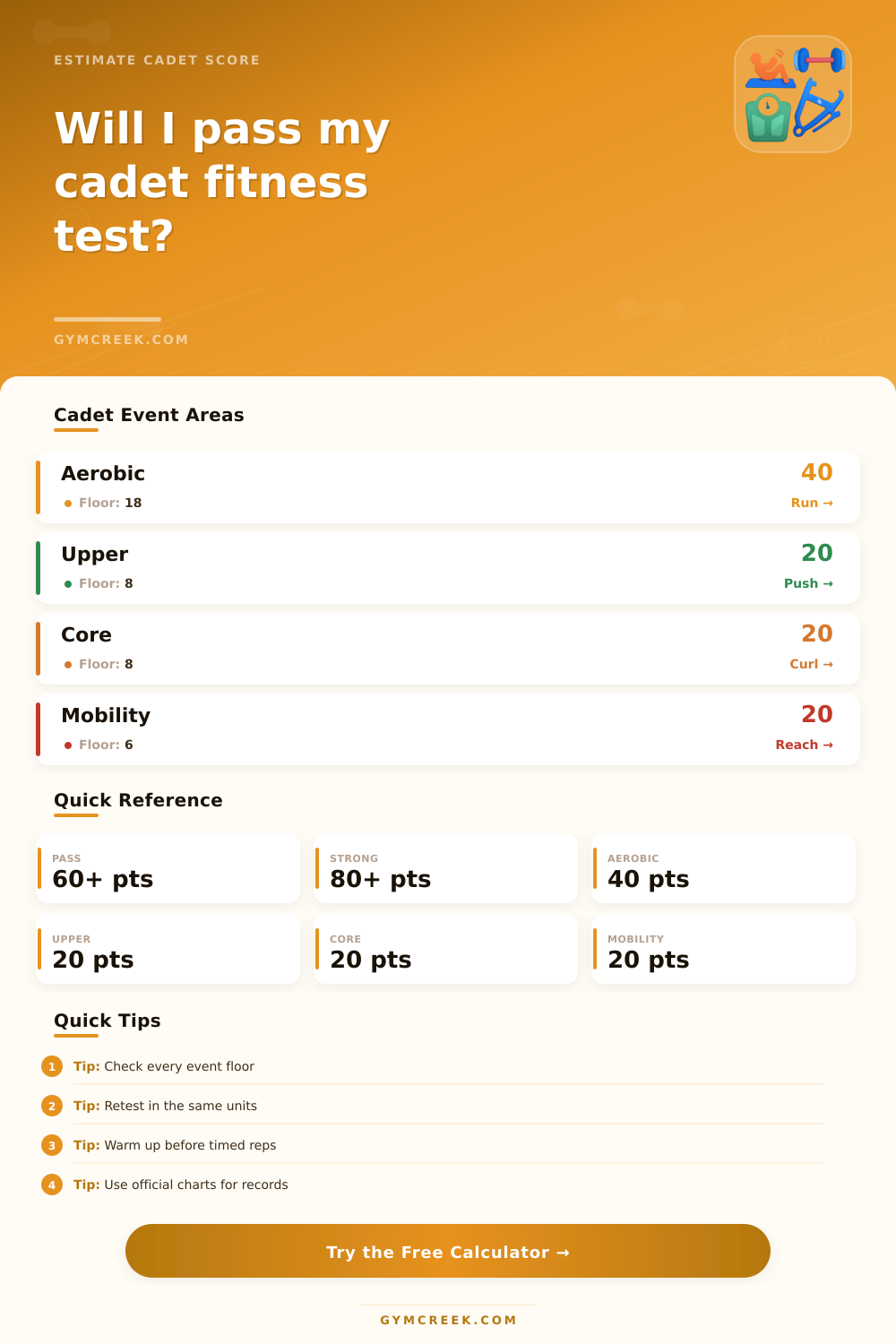
| Strong | 80 to 89.9 | All met | Solid assessment profile |
| Pass | 60 to 79.9 | All met | Meets baseline estimate |
| Review | Below 60 | Any missed | Retest focus needed |
| Area | Max points | Input used | What improves score |
|---|---|---|---|
| Aerobic endurance | 40 | Run time or shuttle laps | Faster run or more laps |
| Upper-body endurance | 20 | Push-ups in 1 minute | More strict reps |
| Core endurance | 20 | Curl-ups, sit-ups, or plank | More reps or longer hold |
| Flexibility and mobility | 20 | Sit-and-reach distance | Longer controlled reach |
| Factor | Easy target | Standard target | Strict target |
|---|---|---|---|
| Younger cadet | Ages 10 to 12 | Lower raw targets | Form consistency |
| Mid cadet | Ages 13 to 15 | Baseline targets | Steady progression |
| Senior cadet | Ages 16 to 18 | Higher raw targets | Assessment readiness |
| Academy prep | Any older cadet | Strict modifier | Competitive profile |
| Output | Method | Inputs | Use |
|---|---|---|---|
| Composite | Weighted event sum | Four event areas | Pass estimate |
| Aerobic points | Age adjusted band | Time or shuttles | Endurance score |
| BMI and WHtR | Body-size ratios | Weight, height, waist | Context only |
| BMR/TDEE | Mifflin-St Jeor | kg, cm, age, sex | Energy context |
💡Tips
Your success in the cadet fitness assessment hinges on understanding that it’s designed to filter out inconsistent performance, not break you down. The test isn’t meant for you to do well without preparation; it needs a roadmap. A snapshot of your strengths and weaknesses; in order to be passed successfuly. It’s about preparing steadily and turning raw physical output into a passing composite score.
Aerobic endurance is weighted most across most programs because efficient running show overall stamina. Your age group is factored into the calculator as points based off your shuttle laps or run time. Guessing is eliminated. In most cases, a mile isn’t always as important as a two-mile run. The farther you go, the larger the chasm between good and great scores, especially if you pass. Cardiovascular fitness can’t be faked. It will show itself in the last few minutes when focus wane and form begins to break down.
How to Prepare for the Fitness Test
The other pillar here is upper body + core strength, and these two often fails together if you have not trained them with specificity. Many cadets prioritize rep count over form; they’ll bend forward partway through a push-up or let their hip sag to get another rep in. Upper body points max out at twenty, as you see on the table, which is exactly half of what is found in the aerobic category. If you’re good at running, you can pull it all together by bombing push-ups and still pass, but that’s playing with fire because one slip on the track could knock your whole score down.
Units differ on core assessments. Some test plank holds, while others test curl-ups. Planks test form control and static stability, whereas curl-ups test muscular endurance of the abs and hip flexor. Before the assessment, don’t mix up the two in practice or your muscle use patterns will be disrupted and your timing thrown off.
Even though mobility seems easy, it’s just as important as strength (it counts for 20 points). If your hamstrings is tight and you can’t reach past your toes, it will be hard to sit still and stretch. Fitness Score is based on body composition measurements (e.g., BMI), but that’s only part of the story; those aren’t directly related to a fitness score. It gives context to how much energy you need so that you can understand why one cadet might get tired quicker then another while doing the same workout volume. Under-fueling will hurt both your performance and recovery.
The number of weeks left before the assessment shows how ready you are, whether you are building good habits or trying to break bad ones in time. The key is knowing what you are measuring, most cadets train to look good, not function well. The point isn’t big muscles but a cardiovascular base and efficient movement patterns that will support those workouts. If there’s a small gap between your target and where you are, work on whatever event is your lowest first, it won’t take much (a couple of extra push-ups, a few tenths-of-a-second off each mile) to improve that weak spot and gain more points. On top of that, it wouldn’t be as hard to add to a solid score as it is to make huge improvements from a poor one. Consistency beats doing things harder.
Prepare by consistently showing up to practice, keeping honest records of your improvement, and paying attention to the scoring bands. That focus will keep you healthy once the test is over and help you finish on time.