Cadence Stride Length Calculator
Estimate stride length, step length, cadence band, pace, speed, and turnover targets from a run, walk, treadmill session, or measured distance test.
📌Descriptive Presets
Presets load realistic walking, running, treadmill, track, sprint, and trail scenarios so you can compare cadence, step length, stride length, speed, and estimated energy context.
⚙Calculator
Stride length estimate
Results appear after calculation.
📊Stride Metrics Grid
📑Reference Tables
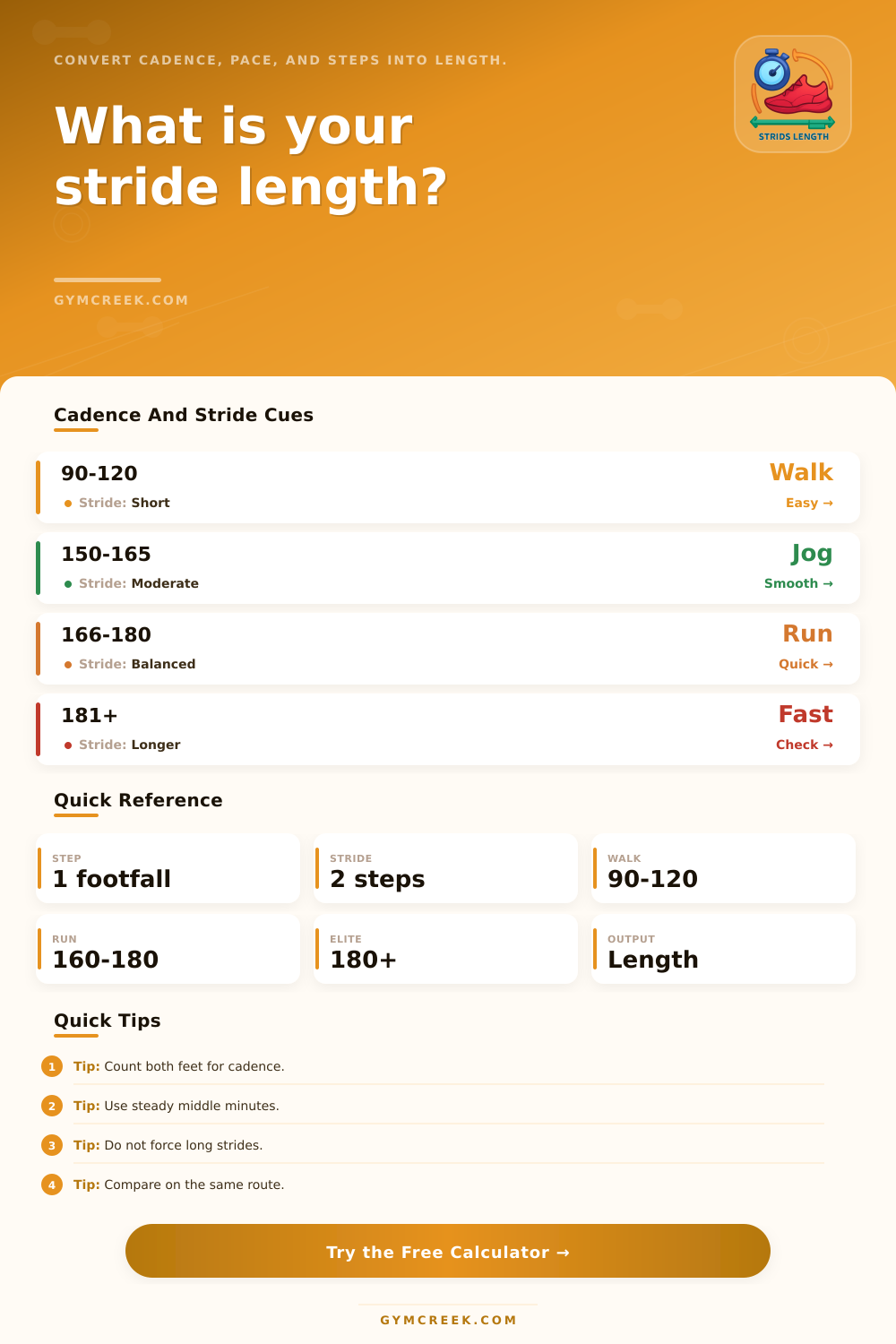
| Movement | Cadence | Stride Cue | Interpretation |
|---|---|---|---|
| Easy walking | 90-110 spm | Short | Comfortable daily pace |
| Brisk walking | 110-130 spm | Moderate | Fitness walking range |
| Easy running | 155-170 spm | Relaxed | Common recreational range |
| Steady running | 170-185 spm | Balanced | Often efficient for many runners |
| Sprinting | 200+ spm | Powerful | Speed from both turnover and force |
| Metric | Formula | Inputs | Meaning |
|---|---|---|---|
| Step length | Distance / steps | Distance, footfalls | One footfall distance |
| Stride length | Step length x 2 | Step length | One left-right gait cycle |
| Speed from cadence | Step x cadence | Length, spm | Distance per minute |
| Target stride | Speed / target spm x 2 | Speed, cadence | Length for new turnover |
| Height Ratio | Walking Cue | Running Cue | Check |
|---|---|---|---|
| Under 0.35 | Very short | High turnover | May be cautious or uphill |
| 0.35-0.45 | Normal walk | Short run step | Often easy effort |
| 0.45-0.60 | Long walk | Balanced run | Common steady range |
| 0.60+ | Very long | Fast or overstride | Check contact and braking |
| Scenario | Best Input | Watch Out | Use |
|---|---|---|---|
| Track rep | Distance + time | Lap accuracy | Form testing |
| Treadmill | Speed + cadence | Belt calibration | Indoor comparison |
| Race file | Steps + distance | Auto-pause gaps | Post-run review |
| Trail run | Distance + time | Grade and surface | Short-stride check |
💡Tips
The ability for a runner to increase there speed are dependent upon two specific variable: cadence and stride length. Cadence is an number of steps a runner takes in a minute, while stride length is the distance that a runner covers in a single step. Overall running speed is calculated as the product of these two variables; therefore, increasing either one will lead to an increase in a runner’s speed.
Increasing cadence will result in runners taking more steps during a minute, while increasing stride length will result in runners covering more distance during a minute with each step that they take. Many runners attempt to increase their stride length as a means of increasing their running speed. However, many runners increase their stride length by reaching there lead foot too far forward in relation to there body.
How Your Steps and Step Length Affect Running Speed
This is referred to as overstriding, and many runners perform this movement because it lead to greater stride length. However, the overstriding runner feels the impact of their stride upon their shins and knee due to the braking action of the overstriding foot. Additionally, overstriding runners often experience a reduction in their running momentum, and may even suffer injury to their joints due to the increased impact of their stride.
A person can utilize a calculator to determine their stride length and cadence in order to gain an understanding of there specific running mechanics. By inputting variables as simple as distance, time, and the number of steps that an individual take, runners can calculate their stride length. Additionally, a person can calculate variables like a runner’s height and weight to determine if an individual’s stride length is too short (leading to shuffling) or too long (leading to overstriding).
Cadence can be categorized as having different classifications or bands. For instance, low cadence indicates that an individual may be overstriding, but high cadence might suggest that an individual’s stride length is too short and their step too small to be efficient. Elite runners often aim for cadences of 180 step per minute, though this is simply a guideline for most runners.
For instance, cadence can differ for runners that are walking, strolling, or sprinting. Cadence can be increased as a means of reducing the impact upon the joint of a runner, but with an understanding of the impact upon stride length. For instance, if a runner aims to increase their cadence while maintaining the same running speed, stride length must be decreased.
Overall, calculators makes it possible for a runner to understand the distance that their stride length must be reduced to reach the target cadence. Thus, the calculator removes the guesswork for runners of what distance they should of aim for during their runs. The distance upon which a runner is running will impact stride length and cadence.
For instance, running on a treadmill will allow a runner to maintain a different cadence than when they are running on a trail. The trail require different steps from the runner to maintain their balance. Thus, a runner may encounter different terrain that modifiers should be used to calculate cadence and stride length.
Overall, a person will have a different stride length on a trail than on a road race. Efficiency in running requires strength and proper posture, as well as a slight forward lean of the body. Additionally, runners should not attempt to increase their cadence unless they have the strength necessary to support such an increased cadence; otherwise, runners may feel frantic with an increased cadence.
The goal for runners is for their feet to land underneath their hip, not in front of their hips. Additionally, as runners increase in strength, their stride length will increase as well. Thus, increasing a runner’s speed through the use of power is more efficient than increasing a runner’s speed through increasing their turnover of cadence.