Cable Curl Load Calculator
Convert the stack pin into usable curl tension with pulley ratio, handle style, arm angle, reps, RPE, tempo, and bodyweight context.
📌Presets
Presets load common cable curl setups and update all unit labels before calculating.
⚙Calculator
Cable curl load snapshot
Enter a stack load and cable setup to estimate actual biceps loading.
📊Curl Metrics Grid
📑Reference Tables
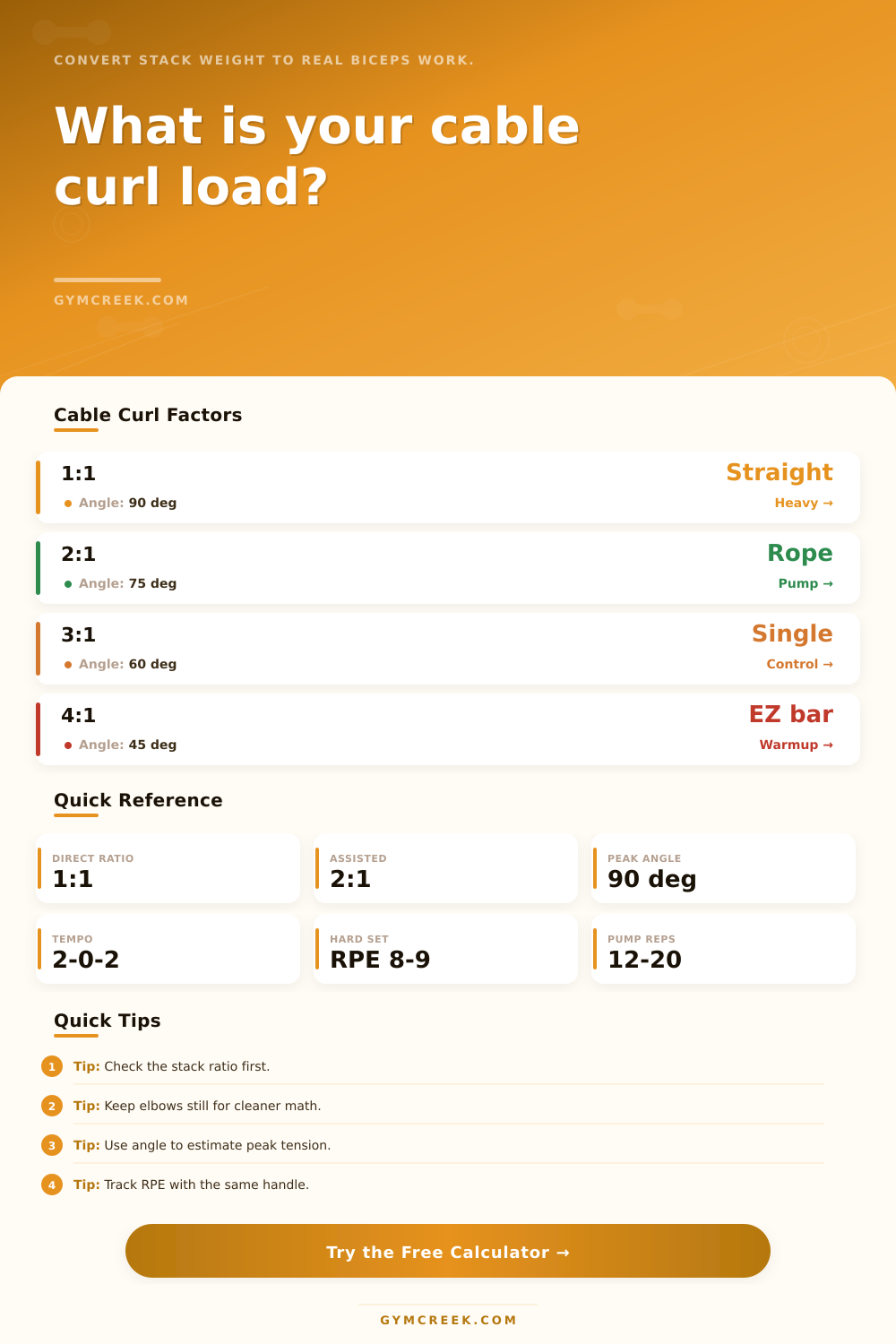
| Pulley Setup | Multiplier | Example Stack | Handle Load |
|---|---|---|---|
| 1:1 direct cable | 1.00 | 80 lb | 80 lb |
| 2:1 assisted stack | 0.50 | 80 lb | 40 lb |
| 3:1 assisted stack | 0.33 | 90 lb | 30 lb |
| 4:1 assisted stack | 0.25 | 100 lb | 25 lb |
| Handle | Load Bias | Grip Demand | Best Use |
|---|---|---|---|
| Straight bar | Neutral | Moderate | Strict two-arm curls |
| EZ curl bar | Slightly easier | Moderate | Wrist-friendly heavy sets |
| Rope attachment | Slightly harder | High | Pump sets and peak squeeze |
| Single handle | Unilateral | Moderate | Side-to-side comparisons |
| Angle | Tension Factor | What It Means | Common Setup |
|---|---|---|---|
| 90 degrees | 1.00 | Peak elbow torque | Cable crosses forearm |
| 75 degrees | 0.97 | Very high tension | Low cable curl |
| 60 degrees | 0.87 | Strong tension | Step-back curl |
| 45 degrees | 0.71 | Moderate tension | High or angled cable |
| Rep/RPE Zone | Stimulus | Fatigue | Tracking Note |
|---|---|---|---|
| 6-8 reps, RPE 8-9 | Strength-biased | High | Keep form strict |
| 10-15 reps, RPE 7-9 | Hypertrophy | Moderate | Most repeatable zone |
| 15-25 reps, RPE 8-10 | Pump-focused | Moderate-high | Watch tempo drift |
| 8-12 reps, RPE 6-7 | Technique work | Low | Good for deloads |
💡Tips
You pin that selector at a 70-pound weight and don’t think of it as seven-oh because that’s not how much tension is on your muscles. That’s not even how much poundage you’re curling. With cable machines, it becomes a physics problem. Handle type, arm angle, and the pulley system all alter the load. And most folks ignore all that. They bemoan achy wrists; they scratch their heads because their progress grinds to a halt.
Know this: What the stack weighs doesn’t represent what it weighs. First comes pulley ratio. You won’t see it in your experience because machine mechanics hide it. However, this is how much you will feel. On a direct one-to-one system, everything that touches the stack lands in your fingers. It’s back-breaking. You have to maintain proper form at all times or risk injuring your elbow.
Why Cable Weights Feel Different
Most commercial gym employ some sort of assisted stack (either two-to-one or three-to-one). This means the stack weigh either half or a third of what you’re actualy pulling. So if you have a 70-pound pin and you attach a two-to-one rope to it, you’re pulling against a 35-pound load. That’s where many folks go wrong: they think they’re pulling against something massive when they’re actually working with light weight. That’s where the calculator comes in. It prevents you from guessing with coefficients. This is the pulley ratio.
Consider the handles themselves. How does that affect your biceps and forearms? With a straight bar, you’re getting more neutral load path. It is good for heavy loads but if your grip gives out before your arms do, it’s going to be rough on your wrists. With an EZ curl bar you bend your wrists ever so slightly. That lets you get away with lifting more weight while experiencing less discomfort.
Rope attachments create external rotation. This put greater contraction at the peak of the move. The rope forces your biceps to work through a slightly different angle, which can be useful for targeting outer head of the muscle. Because it positions your bicep in a new way, it will help stimulate the outer head of the bicep. Lastly, single handles let you work unilaterally. If you have a stronger arm on one side than the other, this will even things out. Keep in mind each handle is biased. Pick the wrong handle and what was meant to be a strength builder turns into a grip endurance test.
Another factor is that load depend on the angle between your arm and cable anchor. Maximum tension occurs when your forearm forms a right angle (ninety degrees) with the cable. That’s typically what you get if you’re standing near the machine while the cable is down low. Shift back off of the machine, or go high with the cable, and that angle will alter. Effective resistance decreases. Peak torque occurs at right angles. At forty-five degrees, for instance, tension may be reduced almost by thirty percent.
Why does it feel like a set’s heavy at the bottom yet light at the top? Because tension varies with geometry. See table to see how tension varies with geometry. Apply that knowledge to your workout. Stand so tension remains high from start to finish.
The last two are tempo and time under tension. When you lift fast you place less stress on the muscle fiber. The longer you hold it, the more energy your muscles needs (slow eccentric phase). For hypertrophy we can use the two-zero-two tempo as a good starting point. You lift for two seconds and lower for two seconds. That holds the muscle under tension just long enough to trigger growth without burning out your central nervous system. This is part of the tool that’s accounted for in the stimulus score. That includes how much time you’re spending moving the weight as well as how many reps you’re doing. If you use a light load and do twenty reps, you may have a high stimulus but little strength gain.
Match the tempo to the goal. Do you want to get bigger? Strength? The timing makes all of the differance. To put those numbers in perspective, use bodyweight as a comparison. For a 100 pound lifter, a 50 pound curl is impressive. For a 250 pound powerlifter, it’s trivial. That’s what the calculator gives you. It gives you a relative load measure. That lets you see how hard you’re working out. You can’t compare yourself to someone else unless they have the same starting point.
In order to track progress properly, everything has to be consistent: if you switch to a heavier pulley or handle ratio from session to session, then the numbers aren’t comparable. You’re tracking something different. Set up once and stick with it for several weeks. Record amount of weight on the handle instead of just the stack weight. See how your biceps react.
You don’t do this to stand there looking at the pin and feeling good about yourself. You do this so that you know how much force your arms are experiencing. Respect the physics and results will come.