Calories Burned Burpees Calculator
Estimate burpee calories from body weight, reps, cadence, session duration, set and rest structure, variation, push-up and jump height, intensity, and weekly sessions.
📌Burpee Presets
Presets fill realistic burpee sessions and auto-calculate. Edit any field to match your own workout.
⚙Calculator Inputs
Burpee calorie snapshot
Enter your burpee session to estimate calories, pace, power proxy, weekly burn, and conditioning load.
📊Metrics Grid
📑Reference Tables
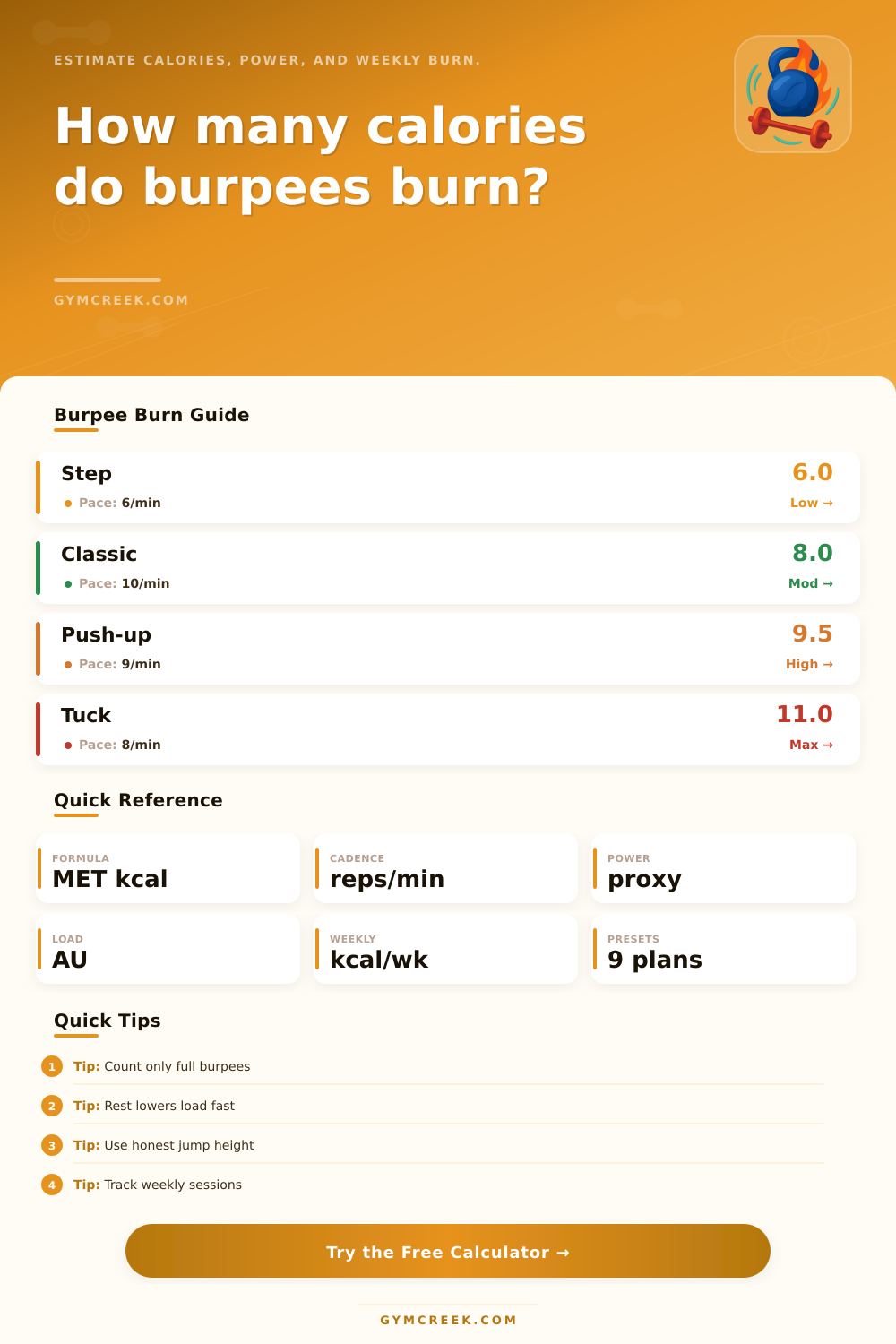
| Burpee variation | Base MET | Typical cadence | Calculation note |
|---|---|---|---|
| Step-back no push-up | 6.0 | 6 to 12 reps/min | Lower impact version with reduced floor speed and jump demand. |
| Classic sprawl burpee | 8.0 | 8 to 15 reps/min | Good default for most no-push-up burpee conditioning blocks. |
| Burpee with push-up | 9.5 | 6 to 12 reps/min | Push-up strength demand raises METs while cadence usually drops. |
| Chest-to-floor or tuck jump | 10.5 to 11.0 | 5 to 10 reps/min | Higher strain options best compared by load, not only calories. |
| Session structure | Density cue | Expected load | Use case |
|---|---|---|---|
| Technique sets | Under 45% work | Low to moderate | Skill practice, warmups, and low-impact conditioning. |
| Classic intervals | 45% to 70% work | Moderate to high | Most burpee circuits, EMOM blocks, and mixed conditioning. |
| Short-rest HIIT | 70% to 85% work | High | Fast intervals where rest is short and breathing cost climbs. |
| Test pace | Over 85% work | Very high | Max-effort sets where pace fade and recovery need attention. |
| Metric | Formula used | Output | Why it matters |
|---|---|---|---|
| Calories | MET x 3.5 x kg / 200 x min | kcal | Standard exercise-energy estimate scaled to body weight and time. |
| Reps per minute | Burpees / session minutes | rpm | Shows whole-session pace after rest and transitions are included. |
| Power proxy | Mass x reps x jump and floor factor | relative watts | Compares explosive demand across body weights and variations. |
| Conditioning load | MET-min x density x intensity | AU | Useful for comparing sessions when calories are similar. |
| Label | Load range | Session feel | Adjustment idea |
|---|---|---|---|
| Low | Under 80 AU | Breathing controlled | Add reps or reduce rest gradually. |
| Moderate | 80 to 160 AU | Hard but repeatable | Keep pace stable before adding difficulty. |
| High | 160 to 260 AU | Intervals feel demanding | Watch technique as fatigue rises. |
| Very high | 260+ AU | Test-like strain | Use sparingly and recover well. |
💡Tips
Burpees is an exercise that includes several different type of movements. Burpees include movements that incorporate squatting, planking, performing a push-up, and jumping. Because burpees include these types of movements, burpees are an exercise that require a high amount of energy from the body.
Consequently, individuals may be interested in learning how many calorie can be burned during burpees; however, the number of calories that are burn during burpees can vary depending on several different factors. One of the main factor that can impact the number of calories that are burned during burpees is the body weight of the individual that is performing the burpees. An individual that weigh more will have to perform more movement with there body during each burpee than an individual that weigh less; therefore, an individual with a higher body weight will burn more calories during each single burpee than an individual with a lower body weight.
How Many Calories Do Burpees Burn?
Other variations of burpees will also impact the number of calories that are burned. For instance, an individual that performs step-back burpees that do not incorporate push-ups will burn fewer calories than an individual that performs burpees that include performing a chest-to-floor push-up. Similarly, an individual that performs tuck-jump burpees will burn more calories during the exercise than an individual that performs standard burpees alone.
The cadence at which an individual performs the burpees will impact the number of calories that are burn during the exercise. Cadence is a measure of the speed at which an individual performs the burpees. However, the length of the rest periods between sets of burpees will also impact the number of calories that are burned.
For instance, an individual may have a high cadence for the burpee movements, but if they take long period of rest between sets of burpees, the density of the exercise will be lower. Density is a factor in the exercise that relates the amount of work that is performed to the total amount of time that the exercise is performed. The depth of the movements will also impact the number of calories that are burned during burpees.
For instance, if an individual performs the push-up portion of the burpee in a shallow manner, they will burn fewer calories than an individual that performs the push-up portion of the burpee in a deep manner. Similarly, if an individual jump a small distance during the burpee, they will burn fewer calories than an individual that jumps a greater distance during the burpees. Any increase in the depth of the push-up or the jump will increase the amount of energy required of each individual during each burpee.
Lastly, the weekly volume of the exercise is another factor that influence the number of calories that are burned. The weekly volume is a measurement of the number of burpees that an individual performs throughout the entire week. A person may perform three sessions of moderate burpees or five sessions of intense burpees during the span of one week.
The total stress that is placed upon the body during the burpee sessions is based off the metabolic demand of the burpee, the work density of the burpee, and the intensity level of the burpees being performed. By tracking the conditioning load of an individual, it is possible to understand the total stress that the burpees place upon the body of that individual. While many individuals believe that performing burpees at a faster cadence is always better than performing them at a slower cadence, individuals that perform their burpees at a faster cadence may find that their range of motion with each burpee is lessen.
As the individual performs more burpees in a minute, their range of motion in the jump portion of the burpee or their performance of the push-up portion of the burpee may be sacrificed. As a result, the individual is performing less work with each burpee. However, performing burpees at a slower cadence will allow for the individual to ensure that their range of motion with each burpee is maximize.
While the individual will burn more energy during each minute that they perform burpees at a slow cadence, they will perform more work with each burpee. The length of the rest periods that an individual takes between sets of burpees create a tradeoff for the individual that is performing those burpees. Short periods of rest will keep the heart rate of the individual elevated and will cause the individual to burn more calories during those burpee sessions.
However, long periods of rest will allow for the individual to perform more quality set of burpees, but will reduce the density of the burpee sessions. Therefore, an individual may opt to use short rest periods if their goal is to burn more calories in a shorter period of time, but may opt for longer periods of rest if their goal is to perform more power in each burpee. The intensity level at which an individual performs their burpees can have an impact upon the number of calories that are burned after the burpee session has been completed.
If the individual performs high-intensity burpee sessions, they will experience the afterburn effect. This afterburn effect causes the body to continue to burn calories after the exercise is complete. The more intense the burpee sessions and the variation of burpees that are performed, the more significant the afterburn effect will be.
It is important for an individual to measure the number of calories that are burned during burpee sessions in order to be able to see progress with the burpees that they are performing. By measuring the same parameters for each session, the individual will be able to see how each change to the burpee sessions impact the body. For instance, the individual can measure how adding more repetitions to each set of burpees increases the number of calories that are burned.
Additionally, the length of the rest periods can also be measured to determine how increasing the length of the rest periods increases the work density of those burpees. By measuring each parameter of the burpee session, the individual can determine which aspect of the burpee sessions they should adjust to achieve their desired goal.