Burpee Test Score Calculator
Score a timed burpee test with pace, form standard, rest penalties, age benchmarks, and a clear next-tier rep target.
📌Presets
Each preset loads a realistic timed burpee test with its own standard, rest, and target score.
⚙Calculator
Burpee test snapshot
Enter reps and time to score your test.
📊Fitness Metrics
📑Reference Tables
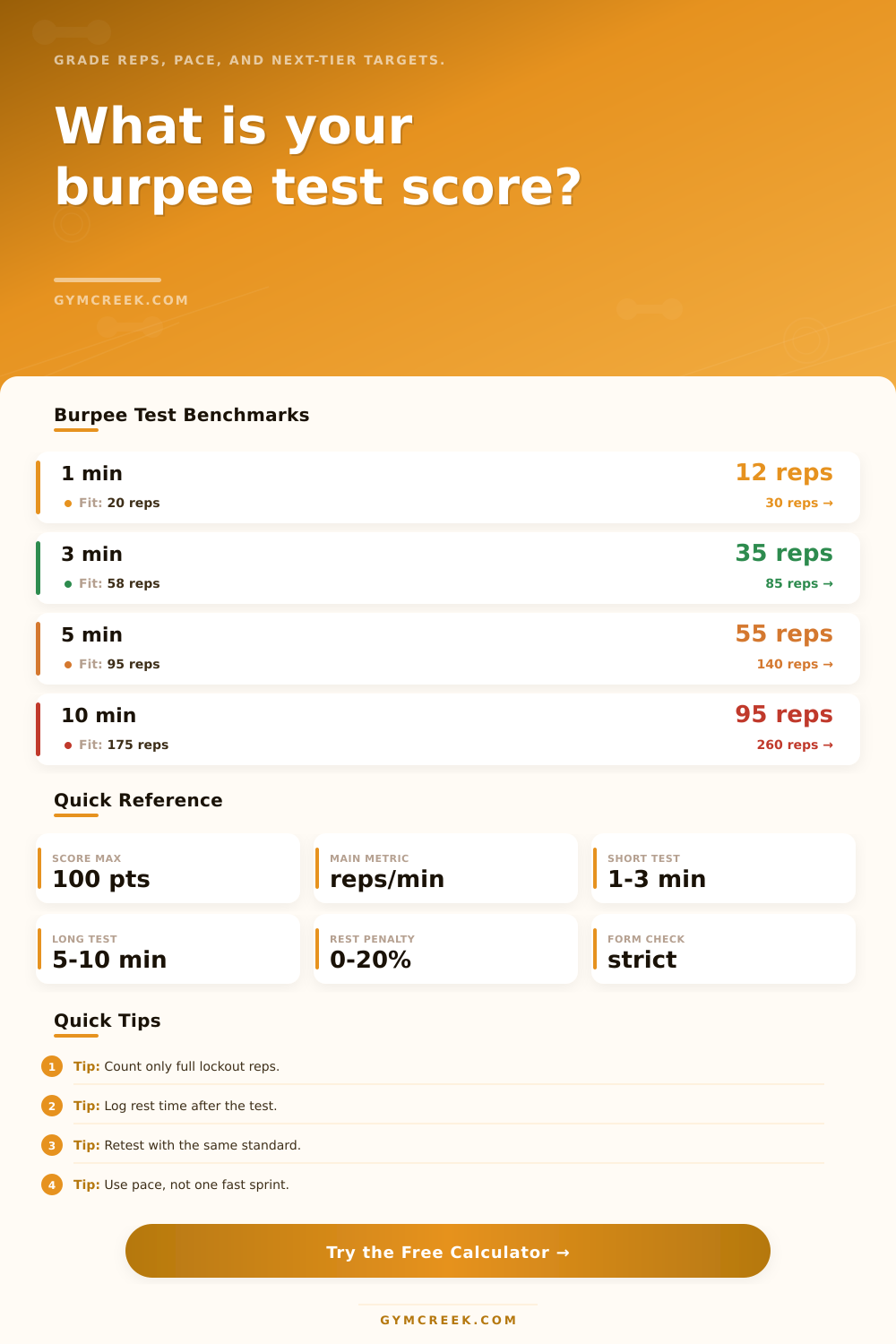
| Duration | Good Use | Pacing Focus | Score Note |
|---|---|---|---|
| 1 minute | Power test | Fast start | Low fatigue |
| 2 minutes | Screening | Smooth reps | Skill matters |
| 3 minutes | Fitness test | Even split | Main standard |
| 5 minutes | Capacity test | Hold rhythm | Endurance weighted |
| 10 minutes | Long grind | Limit pauses | Rest penalty high |
| Tier | Score | 3-Min Men | 3-Min Women |
|---|---|---|---|
| Needs Work | 0-49 | Under 35 | Under 28 |
| Solid | 50-64 | 35-49 | 28-41 |
| Strong | 65-79 | 50-64 | 42-55 |
| Excellent | 80-91 | 65-79 | 56-69 |
| Elite | 92-100 | 80+ | 70+ |
| Age | Male Base | Female Base | Adjustment |
|---|---|---|---|
| 18-29 | 58 reps | 48 reps | Peak pace |
| 30-39 | 54 reps | 44 reps | -7% |
| 40-49 | 48 reps | 39 reps | -17% |
| 50-59 | 40 reps | 33 reps | -31% |
| 60+ | 32 reps | 26 reps | -45% |
| Scenario | Time | Rep Goal | Best Signal |
|---|---|---|---|
| New tester | 1 min | 12-20 | Movement skill |
| Class check | 3 min | 45-60 | Repeatable pace |
| Runner cross-test | 5 min | 80-105 | Breathing control |
| Tactical retest | 2 min | 35-55 | No-rep control |
| Advanced test | 10 min | 180+ | Rest discipline |
💡Tips
Almost everywhere across the globe, in both bootcamps and CrossFit boxes, the burpee are universally loathed. It divides, breaks spirits, and separates those who can sustain effort from those who cannot. But it also happens to be an extremely useful tool when checking overall physical preparedness. Why? It requires us to perform three thing at the same time: cardiorespiratory endurance, muscular strength, and neuromuscular coordination.
Next time you line up for a burpees challenge, remember that you’re more than simply tracking repetitions, you’re testing yourself against your ability to sustain quality movement through mental and physical exhaustion. After entering the number of reps and minutes into the calculator above, the rest is handle for you. No need to fumble with conversion tables or pace coefficients; you’ll have plenty of time for looking at the real-world performance data.
Why Burpees Are Good for Your Fitness
How long is your test? Longer means it measures something different than before. One minute measures both your muscle activation speed and power output. Sprint. If unconditioned, form will break down quicky. Ten minutes reverses everything. Now, the most limiting factors isn’t raw strength but rather metabolic efficiency and mental discipline against creeping exhaustion. The reference table on the page maps all that out in terms of what each duration relates to various fitness area. That way you can choose whether you’re looking at a burst of power or a test of endurance.
So avoid the common mistake of training for a sprint when your goal is realy a marathon-level grind. A ½ rep won’t cut it in terms of functional fitness; form are more important than pure quantity. A vertical jump + a full chest-to-floor movement engages the whole posterior chain and places a real cardiovascular demand on the body. When you skip the push-up or step backwards (thus modifying the rep), you reduce the physical strain per unit of time. Your raw rep count appears larger; however, the physical strain is far less. To create an apples-to-apples comparison, the tool adjusts for this change by basing your score on a different starting point. So no matter what your standard looks like, the tool doesn’t unfairly penalize a strict athlete compared to one who uses a lighter standard. One who uses a lighter standard.
Pacing is a silent killer. Most newbies come out of the gate way too hard and fast, burning themselves out early before slowing down dramatic during the last few minutes. It’s a great start because it feels good, but ultimately results in fewer total reps compared to a more methodical, paced effort. What you’re looking for here is steady, rhythmic work with enough room for short recoveries between sets. No need to grind constantly. By normalizing the rep count based off the actual amount of time spent working, you can use traditional 3-minute mark as a benchmark. Now you can compare results from a five-minute test and know that it’s apples-to-apples, even if there was some extra time remaining on the clock.
Benchmarking also takes into account age and sex. After all, you’re not as fast as you used to be because recovery capacity and muscle mass decrease with age. So if you score higher at a certain benchmark than someone else, it could simply be because of your demographics. For example, if a 25 year old gets the exact same number of reps as a 40 year old, then maybe that 40 year old is scoring higher then they should compared to their peer group. Knowing this can help you set reasonable goals. This way, you don’t have to compare yourself to others so directly. It will still keep you motivated because it allows you to see your progress within your own bracket.
The distinction between good and great performance lie in rest management. When fatigued, high performing athletes don’t come to a dead halt. Instead, they maintain their heart rate and slow down with more subtle transitions or micro-pauses that decrease mechanical stress. This non-rep time is logged giving you a better view into how efficiently you’re working. If you see that a significant part of your testing time was spent stationary, there’s room for improvement in your conditioning. The breakdown will highlight this split which could of been used as a concrete measure to target during training.
The burpee test realy is like a reflection of your entire fitness. It reveals flaws in mental toughness, form or stamina that may be masked in other types of exercise. Its structured data turns a vague feeling of being tired into clear information on how you can improve. Need more strength? Better pacing strategy? More aerobically based fitness? Numbers answer those questions, and you must act on what they say. Respect the pace, keep movement strict and allow the numbers to dictate where you go next.