Burpee Calorie Calculator
Estimate calories burned from burpee version, reps, rounds, pace, pushup and jump choices, body weight, rest ratio, adjusted MET, and mechanical power.
📌Burpee Presets
Each preset loads a realistic burpee session and recalculates reps, active time, rest time, calories, MET, and power output.
⚙Calculator
Burpee calorie snapshot
Enter burpee version, reps, rounds, pace, body weight, pushup, jump, and rest ratio to estimate the session.
📊Metrics Grid
🧮MET and Power Logic
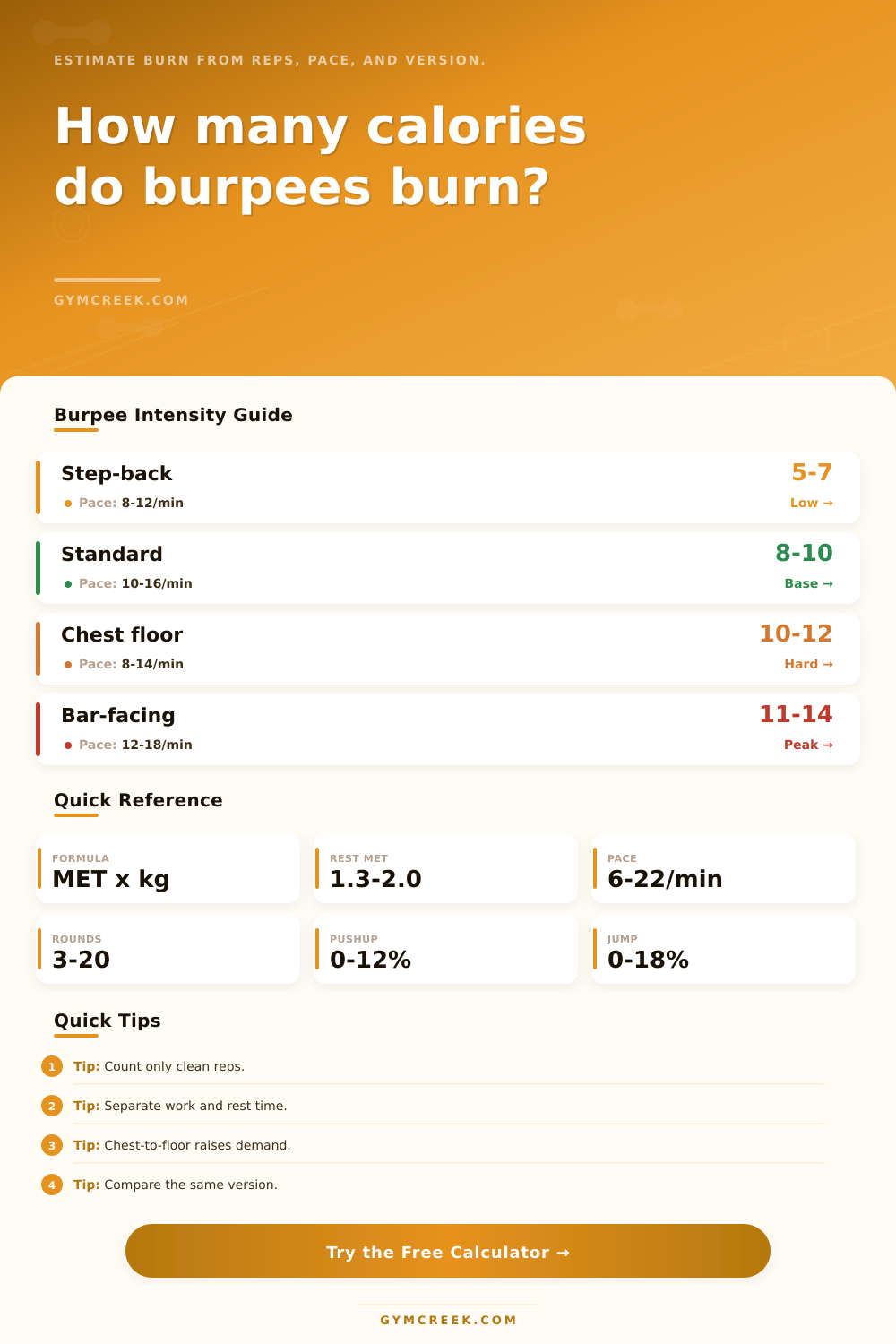
Calories per minute = MET x 3.5 x body weight in kg / 200. The calculator applies that to active burpee time.
Step-back, standard, chest-to-floor, broad jump, box jump, and loaded versions start with different base MET values.
Pushup depth and jump height raise both adjusted MET and the estimated mechanical work completed each rep.
Mechanical work uses body mass, load, gravity, movement displacement, total reps, and active time to estimate average watts.
📑Reference Tables
| Burpee Version | Base MET | Typical Pace | Best Use |
|---|---|---|---|
| Step-back burpee | 5.8 MET | 6-12/min | Lower impact conditioning |
| Standard burpee | 8.6 MET | 10-16/min | General conditioning |
| Chest-to-floor | 10.4 MET | 8-14/min | Competition-style reps |
| Burpee broad jump | 11.6 MET | 6-12/min | Power endurance |
| Bar-facing burpee | 12.2 MET | 12-18/min | Fast race intervals |
| Pace Band | Burpees/Min | Session Feel | Tracking Note |
|---|---|---|---|
| Technique | 4-8 | Controlled | Good for learning |
| Steady | 8-14 | Repeatable | Best for volume |
| Hard | 14-20 | Breathy | Watch form drift |
| Sprint | 20+ | Very hard | Use short rounds |
| Option | MET Effect | Power Effect | When To Use |
|---|---|---|---|
| No pushup | Lower | Less press work | Fast conditioning |
| Strict pushup | Higher | More upper-body work | Strength bias |
| No jump | Lower | Less vertical work | Low impact |
| Box jump | Higher | High vertical work | Power sessions |
| Formula Piece | Uses | Output | Why It Matters |
|---|---|---|---|
| MET kcal | MET, kg, min | Calories | Main burn estimate |
| Rest kcal | Rest MET, kg | Calories | Recovery periods |
| Duty cycle | Work, rest | Percent | Session density |
| Power | Mass, reps, time | Watts | Output comparison |
💡Tips
Burpees are hated by most folks, as if the exercise itself were punishment. Drop down, do a pushup, then jump back up to standing, the whole-body workout strain our systems at the same time.
Fitness trends has kept coming back to the burpee: an effective combination of strength training and cardio. But how many calories does it realy burn on those last few reps when your lungs are burning?
How Many Calories Do Burpees Burn?
Not so fast… It’s not as simple as counting reps; it depends on more factor than we realize.
A hundred burpees, right? If I count to 100 reps, no matter how badly I want to die halfway through, my body will burn the exact same number of calories as someone who did them properley. That’s what you’d think, right?
Nope. Physics and physiology shows that the results depend on the version you choose (see below), how fast you do them, and how much rest you take between set.
And here’s how it works: On this page, there’s a calculator that takes all those variables into account (most other generic fitness trackers don’t).
A regular step-back burpee… Where you walk your feet forward and backward, rather than jump, will torch far fewer calories then its jumping counterpart. That’s because when you jump, your legs has to exert force against gravity, meaning they requires more energy. Add in a pushup with a strict chest-to-the-ground range of motion, and you’re recruiting even more muscle fibers in your upper body, ratcheting up the intensity level yet again.
You can select whatever version of the move you’re doing, ranging from the low-impact step-back to the high-powered broad jump, and the tool estimates the calorie burn based off your choice.
And why does this matter? Because accuracy is everything. Underestimating the effort means you’ll likely undereat and hinder your progress. Overestimating it means you won’t push yourself hard enough to reap any benefit.
Pace also matters. Sprinting through your burpees will cause a different metabolic response than doing them at a slower, controlled pace. The calculator take this into account by assigning a Metabolic Equivalent of Task (MET) value. The faster you move, the greater the MET number and the more calories burned per minute.
That said, your body can’t perform at max-effort indefinitely. Here’s where the rest ratio matter. If you do brief, intense intervals with an equal amount of rest in between, the calculator consider the lower energy use during those rest periods. It tells the difference between recovery calories and work calories to provide a clearer image of what happened during the workout.
Most people overestimate how many calories they’ve burned because they don’t consider the time spent resting.
It also takes into account body weight itself. A heavier person will exert more energy to move their own weight than someone lighter. The calculator use this and adjusts for individual bodies so the estimated output is relative to your size. You should also factor in any additional load (e.g., dumbbells, weighted vest). More weight = more mechanical work per rep, leading to higher wattage estimates plus more calories burned.
If you’re measuring fat-loss with strength-endurance gains, this is good. Not only do you know how many calories you’ve used, but how much mechanical work you did, a new angle on things beyond just calories.
What else? Another trap is thinking all burpees are created equal. A full hand-release pushup burpee isn’t the same as a no-pushup burpee. Or a step-back burpee isn’t the same as a standard version with a jump. This shifts the load required of your triceps, shoulders and chest.
The page’s reference tables spells this out… Showing how changes alter base MET values. They are small, but they are important if you’re tracking progress from week to week or attempting to mimic a workout exactly. Be consistent about form… And therefore about your data.
But at the end of the day, the burpee is still a tool. And as with all tools, using them wisely would of requires some knowledge of how they work. Knowing the variables that drive the burn allows you to make smarter choices: Do I need high-volume and slow-paced or max-effort sprints? Will a weighted vest make it feel harder and allow me to maintain my rep count?
If you’re using burpees to fit in extra movement throughout the day or train for a competition, having the right information in advance allows you to stop guessing and start training with intent. While it’s still a brutal exercise, putting the right context around it will turn it into a powerful and predictable way to build your fitness.