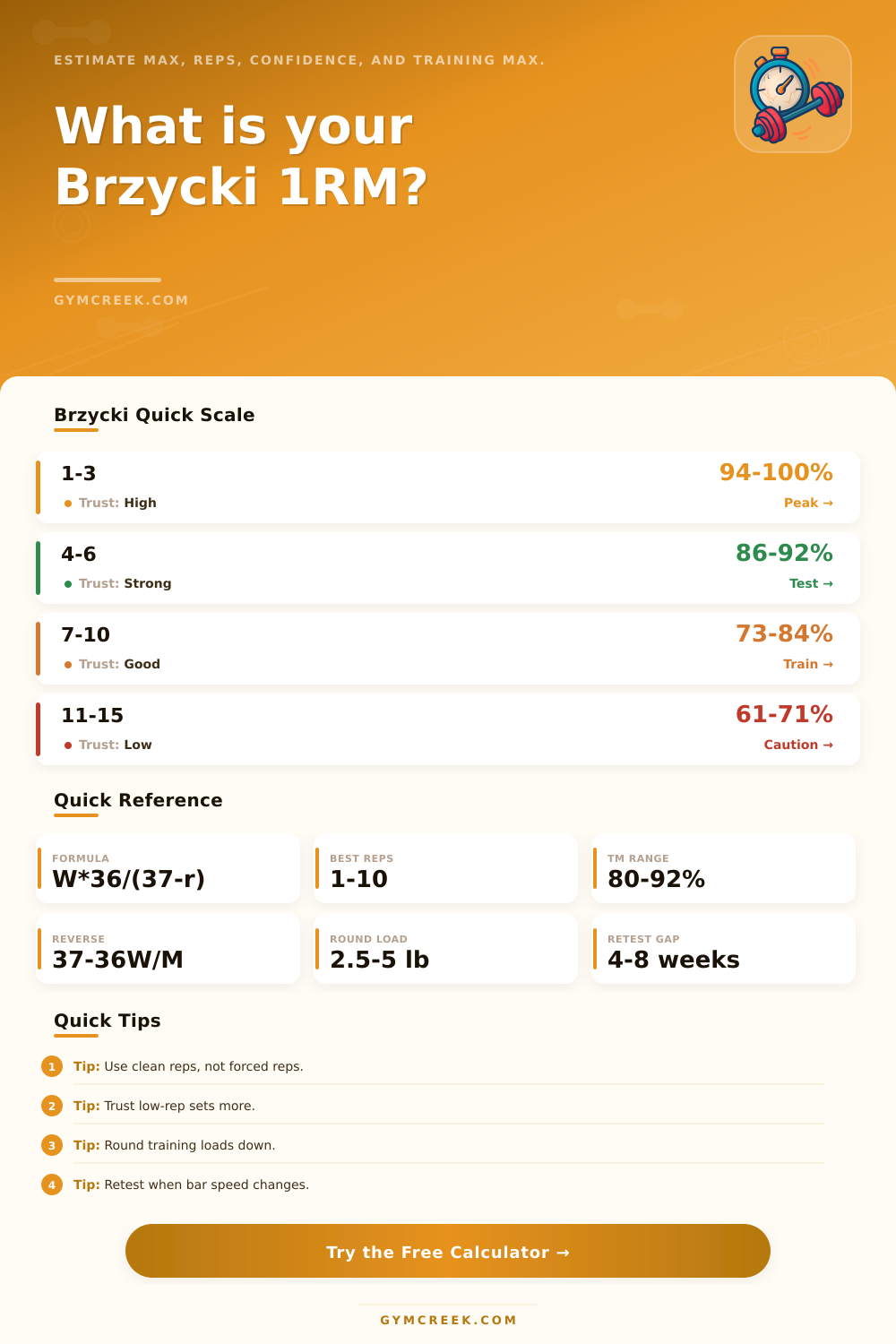
Brzycki 1RM Calculator
Estimate a one-rep max with the Brzycki formula, reverse the math into rep targets, and choose a confidence-adjusted training max.
📌Brzycki Test Presets
Each preset uses Brzycki-only math and fills the planned load, rounding, readiness, and training max assumptions for a different lifting situation.
⚙Calculator Inputs
Brzycki strength snapshot
Enter a tested set to estimate max strength and reverse rep targets.
📊Brzycki Metrics
📑Reference Tables
| Clean reps | Multiplier | 1RM load share | Confidence note |
|---|---|---|---|
| 1 | 1.000 | 100.0% | Direct max or crisp single |
| 3 | 1.059 | 94.4% | Strong estimate when technique is steady |
| 5 | 1.125 | 88.9% | Common strength test range |
| 8 | 1.241 | 80.6% | Useful but more fatigue-sensitive |
| 10 | 1.333 | 75.0% | Upper end of practical reliability |
| 15 | 1.636 | 61.1% | Use a larger training buffer |
| Load as % of 1RM | Reverse estimate | Practical use | Planning note |
|---|---|---|---|
| 95% | About 3 reps | Heavy top set | Stop if bar speed fades |
| 90% | About 5 reps | Strength work | Good for triples to fives |
| 85% | About 6-7 reps | Volume strength | Leave a rep in reserve |
| 80% | About 8 reps | Back-off sets | Solid submax anchor |
| 75% | About 10 reps | Hypertrophy overlap | Fatigue affects accuracy |
| Training max % | Best fit | Confidence need | Adjustment cue |
|---|---|---|---|
| 75-80% | Return from break | Low or unknown | Pick this after long layoffs |
| 82-87% | General strength | Moderate | Useful when the test was 8+ reps |
| 88-92% | Focused strength block | High | Best after clean low-rep tests |
| 93-95% | Short peak | Very high | Use only with recent heavy practice |
| Scenario | Test style | Planning use | Why it differs |
|---|---|---|---|
| Heavy Triple | Low reps | Peaking or strength | High confidence, small buffer |
| Clean Five | Moderate reps | Training block setup | Balanced accuracy and fatigue |
| Volume Ten | Higher reps | Estimate only | More endurance influence |
| Deload Return | Submax set | Conservative restart | Readiness and buffer matter more |
💡Brzycki Notes
The Brzycki formula is used by lifter to calculate their one-rep max based on the weight and number of repetitions that they lifted during their training session. Most lifter do not perform their one-rep max during their training sessions. Most training session include sets that do not include repetitions that reach failure.
These sets provide the data necessary to calculate the one-rep max using the Brzycki formula. To calculate the one-rep max, an individual has to record the weight that they lifted and the number of clean repetition that they performed; then, they can input those numbers into the Brzycki formula to calculate their estimated one-rep max. While the calculated number is not the actual one-rep max that the lifter can produce, that calculated number can be used as the starting point for developing a training cycle for that individual lifter. The accuracy of the calculated one-rep max depends upon a few different factor.
How to Use the Brzycki Formula to Find Your One-Rep Max
First, the weight and the number of repetitions that are lifted is the primary element of the equation. Additionally, the physical readiness of the lifter will have an impact upon the accuracy of the Brzycki formula; if the lifter feels fatigued, for instance, their one-rep max will be calculated to be lower than their true one-rep max. Additionally, the specific exercise that the lifter perform will also have an impact upon the accuracy of the Brzycki formula. For example, deadlifts may lose accuracy at higher repetition count than bench presses, which may be due to the difference in the physical movements of those two exercises.
The user can adjust the training max posture within the calculator to indicate the number of repetitions that the lifter will actually lift during their training cycle. The training max percentage is one of the most critical element within the Brzycki formula calculation. This percentage will determine how much of the calculated one-rep max will actually be lifted during training.
For instance, if an individual chooses a high training max percentage, they may require that their one-rep max test was performed recently, they performed few repetitions of the exercise, and they performed the exercise with good technique. Conversely, if an individual is returning from a break in training, or if the test performed included a high number of repetitions, that individual should choose a lower training max percentage. The bar will feel heavy when the training max percentage is set to high.
Beyond determining a one-rep max, the Brzycki formula also allows for reverse calculation to determine the number of repetitions that a specific weight lifted by the lifter will produce. Using this reverse calculation, an individual can better plan sets to perform to develop strength in those muscles, while avoiding too much guessing about the load that there muscles can handle. Additionally, the difference between the calculated one-rep max and the actual weight that is lifted during training will provide an individual with insight into how they are utilizing their energy and recovering from training; too little energy may indicate that the load is too light for the individuals strength; too much energy may indicate that the load is too heavy for the individual’s recovery cycle.
While the Brzycki formula may be helpful for calculating an individual’s one-rep max, the body weight of the individual does not factor into the equation. However, an individual whose one-rep max is approximately double their body weight will have different training need than an individual whose one-rep max is less than half of their body weight. Thus, although body weight does not factor into the equation, it does provide an individual with insight into whether the strength that they are developing is keeping pace with their body size.
An individual who treats the calculated one-rep max as an absolute number may make common mistakes. For instance, the Brzycki formula assumes that the individual lifted with the same range of motion for each repetition; if they used a spotter to assist with the last repetition, or if they exhibited poor lifting technique, the calculated one-rep max will be too high. Additionally, if the individual performed the test when they were not physically ready for performance of that weight, their calculated one-rep max will not be accurate.
Factors like sleep and physical readiness are not accounted for in the equation, but they can be factored into the readiness score and training max posture calculations for that individual. The true value of the Brzycki formula can be found over a period of time, rather than in a single day. By running the Brzycki formula after the individual lifts the sets during training, by choosing the training max according to the individuals readiness after training, and by continuing to use that strength after training, the individual can determine if the one-rep max calculated was accurate.
Additionally, if adjustments need to be made to the training for that individual, the formula can provide data for the individual to use in creating adjustments to their training program. Thus, the Brzycki formula becomes useful not for the individual’s sets alone, but due to the data that it provides. Therefore, the Brzycki formula is useful not only because it calculates the one-rep max for the individual, but because it allows for that individual to update the number without performing a one-rep max test every single time.
It should of been used more often by people who want to see progress.