Broccoli Fiber Calculator
Estimate broccoli fiber, total carbs, net carbs, per-serving grams, raw-to-cooked yield, and daily fiber goal coverage.
📌Presets
Presets load common broccoli portions and cooking states, then calculate fiber, net carbs, servings, trim loss, and raw-equivalent weight.
⚙Calculator
Broccoli fiber snapshot
Enter a broccoli portion to estimate fiber and net carbs.
📊Broccoli Metrics Grid
📑Reference Tables
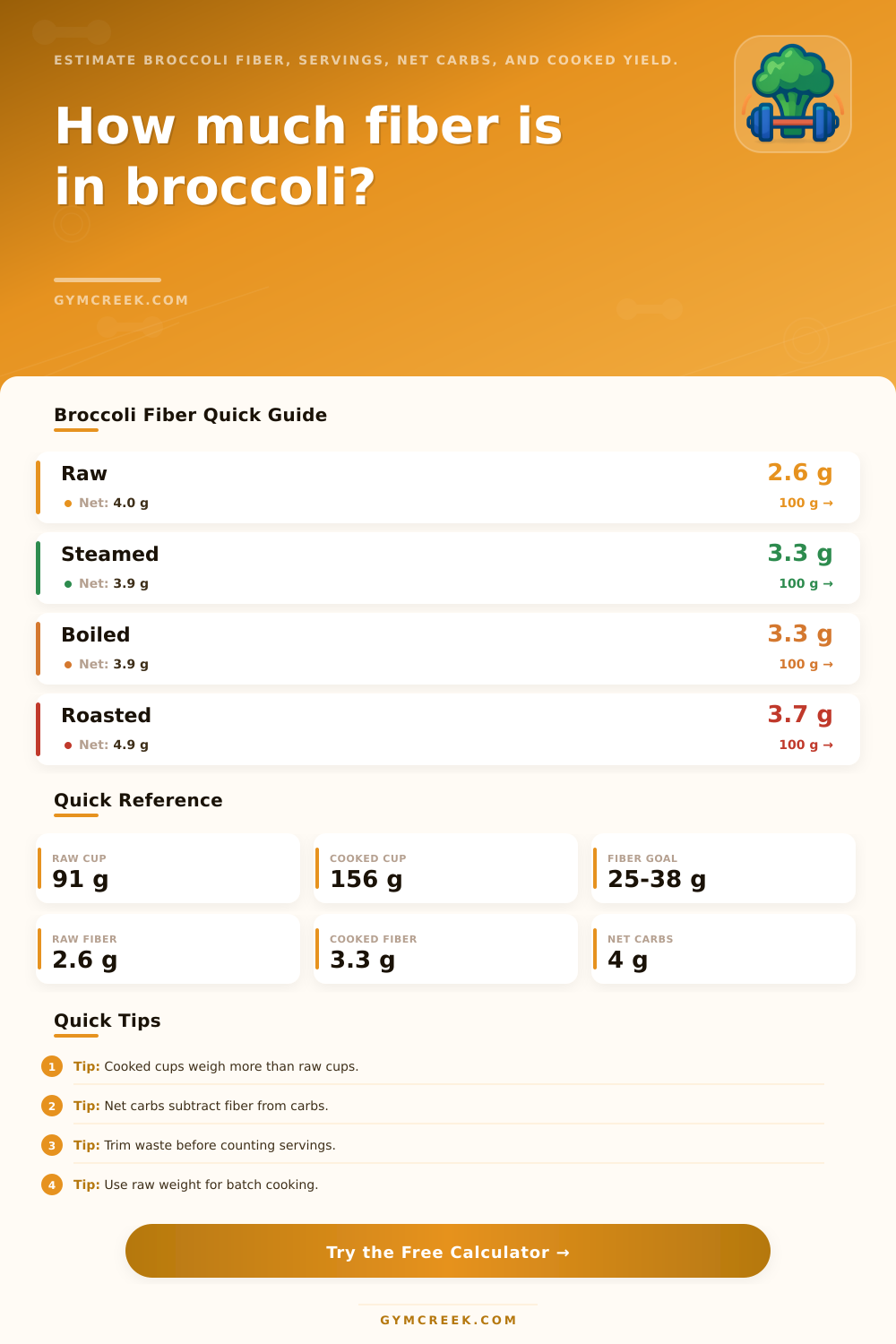
| Broccoli Form | Fiber per 100 g | Total Carbs | Net Carbs |
|---|---|---|---|
| Raw broccoli | 2.6 g | 6.6 g | 4.0 g |
| Steamed broccoli | 3.3 g | 7.2 g | 3.9 g |
| Boiled and drained | 3.3 g | 7.2 g | 3.9 g |
| Roasted broccoli | 3.7 g | 8.6 g | 4.9 g |
| Frozen cooked broccoli | 3.0 g | 5.4 g | 2.4 g |
| Broccoli sprouts | 2.6 g | 5.2 g | 2.6 g |
| Household Measure | Estimated Grams | Best Match | Fiber Estimate |
|---|---|---|---|
| 1 cup raw chopped | 91 g | Raw | 2.4 g |
| 1 cup raw florets | 71 g | Raw | 1.8 g |
| 1 cup cooked chopped | 156 g | Cooked | 5.1 g |
| 1 cup cooked spears | 180 g | Cooked | 5.9 g |
| 1 medium stalk | 151 g | Raw | 3.9 g |
| 1 medium spear | 37 g | Cooked | 1.2 g |
| Cooking State | Yield from Raw | Fiber Effect | Calculator Use |
|---|---|---|---|
| Raw | 100% | Baseline | Salads and snacks |
| Steamed | 89% | Concentrates by weight | Side dishes |
| Boiled | 92% | Similar to steamed | Drained meal prep |
| Roasted | 75% | More water loss | Sheet pans |
| Frozen cooked | 96% | Label-like estimate | Frozen bags |
| Fiber Target | Broccoli Needed | Cooked Cups | Net Carbs |
|---|---|---|---|
| 3 g fiber | 91 g steamed | 0.58 cup | 3.5 g |
| 5 g fiber | 152 g steamed | 0.97 cup | 5.9 g |
| 8 g fiber | 242 g steamed | 1.55 cups | 9.5 g |
| 10 g fiber | 303 g steamed | 1.94 cups | 11.8 g |
💡Tips
When you buy broccoli, do you find yourself wondering whether or not it’s even worth it? Broccoli is nutritious: it contains vitamins and minerals and all that good stuff. But then you cook your broccoli, and it gets smaller! The stalk you cut off shrivels up, and the floret portion you steam does too. When broccoli get smaller like this, it becomes difficult to determine if you’re really consuming an entire serving.
Instead, many people estimate the amount of food in front of them by judging its visual appearance (i.e., “I think I had a pretty big portion”). This leads them to underestimate their dietary fiber or overestimate carbs. Fortunately, there’s a nutrition calculator out there to do the math for us. Simply input the amount of broccoli you started with before cooking along with the cooking method, and the calculator will inform you if the shrunken bowl represent a big change in nutrition.
Why Cooked Broccoli Shrinks and How to Track It
But the source of confusion usually begins with the shape of the vegetable. Broccoli contains both air and water within its cellular structure, which makes it relatively bulky when raw. Cook it (boil or steam), however, and it will become denser (lose volume) yet heavier (gain mass). While a cup of raw chopped broccoli typically weighs around ninety-one grams, a cup of cooked chopped broccoli might weigh upwards of one hundred fifty grams.
Even though the chemical makeup is the same, the change in density mean there is more fiber per cup in cooked broccoli then in raw, even though the nutrient levels are equal. Why does this matter? Nutrition guidelines use uniform measurements. If you compare raw food to cooked food without accounting for weight change, you will have an inaccurate view of what you are consuming.
The thing about fiber: It’s heat-resistant, which means that unlike vitamin C, it won’t be destroyed when you roast or steam (but it *will* concentrate as the water drips off during cooking). But with all cooking, it depends where the fiber comes from: Boil up broccoli, drain, and some of those nutrients will have leaked out into the broth (but most of the fiber remain intact). To take this nuance into account, the calculator lets you choose whether you want to input a raw or cooked amount, then adjust the yield accordingly.
Enter the amount of leftovers you have remaining, or put in the raw weight to see what your finished batch will look like. It even considers trim loss. That is, it knows that while you may choose to peel and eat the woody broccoli-stalk-bottom bit, most people don’t. All that little waste add up.
If you want to regulate blood glucose or avoid sugar, you should of calculated net carbs. To find the net carb value for an item, simply deduct the fiber content from total carbohydrate. Even though the total carb value for broccoli is somewhat moderate, it’s still low on the net carb scale due to being so full of fiber. Roasted broccoli contains roughly nine grams of total carbs per 100g and about five grams of net carbs, meaning it won’t spike your blood sugar! That’s what doesn’t raise your blood sugar!) This explains why green vegetables can make up such large servings within low-carb diets.
Fiber bulks up the food, making it satisfying, while adding little to no metabolic cost compared to sugar or starch. There’s nothing worse than getting generic advice about what to eat. “Eat 25g of fiber per day.” But do you need more or less? Does your age, activity level and gut health matter? By setting your own goal, you get a clear sense of how much that vegetable side-dish is helping you meet YOUR goal. It makes it real.
You know instantly: does this little snack represent five percent of my daily requirements, or twenty? And that changes everything. Instead of focusing on what you are missing, it focuses on what you are adding. It shows how easy it is to meet your nutritional needs with veggies while keeping calories relatively low.
But it’s not just for one-time use in that particular meal. For example, batch cooking also involves another kind of way of thinking: you begin with a huge amount of uncooked food and has to transform it into several individual portions. The yield factor lets you estimate how much of whatever you’re working with you’ll wind up with, for example, how many servings can you expect to get from a head of broccoli?
You will have a lot less once they are roasted on a full-sized baking tray than when they were fresh, since all that water has evaporated. That means each serving will be higher in fiber. Now you can adjust accordingly so that every meal is properly balanced. No more guesswork. Just measure confidently.
But at the end of the day, tracking nutrition doesn’t have to be stressful or rigid. It’s all about the tradeoffs: Nutrient density vs. Mass. Volume vs. Weight. No matter how you cook broccoli, for example, it’ll still give you a nice dose of fiber. Just factor those mass differences into your calculation.
Today’s tools just eliminate the friction in the equation. Now, you’re able to eat your greens with confidence, knowing you understand exactly what they’re doing for you, transforming an otherwise boring vegetable into a key part of your diet. Your head of broccoli at the grocery store is totally worth the trouble once you know its exact role within the greater picture.