British Triathlon Points Calculator
Estimate a British triathlon points-style score from event distance, age group, gender category, finish time, winner or reference time, field strength, placing percentile, and points bands.
📌Points Scenario Presets
This is an estimator for comparing race results. It is not an official British Triathlon ranking, selection, qualification, or series-scoring tool.
⚙Athlete And Category Context
🏁Event Distance And Race Result
📊Field Strength And Percentile
Race score estimate
Enter a finish time and reference time to estimate your score.
📈Live Score Metrics
📚Reference Tables
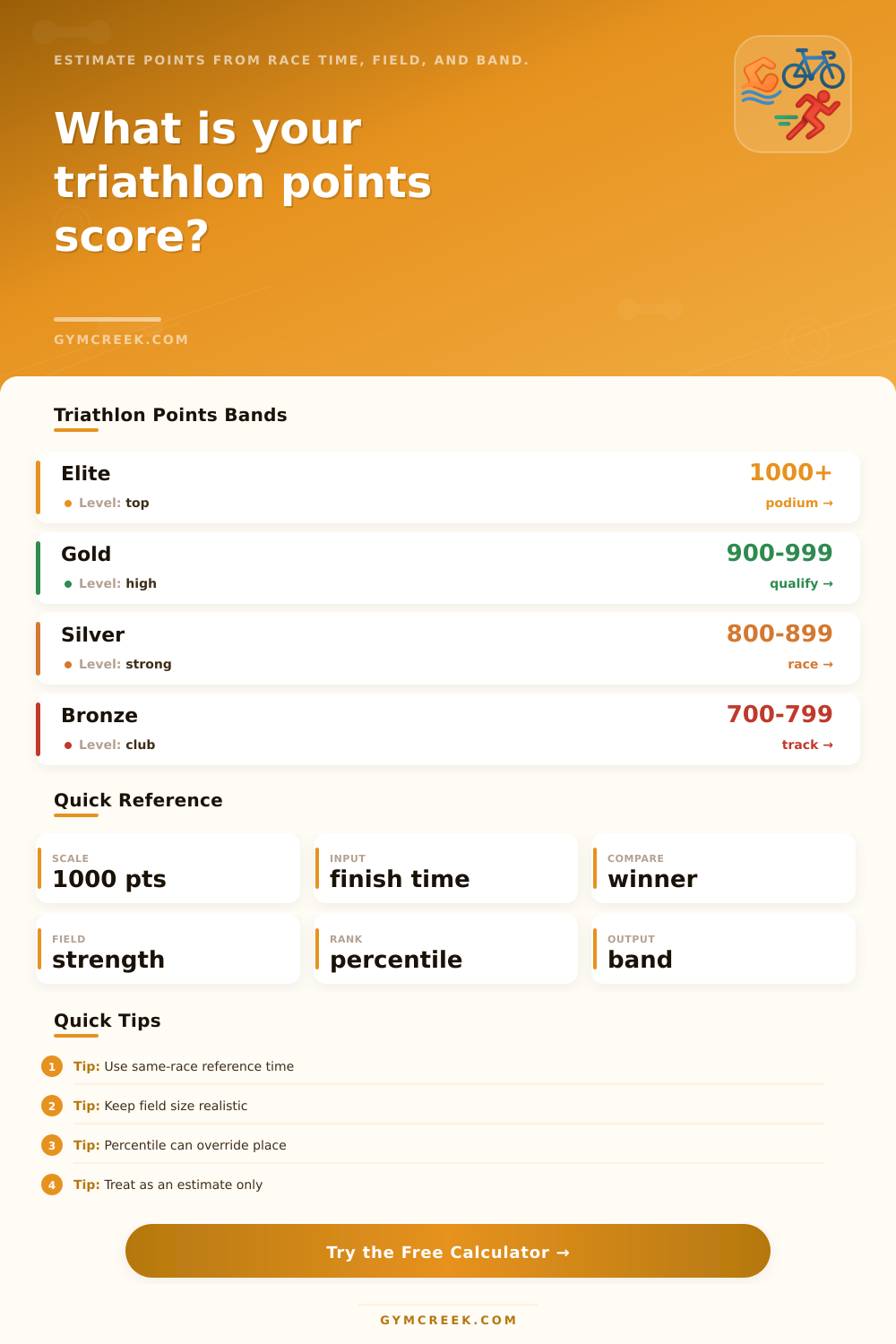
| Band | Points | Typical reading | Use |
|---|---|---|---|
| Race-winning | 1100 plus | Exceptional versus reference | Course-best comparison |
| Elite | 1000 to 1099 | Reference-level performance | Top age-group context |
| Gold | 900 to 999 | Strong category result | Qualifier-style tracking |
| Silver | 800 to 899 | Competitive age-grouper | Season progress |
| Bronze | 700 to 799 | Solid club result | Club comparison |
| Development | Under 700 | Build consistency first | Baseline tracking |
| Distance | Swim | Bike | Run |
|---|---|---|---|
| Super sprint | 0.4 km | 10 km | 2.5 km |
| Sprint | 0.75 km | 20 km | 5 km |
| Standard | 1.5 km | 40 km | 10 km |
| Middle | 1.9 km | 90 km | 21.1 km |
| Long | 3.8 km | 180 km | 42.2 km |
| Custom | User set | User set | User set |
| Target | Points | Needed time | Change |
|---|---|---|---|
| Bronze | 700 | --- | --- |
| Silver | 800 | --- | --- |
| Gold | 900 | --- | --- |
| Elite | 1000 | --- | --- |
| Component | Input | Effect | Reason |
|---|---|---|---|
| Time ratio | Reference / finish | Main score driver | Compares pace to race standard |
| Percentile | Place and field size | Raises or lowers score | Rewards deeper category placing |
| Field strength | Race depth estimate | Quality modifier | Separates local and national fields |
| Course context | Fast to severe | Condition modifier | Harder courses get small credit |
| Age context | Age group | Modest modifier | Useful when references vary |
| Target inversion | Band threshold | Needed finish time | Shows gap to next score band |
💡Calculation Notes
A points-style estimate can transform a single result from a triathlon into a comparable number. A points-style estimate is useful in that it allow a person to track their performance over time, and it lets them decide if there performance at a particular triathlon is strong enough to achieve a goal. A single race result is often difficult to evaluate on its own due to various factors related to that particular race, such as the size of the field of runners, the level of competition, and the distance of the race.
A points-style estimate allows a person to compare their result to other race results. There are several important inputs into the calculation of a points-style estimate. One of the most important is the race result of the winner of the age group division, not the overall race division.
What is a points-style estimate?
The reason for the importance of this time is that the age-group division winner represent the performance of an individual runner who competed against others with similar levels of strength and endurance. The time of the overall winner may represent a runner who competed against professionals or athletes of significantly less endurance. Other important inputs include the strength of the field, the placement in the race, and the percentile in the race.
Other race results may use other methods of calculating these factors, but they is important in determining the value of the runner’s result for that particular race. The distance and format in which the race occurred is another important input to calculate the value of the result of that runner. Different distances will require different considerations of the performance of that runner.
Finally, the conditions of the race (such as hills and weather) may impact the value of that runner’s time, and those factor may be reflected in the estimation of that result. The output of a points-style estimate consists of a score, a band label, and a target time for the next band. Each band label indicates the relationship of the result of the runners time to the reference time for that race.
If the band label is a gold or elite division, it means the runner’s time was close to the reference time. If the band label is a silver or bronze division, it means the runner’s time was competitive in relation to the reference time. Finally, the target time for the next band indicates the goal that a runner should of had in relation to their training program.
The target time is the amount of time that the runner should aim to improve their time more in order to reach the next band in their classification. It is possible for many people to misinterpret the values represented by a points-style estimate. The result of a triathlon using this type of calculation is not an official qualification time for any race or competition, and it isnt an official ranking of the performance of that individual runner.
The number is an estimate of the performance of the runner within the same logic that many triathlon race series utilize in their calculations. Thus, this number is most useful in the evaluation of an individual’s performance over time. The reference tables on the page allows for each individual to view the different time bands and the number of finishers for each of those time bands.
The visibility of each of these tables allows for the individual to adjust the different inputs to the calculation. The accuracy of the points-style estimate will depend upon the reference time and the field information that is provided. If you use the time for the age-group division winner instead of the time for the overall race winner, the estimate is less likely to overstate the performance of the runner in comparison to others in his division.
Conversely, if the size of the field is very small and no adjustment are made to the percentile ranking of the runner, the result of the calculation will overstate the performance of the runner relative to others who compete in the triathlon. Thus, while the points-style estimate makes it easy for individuals to perform the calculations, individuals must make these judgments of the different inputs to the calculation. Despite the fact that a single race result can be evaluated using this calculation, it is most useful when that result is compared to other results from the same runner at other triathlons and at various distance.