Calories Burned Breastfeeding Calculator
Estimate lactation energy use from feeding sessions, minutes, infant age, feeding style, milk expression, parent body weight, baseline activity, hydration reminder, and postpartum timing.
📌Breastfeeding Presets
Presets are planning examples only. They load realistic feeding patterns, not a diagnosis, prescription, or rule for how much anyone should eat.
⚙Calculator Inputs
Breastfeeding energy snapshot
Enter your feeding pattern to estimate lactation energy use, daily and weekly ranges, and a confidence band.
📊Metrics Grid
📑Reference Tables
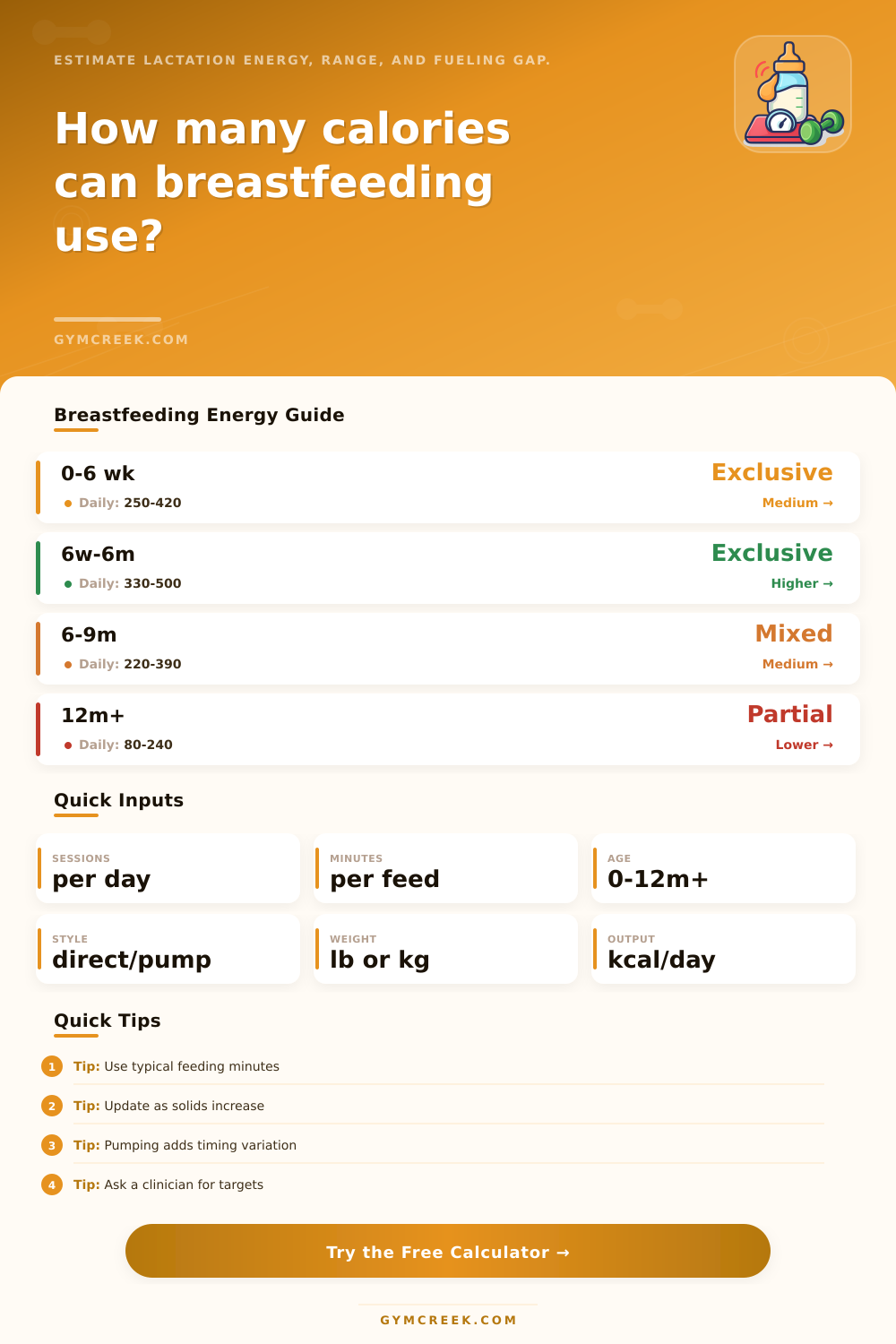
| Infant age band | Base kcal/day | Typical context | Range cue |
|---|---|---|---|
| 0 to 6 weeks | 300 | Early supply changes | Wider |
| 6 weeks to 6 months | 400 | Established milk production | Narrower |
| 6 to 9 months | 330 | Milk plus early solids | Medium |
| 9 to 12 months | 240 | More solids, variable feeds | Medium |
| 12 months plus | 150 | Comfort or extended nursing | Wider |
| Feeding style | Factor | How it is used | Confidence cue |
|---|---|---|---|
| Exclusive or nearly exclusive | 1.00 | Uses full age-band baseline | Higher |
| Mostly breast milk | 0.82 | Trims for mixed intake | Medium |
| Combination feeding | 0.62 | Lower milk share estimate | Medium |
| Partial or comfort nursing | 0.42 | Smaller lactation load | Lower |
| Tandem nursing | 1.35 | Raises for two milk-fed children | Lower |
| Expression pattern | Factor | Best interpretation | Why range changes |
|---|---|---|---|
| No regular pumping | 1.00 | Direct-feeding estimate | Less schedule noise |
| Occasional expression | 1.04 | Small planning bump | Some extra sessions |
| One short pump daily | 1.08 | Regular expression context | Timing varies |
| Two or more pumps daily | 1.14 | Higher handling load | Output can vary |
| Mostly pumping | 1.10 | Session-based pump pattern | Volume unknown |
| Band | Approx range | Usually means | Best next step |
|---|---|---|---|
| Higher | +/- 18% | Established, single infant, stable pattern | Use as planning context |
| Medium | +/- 25% | Some mixed feeding or pumping | Recalculate weekly |
| Lower | +/- 35% | Early, tandem, partial, or changing pattern | Use a broad range |
| Very broad | +/- 42% | Inputs conflict or pattern is changing fast | Ask for personal guidance |
💡Tips
Breastfeeding use energy from the bodys stores to create the milk that are needed to feed an infant. There are a variety of factor that can contribute to the energy that is used in the process of breastfeeding, which make it difficult to determine the actualy amount of energy that is used. However, the calculator that are available on this page can provide an estimate of the amount of energy that is used in breastfeeding.
The calculator consider each of the various variables of breastfeeding and create an estimate of the amount of energy that is used during the process of breastfeeding. The calculator utilizes the various inputs that is based off the way in which you are feeding your infant. The number of times that you breastfeed per day and the length of each session are one of the variable that the calculator considers.
How Many Calories Does Breastfeeding Use
The age of the infant is another of these variables, as the amount of milk that a mother produces change with the growth of the infant and as the infant begins to eat solid food. The style in which you are breastfeeding is another of these variable; exclusive breastfeeding require more energy then feeding that includes both breast milk and pumped milk, for instance, and tandem nursing (feeding two infant at the same time) will require even more energy than exclusive breastfeeding. The number of times that you are pumping milk from your breasts is another variable; occasional pumping of breast milk use less energy than regular and exclusive pumping.
The weight of the individual using the calculator is not one of the main variables that is used to calculate the energy that is used in breastfeeding; however, it is utilize to slightly adjust the energy calculation upwards or downwards. The timing of breastfeeding relative to the postpartum period is one of the variable that the calculator considers; if the mother feeding and recovery stages are not aligned, the energy that is used will be represented by a wider range. The level of activity of the breastfeeding mother is also a variable in the calculation; higher activity levels require more energy.
Finally, while the inclusion of the reminder to stay hydrated does not impact the calorie calculations, it is helpful in reminding the breastfeeding mother to consume fluid during the breastfeeding periods. Because there is no set amount of energy that a mother utilize during the process of breastfeeding, the calorie calculator provide ranges of calories rather than specific value. The energy that is used for lactation may fluctuate due to various factor.
The calculator include a range for lactation energy use to account for these fluctuations. The range is provided daily and weekly, with a note about the level of confidence in that range. The confidence in the calculations will be higher for individuals who has an established feeding pattern with one infant, but the calculations will be of lower confidence if the feeding pattern for the infants fluctuate quickly, such as in the case of tandem nursing.
The reference table on the page can be reviewed prior to using the calculator to determine how age ranges and different feeding style can impact the calculations provided. While many individuals may expect the calculator to provide a single number for nutritional need, that is not the purpose of the calculator. The calculator is meant to help individuals recognize if their current eating and drinking habit are sufficient for their bodies, but not to provide a number for how much of each nutrient should be consumed.
Most individuals find that cue for hunger and thirst are reliable indicators of the need for nutrients, but the lactation calculator does provide insight into the needs of the body during breastfeeding that can help individuals to recognize pattern in their bodies. One of the most common mistake in the use of the calculator is treating the result of the calculator as a static value for lactation energy needs. The bodys need will fluctuate based upon the feeding pattern of the infant, so the value of lactation energy needs should of been recalculated if the infant begins to eat solid food, if pumping need to be adjusted, or if there are change to the number of feeds that must be provided to the infant at night.
Another common mistake is to ignore the fueling gap, which is important for individuals who have a moderate or high level of activity in their day. The value of the calculator is that it make visible to the individual the energy that is used for the production of milk for the infant. The calculator allow individuals to recognize how many feeding minute or feeding session can impact energy use, and to recognize if their current feeding pattern is sustainable.
As a result, individuals can make adjustment to their meals, snacks, or water consumption pattern. While the calculator is a helpful tool that can make it easier for individuals to understand the energy that is used in the body for lactation, it is not a rulebook for the body or its need. Rather, it is a tool that individuals can use to check in on themselves to ensure their daily need and consumption match their bodys cue for hunger, energy, and recovery.