Breakdancing Calorie Calculator
Estimate calories burned from breakdancing rounds, footwork, power moves, freezes, cypher rest, floor condition, skill level, and trick attempts using adjusted MET and anaerobic burst logic.
📌Presets
Each preset loads a realistic breakdancing profile and recalculates the round split, cypher rest, trick attempts, and anaerobic load.
⚙Calculator
Breakdancing calorie snapshot
Enter rounds, move split, cypher rest, floor, tempo, and trick attempts to estimate breakdancing calories.
📊Fitness Metrics
🧮Formula Cards
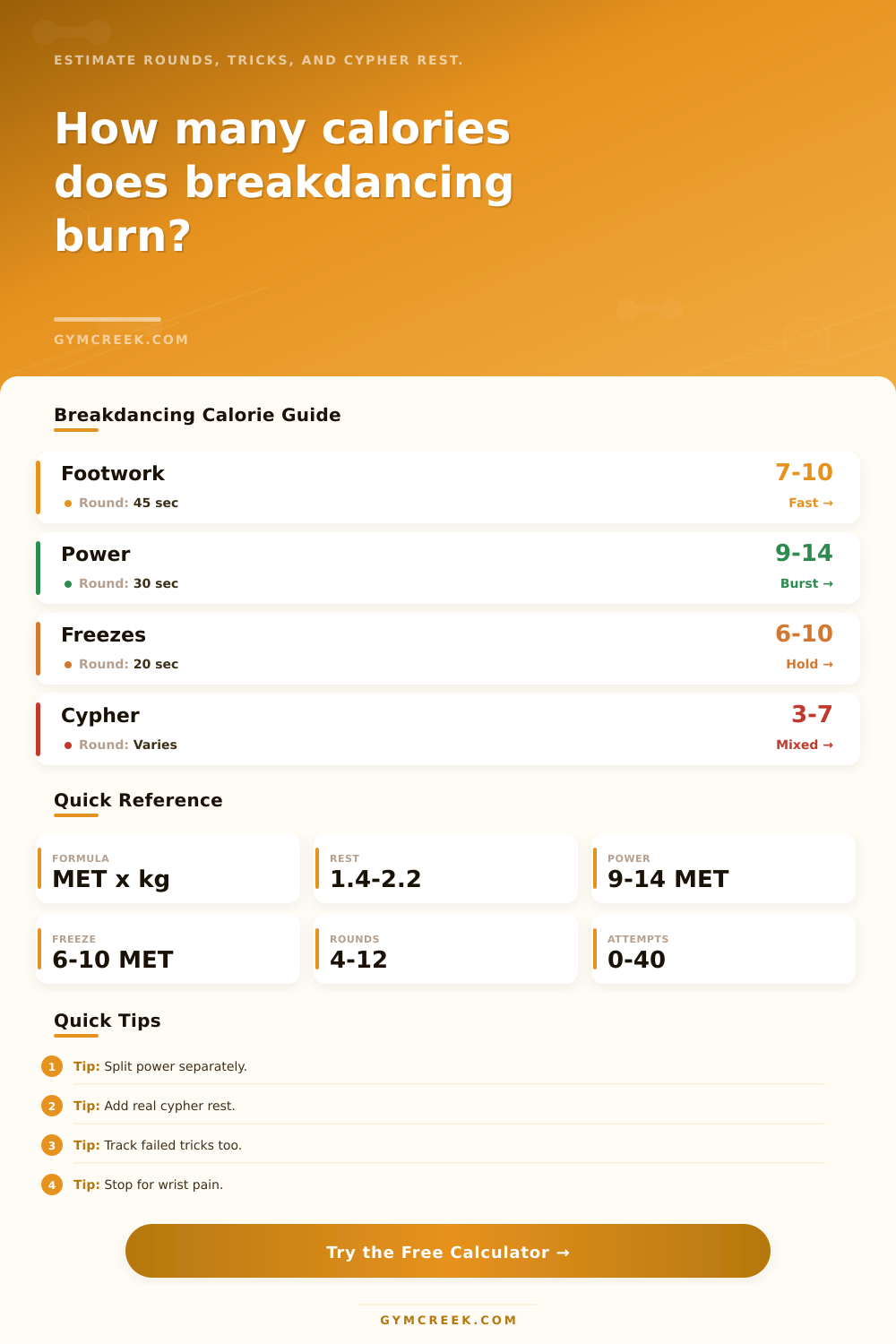
Calories per minute = MET x 3.5 x body weight in kg / 200. The calculator applies this to toprock, footwork, power, freezes, rest, warm-up, and cooldown.
Footwork, power, and freeze shares are normalized. Any leftover share becomes toprock and transitions, so the round total always sums to 100%.
Trick attempts add a small high-intensity allowance based on power share, tempo, skill, success rate, and floor resistance.
The safety note responds to floor condition, freeze volume, power share, and high missed-attempt load so calorie chasing does not override joint signals.
📑Reference Tables
| Breaking Element | Base MET | Energy Type | Model Note |
|---|---|---|---|
| Toprock and groove | 4.8 to 6.8 | Aerobic | Upright rhythm, entries, resets |
| Footwork and transitions | 7.0 to 10.5 | Mixed | Low travel and repeated level changes |
| Power moves | 9.0 to 14.0 | Anaerobic | Short bursts with high arm and trunk load |
| Freezes and holds | 6.0 to 10.2 | Isometric | Bracing, balance, wrist and shoulder demand |
| Cypher rest | 1.4 to 2.2 | Recovery | Standing, walking, hyping, waiting |
| Session Type | Rounds | Rest Ratio | Best Input |
|---|---|---|---|
| Beginner practice | 4 to 10 | 80 to 160% | Round length |
| Open cypher | 6 to 18 | 90 to 220% | Rest ratio |
| Battle rounds | 4 to 10 | 40 to 120% | Tempo |
| Power lab | 8 to 30 | 120 to 300% | Attempts |
| Crew rehearsal | 8 to 24 | 30 to 100% | Run count |
| Floor Condition | Modifier | Calorie Effect | Safety Note |
|---|---|---|---|
| Sprung studio | 0.98x | Slightly lower | Best for repetition |
| Polished wood | 1.00x | Baseline | Watch slide control |
| Slick/cardboard | 1.04x | Higher control | Limit hard crashes |
| Sticky surface | 1.10x | Higher torque | Protect knees and wrists |
| Concrete/outdoor | 1.13x | Higher bracing | Use padding for drills |
| Formula | Variables | Output | When Used |
|---|---|---|---|
| Round minutes | Rounds, sec | Dance time | Main work block |
| Weighted MET | Split, skill | Dance MET | Element mix |
| Burst add-on | Tricks, power | Extra kcal | Anaerobic attempts |
| Mifflin BMR | kg, cm, age | Baseline | Daily context |
💡Tips
The beat drops in hard, you’re dropped into a cypher. Shoulders are hot, and you find yourself wondering how many calories it burns to spin and freeze, because you’re certain it’s more then you think. The style on display with breakdancing feel like all flash; but beneath that, it’s a brutal metabolic engine. A mix of explosive power, still holds, and quick feet make it a confusing beast for your average exercise tracker.
Most generic apps lumps dance as one moderate activity, missing what happens on the floor. You input your move split and round count, and the calculator above crunches the numbers for you. No more guesswork with conversions and coefficients.
How to Count Breakdancing Calories
Because here’s the thing: Breakdancing isn’t a steady state activity. It’s a flurry of high intensity bursts followed by moments of rest or tension. Enter your power move percentage to tell the tool how much anaerobic load you’re carrying. Flares or windmills requires huge amounts of energy within seconds. This spikes your heart rate different than a longer jog. By factoring in an anaerobic allowance, the tool accounts for this. So your estimate take into account those short sharp bursts which make up the sport. It doesn’t smooth it all out into an average.
How about the floor you’re standing on? Concrete makes you brace for each landing; a sprung studio floor soak up some of that impact. Making an adjustment in your bodys mechanics costs a lot more energy. In fact, there’s a way to adjust for this in the calculator: Floor Condition inputs both shock absorption and surface friction. When you dance on slick cardboard, your muscles has to work harder to maintain control. Even if you don’t move any faster, you’ll burn a few more calories doing that extra work. Small things, but they matter if we want accurat results.
The other thing is the cypher dynamic. You don’t dance all the time. There’s watching, waiting and hyping your crew. That down time isn’t free. Your nervous system are up and your heart rate is high. That’s what the cypher rest ratio input picks up. It keeps from making common error of just measuring active seconds. When you’re in a real battle, the break time between rounds factor into the overall session burn. Skewing your results by ignoring it will lead you astray. The chart on the page explain it nicely with a reference table showing how the rest-to-work ratio is impacted based off type of session. A final in a jam will have less rest than a beginner practice session and the numbers shows that disparity.
There’s also something interesting about skill level. For example, a beginning breaker may burn more calories *per minute* doing real work than a master breaker. Why? Because he or she is inefficient. The beginner fights his or her body. There’s wasted motion. Extra friction caused by fighting oneself. The advanced breaker move with the flow. With technique. With efficiency. And the calculator accounts for this in its base metabolic equivalents. It takes into account the fact that struggling itself burn calories. That’s what people miss. They think they’ll burn more because it’s harder. In some cases, if you learn how to do it efficienty, you’ll end up burning less while actualy doing more.
Weight is given to tricks as well. Even if you drop a freeze or fail at a power move, it still taxes your core and shoulders. There’s a field for trick attempt counts and success rate on the tool. It knows when you fall off headspin. You have to recover from that. That safety adjustment brings the estimate into physical reality. No matter how aesthetically pleasing something looks, there’s an effort put out by the body and it will pay for it. You should of known that.
Finally: Calories are for knowing how hard you’re going. As much as breakdancing is physical, it’s also mental. How do you feel? That’s your number one metric. The numbers provide a baseline; that’s all. Listen to your body more than your screen, your wrists, your shoulders. The burn in your muscle are the best number of all.
The beat drops out, the cypher swirls around you again, and you know you put in everything.