
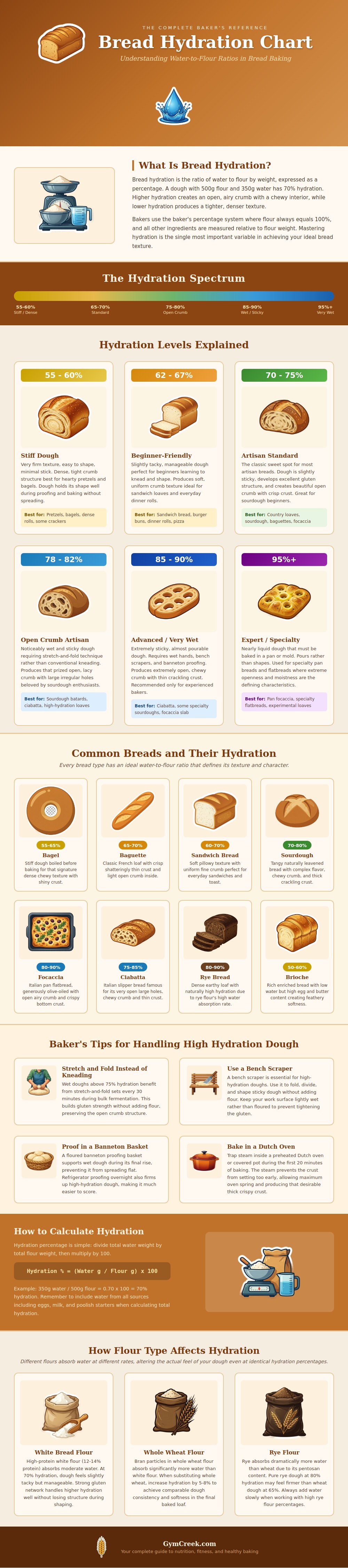
Bread hydration are the measurement of an amount of water in a bread recipe compared to the weight of the flours in that recipe. To calculate the hydration percentage for a bread recipe, divide the total weight of the water by the total weight of the flour in the recipe, and multiply the result by one hundreds. The result will be a percentage that represents the amount of water in relation to the weight of the flour in the recipe.
Bread hydration is importance in the baking of bread to ensure that the texture of the bread is as desired, and that the dough can be handle during the kneading and shaping of the bread. Bread hydration can lead to different texture in the finished bread. Bread recipes with low hydration will result in textures that is dense and chewily, like bagels and pretzels.
What Is Bread Hydration and How to Measure It
Bread recipes with high hydration will result in textures that is light with large holes throughout the bread, which is often desired in artisan loaves. Bread recipes with low bread hydration will result in dough that is stiff and holds its shape easy. Bread recipes with high bread hydration will result in doughs that is wet and sticky, requiring different technique to knead and shape that dough.
Water are required to activate the proteins in the flour that create gluten. Gluten is an ingredient that provides structure to the baked bread, thus water is required for baking bread. The water also transform into steam during the baking of the bread, which pushes the dough outward.
High bread hydration means that there is more water in the dough, which create more steam during baking. More steam during baking allow the gluten in the bread to expand more. However, the dough with high hydration is more difficult to handle because it cannot support its own weight.
The type of flour that the baker uses will change the way that bread hydration affect the dough. Flours that contains bran and pentosans, like whole wheat flour or rye flour, will absorb more water than flours like white bread flour. Thus, a dough that use whole wheat flour may dry even with a high hydration percentage.
Therefore, the baker should add water gradual to the flour, allowing the baker to observe how the dough feels, and to adjust the amount of water according to the type of flour that is being used. In bread recipes that contain high bread hydration, specific techniques is used to shape the dough. Traditional kneading of the dough is difficult with high hydration bread, so only stretch and fold motions are often used to knead the dough.
A bench scraper is used to move the sticky dough along the benchtop, without adding extra flour to the dough. Adding extra flour will change the hydration of the dough. Changing the hydration will change the texture of the bread.
A floured basket is used to hold high hydration bread, to maintain its shape. Additionally, baking the bread under a lid will trap the steam from the bread, allowing the dough to expand full during the baking of the bread. When calculating the hydration of bread recipes, it is important to remember that all liquid are considered to be the weight of the water.
The weight of eggs, milk, and water in a starter must be consider when calculating the weight of the water in the recipe. If the total weight of the water is not calculated correctly, the hydration percentage will be incorrect. Thus, understanding how the water, the flour, and the gluten interact within the dough will allow bakers to use hydration as a means of controlling the texture of the bread, and the way in which the dough should be handle during its baking process.
