Brazilian Jiu Jitsu Calorie Calculator
Estimate calories burned during drilling, positional sparring, live rolling, competition rounds, and rest using BJJ-specific MET values, body weight, round structure, and training load.
📌Presets
Each preset loads a realistic Brazilian jiu jitsu session profile and recalculates the calorie estimate.
⚙Calculator
BJJ calorie snapshot
Enter round structure and intensity to estimate calories burned.
📊Fitness Metrics
🧮Formula Cards
Calories per minute = MET x 3.5 x body weight in kg / 200. This is the main BJJ energy estimate.
Base MET comes from session type and intensity, then uniform, belt efficiency, partner resistance, stand-up time, and bottom pressure adjust the workload.
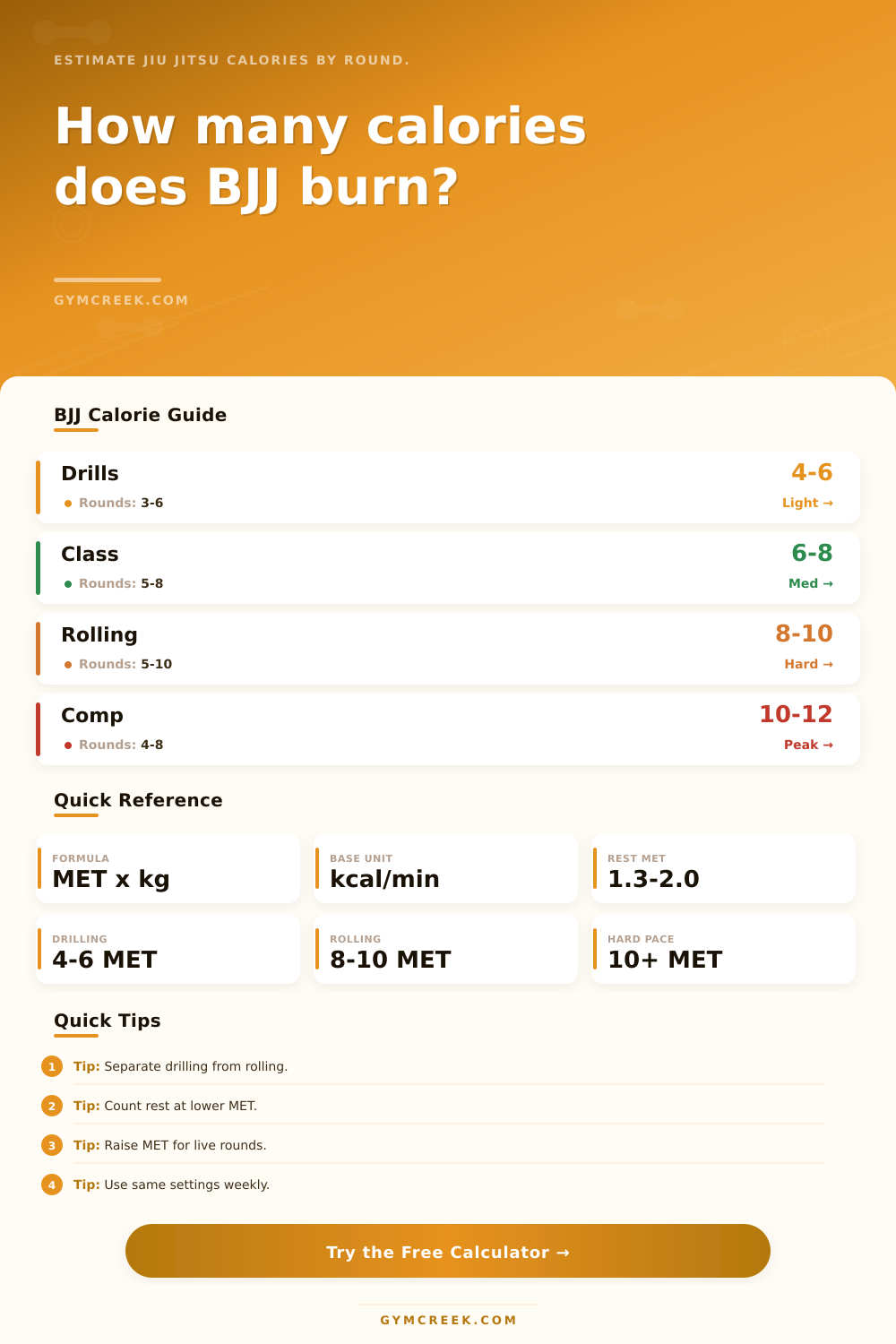
Active rounds use adjusted BJJ MET. Rest periods use 1.3 to 2.0 MET depending on session intensity and recovery demands.
Mifflin-St Jeor estimates BMR from weight, height, age, and gender, then activity level converts that value to estimated TDEE.
📑Reference Tables
| BJJ Session | Light | Moderate | Hard |
|---|---|---|---|
| Fundamentals class | 4.0 MET | 5.3 MET | 6.4 MET |
| Technique drilling | 4.5 MET | 5.8 MET | 7.0 MET |
| Positional sparring | 6.0 MET | 7.5 MET | 9.0 MET |
| Live rolling | 6.8 MET | 8.5 MET | 10.0 MET |
| Competition rounds | 8.0 MET | 10.0 MET | 11.8 MET |
| Round Setup | Work | Rest | Use Case |
|---|---|---|---|
| Fundamentals | 4 x 5 min | 90 sec | Skill pace |
| Class rounds | 6 x 5 min | 60 sec | Normal class |
| Open mat | 8 x 6 min | 90 sec | Mixed pace |
| Shark tank | 10 x 3 min | 30 sec | Peak pace |
| Load Factor | Low | Base | High |
|---|---|---|---|
| Uniform style | No-gi 0.97x | Gi 1.00x | Grip 1.04x |
| Partner resistance | Drill 0.90x | Normal 1.00x | Max 1.18x |
| Stand-up time | 0-10% | 20-35% | 50%+ |
| Bottom pressure | 0-20% | 30-45% | 60%+ |
| Formula | Variables | Output | When Used |
|---|---|---|---|
| MET kcal | MET, kg, min | Calories | Main burn |
| Rest kcal | Rest MET, kg | Break burn | Between rounds |
| Mifflin BMR | kg, cm, age | Baseline | Daily context |
| TDEE share | Calories, TDEE | Percent | Session load |
💡Tips
There’s a certain kind of tired that happens when you walk onto the mats after a grueling roll. Muscular exhaustion spread through your shoulders and down into your legs. Emotional fatigue rests in your bones and remind you that you just came from doing something very, very difficult. A lot of newcomers gape up at the mat and ask themselves; “How am I going to keep this up?”
That all depends upon what you do with the calories you burned. The metabolic cost of Brazilian jiu jitsu is one way of turning your vague post-roll depletion into actual numbers. It allows you to realize that what you’ve been doing isn’t just motion but an investment in yourself.
Why You Burn So Many Calories in Jiu Jitsu
How does this burn work? Well, that’s where all the good stuff comes from: the math. Metabolic equivalent (MET) is the value used here. One MET equals amount of energy required to sit down and do nothing. On the other end of the scale, live rolling typicaly ranges from 8, 10 METs based off intensity and round structure. Plug in your intensity, round structure and body weight into the calculator, and let it do the math for you. No need to guess coefficients or conversions. Instead, it will take those basic MET values and convert them into calories you’ll be burning every minute.
Why is that important? Jiu jitsu isn’t a steady-state activity. Instead, it’s a bunch of intense bursts with short rest periods in between. If we treats it as a constant jog, we underestimate just how taxing it can be on our bodies. The rest period and round length make a big difference in output. A 3 min round with 2 mins of rest will require a very different physiological response than a 5-min round with just 30-sec rest. As rest gets shorter, you’ll need your cardiovascular system to perform more of its work. That means getting your heart rate down and clearing lactate out of your muscles faster. To reflect this, the tool assigns a lower MET value to rest time. Because it’s right: even though you’re on the mat, you’re not entirely off the hook. You’re still recovering.
Another important distinction is separating live rolling from drilling. Drilling tends to be cooperative, technical and therefore moderate-intensity. Live rolling throws uncertainty into the mix, adds resistance and skyrockets energy demand. With the calculator, you can divide them up. This provides a better view of how much energy you really use.
But it also has to do with partner resistance and uniform style. Rash guards slide while gis creates more friction. More friction means more energy expenditure. If your gi is heavy, it takes more upper body strength to grip it. Grabbing a sleeve or collar adds extra static tension. This raises your heart rate more then just moving around does.
There’s also experience. Novices expend more energy. Their movement is less efficient. They tense up. They overcompensate. Don’t conserve momentum. Smoothness comes as you go down the belt ladder. You don’t waste as much energy battling your own body. The calculator accounts for this efficiency curve. It knows a brown belt burning 300 calories in a given move doesn’t burn as many as a white belt. That’s what most people get wrong. They think higher skill equals more output. It usually equals less output for the same effort.
These numbers are for you to apply to managing your recovery and nutrition. If you know a session costs you six hundred calories, you can fuel accordingly. Fuel yourself up for it. Avoid the pitfall of eating too little when you’re cutting weight. Under-eating occurs when you view jiu jitsu as light cardio. It’s not. It’s anaerobic conditioning pretending to be martial arts. Monitoring your total calories each week lets you identify trends. Did you go live rolling one night (Tuesday) and burn more? Do you notice a difference between structured classes versus open mat session? The page has some tables showing reference numbers broken down by session types. These show how basic class intensities compare to competition pace.
At the end of the day, though, numbers are just that: numbers. They serve as a frame of reference for the needs of your body. What the mat will teach you is what the numbers can’t. How to catch your breath with lungs on fire? Efficiency when all your muscles want to stop? Yeah, you’ll be sore after training. You’ll question whether or not you made it through one more five minute round. Now, though, you’ll have an idea of just what price you paid along the way. And it makes the sweat taste just a bit sweeter.